
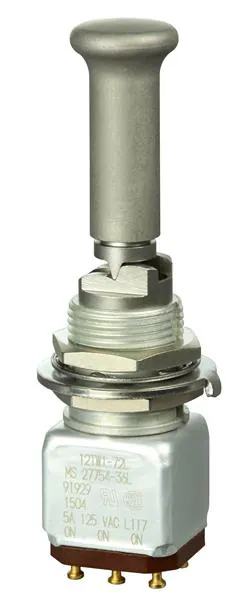
Honeywell 12TW1-72L Toggle Switch Overview
The Honeywell 12TW1-72L toggle switch is a specialized member of the MICRO SWITCH TW family, designed for applications where a standard toggle is not enough. Its most notable distinction is the locking lever format, which adds an extra layer of operational control in systems where accidental actuation needs to be reduced. For engineers and maintenance teams, the Honeywell 12TW1-72L toggle switch is not simply a panel switch; it is a control device intended for disciplined switching behavior in demanding equipment.
Core Technical Identity of the Honeywell 12TW1-72L Toggle Switch
The Honeywell 12TW1-72L toggle switch is widely identified as a DPDT, three-position, solder terminal switch with a 15/32 inch bushing and locking lever. That combination is especially useful in systems where operators need both compact installation and a deliberate actuation method. A locking lever matters in real-world field use because it reduces the chance of unintended switching caused by vibration, incidental contact, or rushed manual operation.
From a system design perspective, the Honeywell 12TW1-72L DPDT toggle switch supports two-circuit control with a more advanced actuation profile than a simple two-position switch. That can be valuable in panel logic, directional control, staged activation, or multi-mode equipment interfaces.
Why Locking Lever Design Matters
In complex machinery, not every switch should move as easily as a standard lever. The Honeywell 12TW1-72L locking lever toggle switch is the kind of component engineers consider when they want the operator to make a more intentional movement. This can improve control discipline in industrial panels, aviation support equipment, vehicle systems, or service platforms where an accidental switch movement could disrupt a function or trigger an unwanted operating state.
Another advantage is mechanical consistency. TW Series switches are associated with rugged, miniature military-grade construction, and that makes the Honeywell 12TW1-72L toggle switch well suited to compact installations where the panel area is tight but reliability expectations remain high.
Use Cases in Modern and Legacy Systems
The Honeywell 12TW1-72L toggle switch is relevant in both new design work and replacement planning. In new systems, it supports structured human-machine interaction where a locking action is preferred. In retrofit environments, it can be important where an existing assembly already relies on a TW Series footprint, solder termination, and a military-style toggle switch format.
Because many engineers search by brand, code, and switch category together, terms like Honeywell 12TW1-72L toggle switch, Honeywell 12TW1-72L DPDT switch, and Honeywell locking lever toggle switch are all naturally relevant when documenting or selecting this part. For more information on Honeywell solutions, it helps to compare the 12TW1-72L with standard-lever variants in the same family.
FAQ
What is the main difference between the Honeywell 12TW1-72L and a standard toggle version?
The biggest difference is the locking lever configuration. While standard toggle switches are designed for straightforward actuation, the Honeywell 12TW1-72L introduces a more controlled movement pattern that helps reduce unintended operation in sensitive or high-vibration environments.
Is the Honeywell 12TW1-72L a DPDT switch?
Yes. It is generally identified as a double-pole, double-throw toggle switch with three positions. This makes it suitable for applications that need two circuits to be managed together through one compact panel component.
Where is the Honeywell 12TW1-72L commonly used?
It is well aligned with industrial machinery, aerospace-related support systems, rugged vehicles, and control panels where reliability, compact dimensions, and deliberate actuation are priorities.
Why choose a locking lever instead of a standard lever?
A locking lever can help protect the intended operating sequence. In real equipment, that reduces the chance of accidental switching, especially in panels exposed to operator movement, vibration, or mechanical disturbance.
Is this switch better for replacement or new designs?
It can serve both roles. It is useful in retrofit projects where an original TW Series part must be matched closely, and it is also a logical choice in new designs that need a compact locking lever toggle switch with proven environmental durability.