
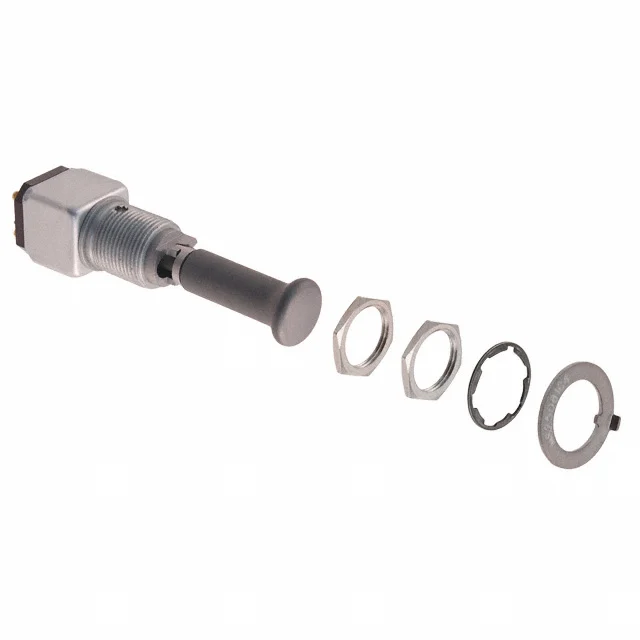
Honeywell 12TW1-50F Toggle Switch Technical Guide
The Honeywell 12TW1-50F toggle switch is part of the well-known TW Series, a compact family of military-grade toggle switches designed for demanding control environments. In practical terms, this Honeywell 12TW1-50F toggle switch is used where engineers need a dependable manual interface, a small behind-the-panel footprint, and a more controlled switching action than a standard non-locking lever can offer.
As a Honeywell 12TW1-50F operator control accessory, this model is built around a DPDT 3-position configuration with special circuitry, solder terminals, and a 15/32 inch bushing. One of the defining features of this version is its mushroom-style locking lever, which is configured to lock in the extreme position opposite the keyway. That detail matters in applications where accidental switching into a critical state must be reduced.
What Makes the Honeywell 12TW1-50F Different?
Many toggle switches look similar from the outside, but the internal behavior and lever arrangement determine whether a part truly matches the application. The Honeywell 12TW1-50F DPDT toggle switch stands out because it combines a three-position structure with a locking lever format suited to more controlled manual actuation. This makes it relevant for aerospace panels, industrial machinery, test equipment, and rugged instrumentation where repeatable human input is important.
The TW Series is widely associated with applications exposed to shock, vibration, dust, splashing water, and temperature variation. That broader platform value gives the Honeywell 12TW1-50F accessory switch a strong technical profile for designers who need durability as well as precise control behavior.
Technical Highlights
- DPDT, 3-position switch format
- Special circuitry architecture for controlled switching logic
- Solder terminals for secure wiring integration
- 15/32 inch bushing for panel mounting
- Mushroom-style locking lever
- Locked in the extreme position opposite the keyway
- Compact miniature military-grade construction
Common Application Context
The Honeywell 12TW1-50F toggle switch is often a fit where a standard lever would be too permissive. Designers may prefer it in control panels that demand deliberate operator action, especially when one lever position should not be entered casually. That can include defense electronics, specialized vehicles, process control panels, laboratory equipment, and other systems where manual control integrity matters.
Because the switch belongs to the Honeywell TW family, it also benefits from the series’ reputation for panel-space efficiency. In compact enclosures, every millimeter behind the panel counts. A miniature switch with a defined locking position helps simplify the control layout without giving up robustness.
FAQ
Is the Honeywell 12TW1-50F a standard toggle switch?
No. While it is still a manual toggle switch, it is not just a generic panel switch. The Honeywell 12TW1-50F toggle switch uses a specific DPDT 3-position design with a locking lever arrangement, which makes it more specialized than common commercial toggles.
Why does the locking lever matter?
The locking lever is important because it helps reduce unintended actuation. In real operating environments, vibration, gloves, quick maintenance activity, or crowded control panels can all increase the risk of accidental switching. A locking feature adds a useful layer of operational discipline.
Is the Honeywell 12TW1-50F suitable for harsh environments?
It is part of a series developed for demanding applications, including environments where mechanical stress and contamination resistance are important. That is why the TW platform is frequently discussed in military-grade and industrial control contexts.
What should engineers verify before specifying this model?
They should confirm the exact switching logic, panel cutout compatibility, lever locking behavior, wiring method, and the intended operator interaction. In toggle switch selection, the lever and circuit behavior are just as important as the electrical rating.
For more information about Honeywell, review the broader product ecosystem and related control components.