
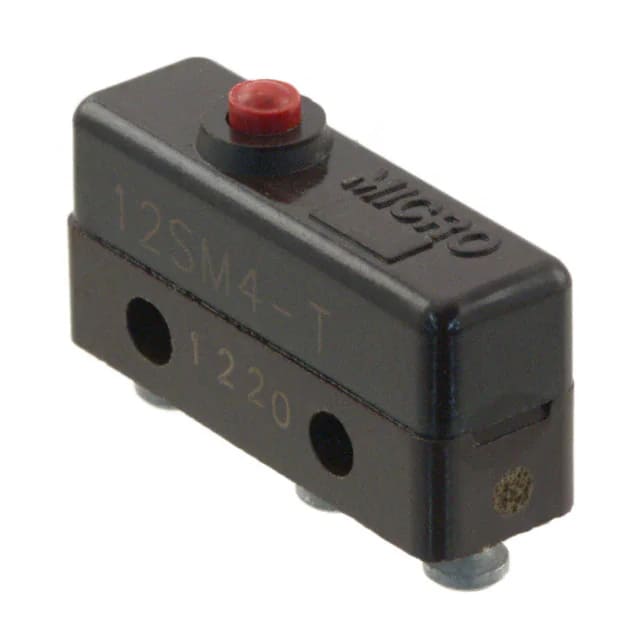
Honeywell 12SM4 Basic Switch: Compact SPDT Performance in a Subminiature Format
The Honeywell 12SM4 basic switch belongs to the MICRO SWITCH SM Series, a family known for compact size, precise actuation, and dependable electromechanical performance. Unlike the sealed SE Series models, the Honeywell 12SM4 basic switch is positioned as a subminiature basic switch for applications where compact dimensions, repeatable switching, and straightforward mechanical integration are major priorities.
Technical Identity of the Honeywell 12SM4 Basic Switch
The Honeywell 12SM4 basic switch is commonly identified as an SPDT switch with a round pin plunger actuator. Technical listings associate it with a 1 A class rating, a subminiature body format, and characteristics that support precision switching in compact assemblies. Product references also describe gold contact construction in some listings, which can be useful where signal integrity and dependable low-current contact behavior are important considerations.
Because this model sits within the SM Series, it is often evaluated by engineers looking for a Honeywell 12SM4 subminiature switch, Honeywell 12SM4 pin plunger basic switch, or Honeywell 12SM4 electromechanical switch for tightly packaged mechanisms.
Where the Honeywell 12SM4 Basic Switch Is Commonly Used
Compact switches like the Honeywell 12SM4 basic switch are often used in instrumentation, compact industrial controls, small electromechanical assemblies, appliance mechanisms, and equipment where travel tolerances must be detected accurately without consuming too much space. The pin plunger format makes it useful when motion can be transferred directly and consistently to the actuator.
Another advantage is packaging efficiency. In many modern product designs, available space is a design constraint from the beginning, not an afterthought. A subminiature switch can help preserve layout flexibility while still offering familiar mechanical feedback and deterministic switching action.
Why Basic Switches Still Matter
The 12SM4 basic switch shows why classic electromechanical components continue to hold value. They are direct, understandable, and easy to integrate into systems that need tangible position or travel feedback. For maintenance teams, this often means simpler troubleshooting. For engineers, it means predictable behavior in a small footprint.
For more information about Honeywell, it can be useful to compare the SM Series with sealed switch families when a project balances compact size against environmental exposure.
FAQ
What type of switch is the Honeywell 12SM4?
The Honeywell 12SM4 basic switch is generally identified as a subminiature SPDT electromechanical switch with a round pin plunger actuator.
What makes the 12SM4 different from a sealed switch?
The main difference is product focus. A basic switch emphasizes compact switching performance and integration flexibility, while a sealed switch is specifically designed to handle contamination and harsher environmental exposure.
Where is the 12SM4 most useful?
It is useful in compact mechanisms, control assemblies, instrumentation, and applications where installation space is limited but dependable mechanical switching is still required.
Why do engineers use SPDT basic switches like the 12SM4?
SPDT switches provide more control flexibility than a single-output contact arrangement. They can support alternative signal paths, state changes, and clearer logic handling in compact circuits.
What should be reviewed before choosing the Honeywell 12SM4 basic switch?
Design teams should check the electrical load, required actuation force, dimensional constraints, termination style, and expected lifecycle demands. A compact switch performs best when the mechanical interface is carefully matched to the application.