
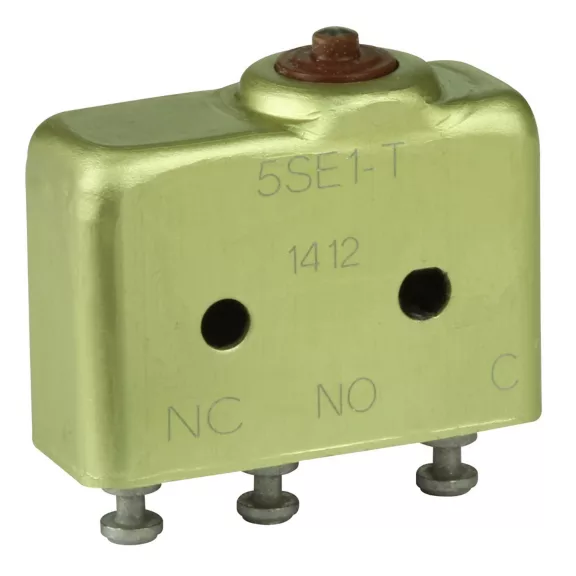
Honeywell 12SE6 Sealed Switch: Reliable SPNC Switching for Demanding Installations
The Honeywell 12SE6 sealed switch is part of the MICRO SWITCH SE Series and is widely associated with applications that need sealed, compact, and durable position sensing. This model is commonly described as a Honeywell 12SE6 sealed basic switch with a stainless steel pin plunger and wire lead termination. It is typically referenced as a single pole normally closed configuration, making it especially relevant where a closed-circuit state must be maintained until mechanical actuation occurs.
What Defines the Honeywell 12SE6 Sealed Switch?
The Honeywell 12SE6 sealed switch stands out because it combines environmental protection with a familiar electromechanical operating principle. It is linked to a 5 A at 250 Vac / 30 Vdc class and a broad operating temperature range suitable for equipment exposed to harsh service conditions. In practice, that means it can be considered for installations where contamination, temperature fluctuation, and mechanical vibration are all real concerns rather than theoretical ones.
The wire lead arrangement is also significant. In many field installations, prewired or leaded switch formats simplify routing and reduce assembly friction, especially when the switch is mounted in confined spaces or within sealed housings of its own.
Common Application Areas
The Honeywell 12SE6 sealed switch is often relevant in access panel monitoring, mechanical limit detection, status verification, and actuator or valve position feedback. A normally closed switch can be particularly useful in circuits that are designed to monitor continuity as part of a fail-aware control strategy.
Search patterns such as Honeywell 12SE6 pin plunger switch, Honeywell 12SE6 electromechanical sealed switch, and Honeywell 12SE6 SPNC switch are common because engineers usually need exact information about circuit behavior, actuator type, and environmental suitability before release into production or maintenance stock.
Why the Normally Closed Format Matters
Not every application needs SPDT flexibility. In many machine and vehicle systems, a normally closed sealed switch offers a very clear operating logic. It allows the circuit to remain in its default state until a specific mechanical action occurs. That clarity can simplify diagnostics and make system behavior easier to interpret during troubleshooting.
For more information about Honeywell, reviewing related switch series can help determine whether a normally closed sealed design is the best fit for the intended control strategy.
FAQ
What does SPNC mean on the Honeywell 12SE6?
SPNC means single pole normally closed. In simple terms, the electrical path is closed in its resting state and changes when the switch is actuated.
Why is the Honeywell 12SE6 useful in harsh environments?
Its sealed design helps protect the switching mechanism from environmental contamination such as dust and moisture. That makes it better suited to rugged conditions than an open-frame alternative.
Where is the Honeywell 12SE6 commonly applied?
It is suitable for industrial controls, mobile equipment, enclosed mechanical systems, and applications that require dependable position sensing or continuity-based status monitoring.
What advantage does wire lead termination offer on the Honeywell 12SE6 sealed switch?
Wire leads can make installation simpler in compact assemblies and can support cleaner routing in systems where direct terminal access is limited or where harness integration is preferred.
How should engineers validate the Honeywell 12SE6 for real use?
They should verify electrical load, environmental exposure, mounting arrangement, actuation mechanics, and the logic requirement of a normally closed circuit. Those factors together determine whether the part is correct for the application.