
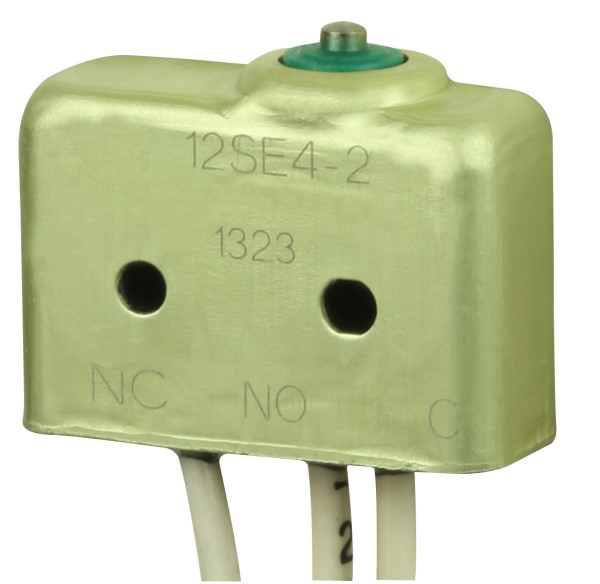
Honeywell 12SE4-2 Sealed Switch: Key Features and Application Insights
The Honeywell 12SE4-2 sealed switch is a compact SE Series switch developed for applications that need dependable switching in environments where water, dust, and vibration can create long-term reliability issues. This model is commonly referenced as a Honeywell 12SE4-2 SPDT sealed switch with a pin plunger actuator and wire lead termination, making it a practical option for designs that require both mechanical simplicity and sealed durability.
Technical Character of the Honeywell 12SE4-2 Sealed Switch
In many control systems, the value of a sealed switch comes down to repeatability. The Honeywell 12SE4-2 sealed switch is typically selected where a compact package must still handle demanding service conditions. It is associated with a 5 A at 250 Vac / 30 Vdc class, SPDT switching behavior, and a pin plunger format that supports direct, controlled actuation.
Its wire lead termination can be an advantage in equipment where traditional terminal access is inconvenient or where harness-based integration is preferred. This detail often matters in real installations, because the wiring method can affect serviceability just as much as the switching function itself.
Where the Honeywell 12SE4-2 Fits Best
The Honeywell 12SE4-2 sealed switch is well suited to position indication, door and panel monitoring, actuator state detection, and mechanical travel confirmation. Applications may include industrial machinery, transport systems, mobile equipment, and specialized enclosures where a sealed electromechanical switch helps reduce contamination-related failure modes.
Because the SE Series is designed for environments where liquid or particulate contamination may be present, the Honeywell 12SE4-2 switch is often considered when designers need a more robust alternative to exposed miniature switch constructions. It is also useful where environmental protection must be combined with a familiar pin plunger operating style.
Why Engineers Still Prefer Sealed Electromechanical Switches
Even in modern systems with advanced sensing technologies, sealed electromechanical switches remain relevant because they offer direct physical confirmation. In the case of the Honeywell 12SE4-2 basic switch, that straightforward mechanical action can support diagnostics, simplify control logic, and improve confidence in safety-related or status-related feedback loops.
For more information about Honeywell, reviewing related sealed switch families can help determine whether this exact configuration is the best match for mounting style, wiring, and environmental exposure.
FAQ
What does SPDT mean on the Honeywell 12SE4-2 sealed switch?
SPDT means single pole double throw. In practical terms, the switch can change between two output paths, which makes it useful in control circuits that require more flexible signal routing than a simple on/off contact arrangement.
Why is the Honeywell 12SE4-2 considered a sealed switch?
It belongs to Honeywell’s SE Series, which is designed for applications where contamination from water or particulates can affect switch reliability. The sealed housing helps protect the internal mechanism.
Is the Honeywell 12SE4-2 appropriate for industrial machinery?
Yes. It is a strong candidate for machinery that needs compact position detection with better environmental resilience than an unsealed switch can typically provide.
What is the benefit of wire leads on the Honeywell 12SE4-2?
Wire leads can simplify installation in tight assemblies, reduce connector complexity in some designs, and make cable routing more manageable when space around the switch body is limited.
How should the Honeywell 12SE4-2 be selected for a project?
Selection should be based on required switching logic, actuator interface, available installation space, environmental conditions, operating force expectations, and the preferred electrical termination method. A good fit is always application-specific.