
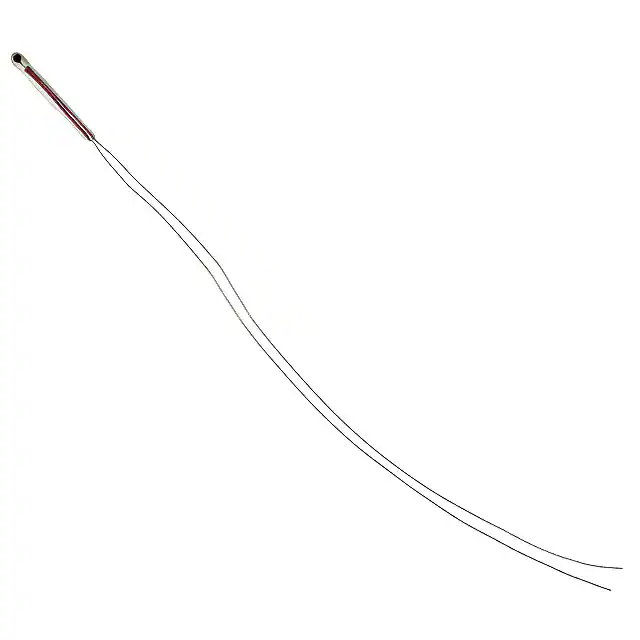
Honeywell 120-202EAJ-Q01 Mini Glass Probe Temperature Sensor Guide
The Honeywell 120-202EAJ-Q01 temperature sensor is a compact NTC thermistor probe that is often identified as a mini glass probe within Honeywell’s 120 Series temperature sensing range. That distinction matters because mini probe formats are not selected only for size. They are usually chosen when a design needs a thermally responsive sensing element that can fit into tight locations while maintaining stable electrical behavior and reliable packaging.
What Defines the Honeywell 120-202EAJ-Q01
The Honeywell 120-202EAJ-Q01 NTC thermistor probe is associated with a 2 kOhm nominal resistance and a mini cylindrical glass body. Public technical references also distinguish it with a beta value that differs from several neighboring 120 Series codes, which makes it relevant when an engineer is matching a specific resistance-temperature relationship rather than simply choosing any 2 kOhm thermistor. That is an important point, because in thermal measurement, similar-looking sensors can behave differently once calibration and conversion logic are applied.
The Honeywell 120-202EAJ-Q01 mini glass probe temperature sensor is particularly useful in applications where physical access is limited or where the sensing point must sit close to a targeted thermal source. The probe body is small, and Honeywell support information published online also provides body length, lead length, and body diameter details that help with packaging decisions. This makes the part easier to assess during both new product development and replacement validation.
Why Engineers Research This Model
Engineers tend to look up the Honeywell 120-202EAJ-Q01 temperature sensor when they need a compact thermistor with known dimensional and electrical characteristics. In practice, that may involve thermal feedback in electronics, compact instrumentation, process control modules, or specialized sensing assemblies. Because the part is glass-encapsulated, it also attracts attention in environments where stability and repeatability matter over time.
Another reason this model stands out is that mini probes can improve measurement strategy in dense assemblies. A smaller sensing element may be easier to position near the true point of interest, which can produce more useful thermal data than a larger package mounted farther away. That advantage is especially relevant in controlled equipment where temperature gradients exist over very short distances.
Application Perspective
The Honeywell 120-202EAJ-Q01 temperature sensor may be considered in compact control electronics, laboratory devices, custom embedded systems, instrumentation, and service projects where exact Honeywell thermistor references are required. It is best understood as a technical sensing component intended for accurate thermal feedback, not as a general descriptive label for temperature monitoring.
For more information about Honeywell, reviewing the broader sensing range can help clarify how this mini probe compares with standard 120 Series probe options.
FAQ
What is the main difference between the Honeywell 120-202EAJ-Q01 and other nearby 120 Series codes?
One of the most important differences is the thermistor curve profile, reflected in the published beta value. That distinction affects how the sensor translates resistance into temperature and can change calibration behavior in a real circuit.
Why is the mini glass probe format useful?
It helps in tight mechanical layouts where the sensing point must be placed very close to the target area. This can improve thermal tracking in compact equipment.
Is the Honeywell 120-202EAJ-Q01 only useful for miniature devices?
No. Although its size is a major advantage, the sensor can also be used in larger systems when a localized, precise sensing point is needed inside the assembly.
Why do dimensional details matter so much for this part?
Because sensor placement strongly affects measurement quality. Body size, lead length, and diameter influence how the probe is installed and how closely it represents the temperature that the designer actually wants to measure.
What should engineers confirm before specifying this sensor?
They should confirm the electrical curve, tolerance, environmental suitability, body dimensions, and integration method. Those checks reduce the risk of calibration mismatch or installation issues later in the project.
Can the Honeywell 120-202EAJ-Q01 be relevant for replacement work?
Yes. Exact part numbers are often critical in repair, retrofit, and validation scenarios where the original circuit behavior depends on a specific thermistor response and package geometry.