
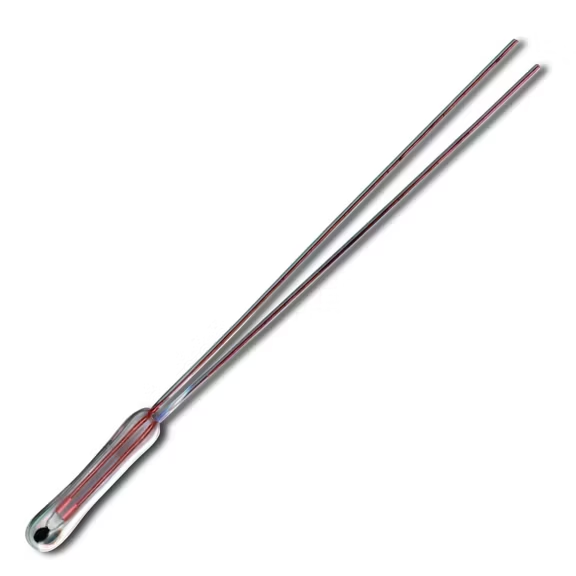
Honeywell 120-202EAG-Q04 Temperature Sensor Design Notes
The Honeywell 120-202EAG-Q04 temperature sensor is an NTC thermistor probe from Honeywell’s 120 Series, developed for applications that need temperature feedback in a compact but technically dependable format. While many engineers focus first on resistance value, the real strength of this model is the combination of its electrical behavior and its physical configuration. In actual use, that combination can make integration easier in places where a standard sensor package would be too large or too mechanically restrictive.
Why the Honeywell 120-202EAG-Q04 Stands Out
The Honeywell 120-202EAG-Q04 NTC thermistor probe is commonly associated with a 2 kOhm nominal resistance, a cylindrical glass probe body, and a broad operating temperature capability. One of the more practical differentiators visible in public technical listings is its longer lead wire format compared with some adjacent 120 Series references. That detail may sound minor, but in equipment design it can simplify placement, routing, and thermal positioning when the sensing point is not located directly next to the control electronics.
This is one reason the Honeywell 120-202EAG-Q04 glass probe temperature sensor attracts attention in technical searches. Engineers are often looking for a thermistor that is not only electrically appropriate, but also easier to accommodate in the mechanical reality of a product. Lead length, probe geometry, and mounting style can all influence how accurately the sensor tracks the intended thermal zone.
How It Fits Into Engineering Decisions
The Honeywell 120-202EAG-Q04 temperature sensor is useful in projects where the sensing element must remain compact while still offering robust thermal behavior across a wide range. The glass-encapsulated probe supports stable sensing, while the free-hanging style allows designers to place the sensor more directly in the environment being measured. This can be beneficial in monitoring applications, controller assemblies, and prototypes where temperature needs to be read at a very specific point rather than inferred from a nearby surface.
Because the part belongs to Honeywell’s structured temperature sensor portfolio, it is often evaluated alongside nearby variants rather than in isolation. In those comparisons, seemingly small differences such as lead length or curve selection become meaningful. That makes the Honeywell 120-202EAG-Q04 temperature sensor especially relevant for teams that need a compact NTC probe with more flexible mechanical reach.
Where This Sensor May Be Considered
Possible application contexts include embedded electronics, laboratory systems, thermal mapping setups, custom industrial controls, compact instrumentation, and maintenance projects that require matching an existing Honeywell sensing reference. In each case, the aim is usually accurate and repeatable temperature feedback, not generic ambient sensing.
For more information about Honeywell, it helps to review related temperature sensing products in the same portfolio.
FAQ
What type of product is the Honeywell 120-202EAG-Q04?
It is an NTC thermistor temperature probe in Honeywell’s 120 Series, built around a cylindrical glass sensor package.
Why is the longer lead wire important?
Longer lead wire can improve installation flexibility. It allows the sensing point to be positioned more precisely without forcing the rest of the electronics to move with it.
Is the Honeywell 120-202EAG-Q04 suitable for compact assemblies?
Yes. Its compact glass probe format makes it attractive in assemblies where space is limited but reliable thermal feedback is still required.
Why do engineers search for the exact phrase Honeywell 120-202EAG-Q04 temperature sensor?
Because the exact code often corresponds to a specific mechanical and electrical combination. When a design depends on that combination, using the precise reference becomes essential.
What should be reviewed before using this thermistor probe in a new design?
Review the resistance-temperature behavior, probe location strategy, environmental exposure, wiring layout, and calibration method. These details influence how the system will interpret the sensor signal in real operating conditions.
Can this model be relevant in retrofit or repair work?
Absolutely. Exact sensor references are often researched when restoring existing equipment, maintaining compatibility, or documenting a legacy thermal measurement path.