
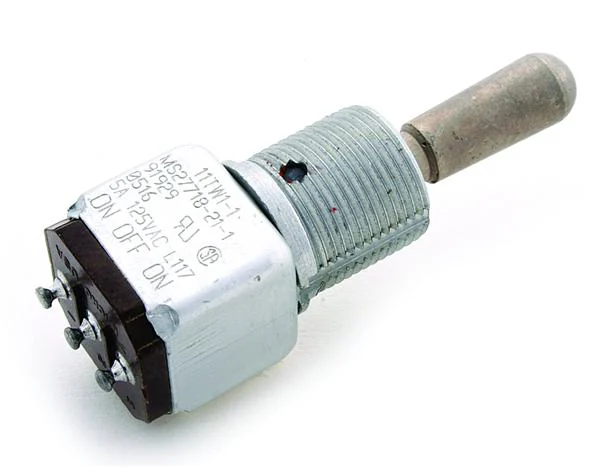
Honeywell 11TW1-3D Operator Control Accessory
The Honeywell 11TW1-3D operator control accessory combines two desirable characteristics in one compact device: an SPDT On-On circuit and a locking lever. As part of the Honeywell TW Series, the Honeywell 11TW1-3D toggle switch is positioned for demanding control environments where operators need to select between two active states while also reducing the risk of accidental actuation.
Why the Honeywell 11TW1-3D Stands Out
Many control applications need more than a simple On-Off switch. They need a reliable way to switch between two active functions, but they also need some level of protection against unintended movement. The Honeywell 11TW1-3D operator control addresses both needs. Its SPDT On-On design supports manual selection logic, while the locking lever helps ensure that selection changes are made deliberately.
This makes the model especially relevant in harsh-duty panels, transport systems, aerospace-style installations, and industrial machinery where vibration, movement, or close operator interaction can increase the chance of accidental switch contact.
Technical Characteristics of the Honeywell 11TW1-3D
The Honeywell 11TW1-3D operator control accessory is a panel mount SPDT toggle switch with an On-On function. It is rated at 5 A, with listed voltages of 125 Vac and 28 Vdc. The switch uses solder turret terminals, a 15/32-32 threaded bushing, and fits a 12.40 mm circular panel cutout.
Its actuator style is a locking lever with an approximate actuator length of 29.46 mm. Like other rugged TW Series variants, it is environment sealed and rated for operation from -65°C to 71°C. Those details make the Honeywell 11TW1-3D Honeywell operator control accessory an appropriate choice where physical durability and intentional switching behavior matter.
Value in System Integration
The real value of the Honeywell 11TW1-3D accessory is how it balances operator usability with controlled actuation. In practical system design, that can improve interface discipline and reduce the likelihood of incorrect switching when the panel is used in motion, under stress, or in physically crowded environments.
Because the switch is part of a recognized Honeywell family, it also offers continuity for organizations that standardize on TW Series components. That can simplify documentation, sourcing, and maintenance planning.
Typical Application Areas
The Honeywell 11TW1-3D operator control accessory is relevant for industrial control systems, rugged vehicles, specialist electrical cabinets, aviation-style panels, and equipment where two active circuit states must be selected with confidence and without casual misoperation.
For more information about Honeywell, reviewing the wider product family can help identify related switch and control options.
FAQ
What is the difference between Honeywell 11TW1-3 and Honeywell 11TW1-3D?
The key difference is the actuator. The Honeywell 11TW1-3D operator control accessory uses a locking lever, while the standard 11TW1-3 uses a standard round actuator. Electrically, both are SPDT On-On devices, but the 3D variant adds an extra layer of operational control.
What does SPDT On-On mean on the Honeywell 11TW1-3D?
SPDT On-On means the switch routes one common circuit between two active outputs or positions. It is ideal when the operator must choose between two live states rather than simply turning something on or off.
Why is the locking lever important on the Honeywell 11TW1-3D?
The locking lever helps reduce accidental actuation. In rugged or safety-conscious environments, that can be a practical advantage because it encourages more deliberate switching behavior.
Is the 11TW1-3D sealed for demanding environments?
Yes. The switch is listed as environment sealed and is designed for use in challenging installations where exposure to dust, splashing, vibration, and temperature variation can be part of normal operation.
What are the electrical ratings of the 11TW1-3D?
The switch is rated for 5 A and includes listed voltage ratings of 125 Vac and 28 Vdc. Final circuit compatibility should always be reviewed within the full system design.
Where is the Honeywell 11TW1-3D most useful?
It is most useful in operator panels that need a two-state active selection combined with protection against unintended switching. Typical examples include industrial equipment, mobile systems, technical consoles, and other professional control environments.