
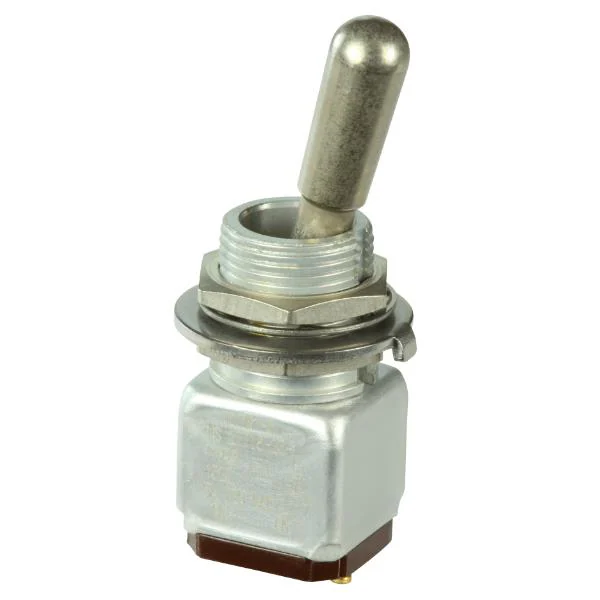
Honeywell 11TW1-3 Operator Control Accessory
The Honeywell 11TW1-3 operator control accessory is a TW Series miniature toggle switch built for applications that require a dependable SPDT On-On switching function. Compared with basic On-Off devices, the Honeywell 11TW1-3 toggle switch gives engineers and panel designers a more flexible manual input option because it supports switching between two active states rather than simply turning one state on or off.
Understanding the Honeywell 11TW1-3 Function
The Honeywell 11TW1-3 operator control uses a single-pole double-throw (SPDT) circuit with an On-On function. This means the switch routes the circuit between two live paths. In practical terms, that makes it suitable for selection tasks, directional control logic, alternative signal paths, or any application where the operator must choose between two active operating conditions.
That functional difference is why the Honeywell 11TW1-3 accessory is often considered for more nuanced control interfaces than a simple SPST On-Off switch.
Technical Features of the Honeywell 11TW1-3
The Honeywell 11TW1-3 operator control accessory is a panel mount SPDT toggle switch rated at 5 A, with listed voltages of 125 Vac and 28 Vdc. It uses a standard round actuator with an actuator length of approximately 17.27 mm. Like other models in this sealed TW Series format, it also uses solder turret terminals, a 15/32-32 threaded bushing, and a 12.40 mm circular panel cutout.
The switch is listed as environment sealed and suitable for operating temperatures from -65°C to 71°C. For technical buyers, that combination signals a control component intended for rugged service rather than light-duty office or consumer use.
Why Engineers Choose the Honeywell 11TW1-3
The main value of the Honeywell 11TW1-3 Honeywell operator control accessory is operational flexibility. An SPDT On-On format gives a panel designer the ability to direct one input across two outputs or two paths without requiring additional interface complexity. This can simplify wiring logic and maintain a clear, intuitive user experience at the panel level.
Its compact body also matters. In many industrial and transport applications, behind-the-panel space is limited. A miniature toggle switch that still offers sealing and ruggedness is often easier to integrate than a physically larger alternative.
Typical Application Areas
The Honeywell 11TW1-3 operator control accessory is often relevant for industrial systems, heavy-duty machine controls, aerospace-style panels, rugged mobile equipment, and specialist electrical assemblies that require a manual selection between two active states.
For more information about Honeywell, it is useful to review the broader switch and operator control portfolio.
FAQ
What does On-On mean for the 11TW1-3?
On-On means the switch has two active positions rather than one active and one off position. This is helpful in applications where an operator needs to choose between two operating paths or two active circuit states.
Is the 11TW1-3 an SPDT switch?
Yes. The Honeywell 11TW1-3 operator control accessory is an SPDT panel-mount toggle switch, which is one of its defining technical characteristics.
What are the main ratings of the 11TW1-3?
The switch is rated at 5 A and includes listed voltage ratings of 125 Vac and 28 Vdc. It is also designed for a broad temperature range and sealed operation in demanding environments.
Why would someone choose the 11TW1-3 instead of an SPST switch?
An SPDT On-On switch supports more control flexibility. If a panel needs to alternate between two active outputs or functions, the Honeywell 11TW1-3 operator control accessory is usually more appropriate than a standard On-Off switch.
Is the Honeywell 11TW1-3 sealed?
Yes. It is listed as environment sealed, which is important for applications exposed to dust, moisture, vibration, or similar operating challenges.
What type of wiring termination does the Honeywell 11TW1-3 use?
This model uses solder turret terminals. That style is often preferred in applications where secure, durable terminations are required and wiring stability is important over the long term.