
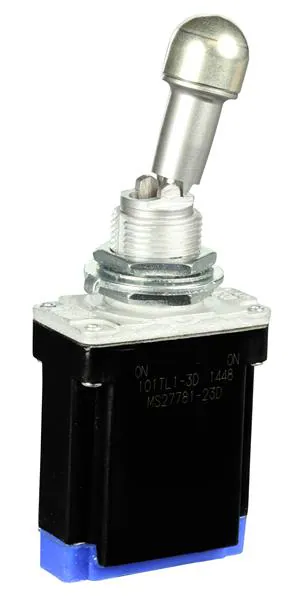
Honeywell 101TL1-3F Operator Controls: Technical Overview and Application Guide
The Honeywell 101TL1-3F Operator Controls model is part of the well-known TL Series of military-grade toggle switches. This specific configuration is widely referenced in searches for industrial toggle switch, sealed operator controls, and SPDT panel mount switch because it combines a compact panel-mount format with a locking lever design and environmental sealing. In practical terms, the Honeywell 101TL1-3F operator controls switch is built for applications where reliable manual switching is required in harsh conditions.
Core Technical Characteristics
The Honeywell 101TL1-3F Operator Controls variant is a single-pole double-throw (SPDT) toggle switch with an On-On switching function. It is designed for panel mounting, uses IWTS termination, and features a locking lever with an actuator length of approximately 26.67 mm. The switch is also described as environment sealed, which matters in systems exposed to dust, splashing water, vibration, and temperature swings. For engineers looking up Honeywell 101TL1-3F locking lever toggle switch or Honeywell SPDT operator controls, those are the defining specification points.
Why This Switch Matters in Demanding Environments
One reason the Honeywell 101TL1-3F Operator Controls unit remains relevant is its TL Series heritage. Honeywell positions the TL line for military, aerospace, commercial aircraft support equipment, and rugged industrial machinery. A bonded seal between the lever and bushing, along with the sealed case construction, helps protect the switching mechanism against contamination. That makes this part suitable for applications where a standard commercial toggle switch may not be robust enough.
Its SPDT operator controls arrangement also supports flexible circuit logic. Engineers often use this kind of switch for selection functions, mode changes, or redundant circuit routing where two output paths must be managed manually. The locking lever adds a safety benefit by reducing unintentional actuation during vibration or operator contact.
Installation and Design Considerations
From an integration standpoint, the Honeywell 101TL1-3F Operator Controls switch uses a threaded bushing for panel installation and a circular panel cutout format. Designers working on control panels, maintenance consoles, and rugged machine interfaces should also note the wide operating temperature capability associated with the TL family. That range supports use in low-temperature outdoor systems and warm equipment compartments without forcing a redesign around the switch.
For more information about Honeywell, it helps to review the broader TL Series ecosystem because the series includes several circuit styles, lever types, and pole configurations that look similar externally but behave differently electrically.
FAQ
What type of switch is the Honeywell 101TL1-3F Operator Controls model?
It is a sealed SPDT panel mount toggle switch with an On-On function. That means it can connect a common input to one of two output paths.
Why does the locking lever matter?
The locking lever helps prevent accidental switching. In vehicles, aerospace panels, and industrial machinery, this can be important where vibration or unintended contact could otherwise move the actuator.
Is the Honeywell 101TL1-3F suitable for harsh environments?
Yes. The TL Series is known for sealed construction and military-grade design intent. It is commonly considered for environments with dust, splash exposure, mechanical shock, and vibration.
What does IWTS termination mean here?
IWTS stands for Integrated Wire Termination System. In the TL family, it is used to support maintainability and serviceability while protecting terminations more effectively than exposed metal terminal arrangements.
Where is the Honeywell 101TL1-3F Operator Controls switch commonly used?
Typical examples include aerospace control panels, support equipment, military platforms, rugged industrial operator stations, and specialized vehicle control interfaces where dependable manual switching is essential.