
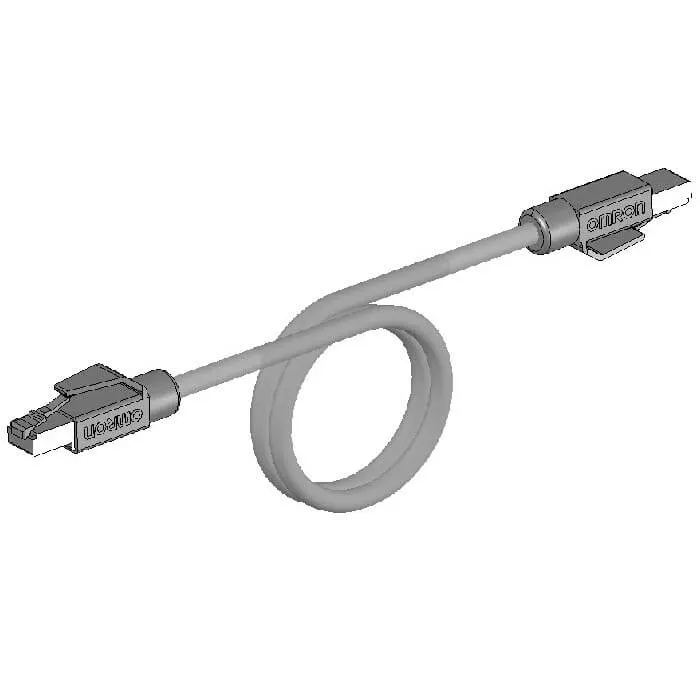
Omron XS5W-T421-KMD-KR Robotic Industrial Ethernet Cable
| Specification | Value |
|---|---|
| Manufacturer | Omron |
| Model | XS5W-T421-KMD-KR |
| Product Type | Industrial Ethernet Cable |
| Ethernet Category | Cat5e |
| Cable Type | SF/UTP |
| Connector 1 | RJ45 Straight Plug |
| Connector 2 | RJ45 Straight Plug |
| Cable Length | 15 m |
| Suitable for Robotics | Yes |
| Outer Sheath | PVC |
| Cable Diameter | 6.5 mm |
| Outer Sheath Color | Blue |
The Omron XS5W-T421-KMD-KR Robotic Industrial Ethernet Cable is engineered for Ethernet communication in automation systems where continuous cable movement is part of normal machine operation. Unlike standard Ethernet assemblies intended for stationary installations, this model is specified for robotic applications, making it suitable for equipment that performs repetitive motion while maintaining dependable network communication. It combines a Category 5e SF/UTP cable with straight RJ45 connectors on both ends and a durable PVC outer sheath. The manufacturer specifies a cable length of 15 meters and a robotic-rated construction for demanding industrial environments. :contentReference[oaicite:0]{index=0}
Technical Description
The Omron XS5W-T421-KMD-KR Robotic Industrial Ethernet Cable belongs to Omron’s Industrial Ethernet cable family developed for EtherCAT, EtherNet/IP, and other Ethernet-based automation networks. Its dual RJ45 connector configuration allows direct connection between industrial switches, programmable controllers, industrial computers, machine vision equipment, and network infrastructure without requiring connector adapters.
The robotic cable construction is intended to withstand repeated bending and continuous movement encountered in robotic cells, automated transfer systems, and moving machine assemblies while supporting reliable Ethernet communication.
Operating Principle
The cable transfers Ethernet data using four twisted conductors designed according to Category 5e specifications. The SF/UTP shielding helps reduce electromagnetic interference produced by servo motors, frequency converters, switching devices, and other industrial electrical equipment that may affect communication quality.
Its flexible robotic cable construction allows the communication link to remain stable during repetitive mechanical movement, reducing the risk of cable fatigue in applications involving continuous motion.
Typical Applications
- Industrial robotic cells
- Automated assembly equipment
- Motion control systems
- Machine vision networks
- Industrial Ethernet switches
- Automated conveyor systems
- PLC communication networks
- Flexible manufacturing equipment
Industrial Applications
Automotive production facilities frequently deploy robotic welding and material handling systems that require Ethernet communication between controllers and moving equipment. A robotic-rated Ethernet cable helps maintain stable communication despite continuous cable flexing.
Electronics manufacturing lines also benefit from flexible communication cables where pick-and-place robots, inspection stations, and servo-controlled positioning systems exchange real-time operational data.
In logistics automation, robotic palletizing systems, autonomous transfer equipment, and automated sorting machines rely on industrial Ethernet communication for synchronized control and operational feedback.
Advantages
- Robotic cable construction for repetitive movement
- Category 5e Ethernet performance
- SF/UTP shielded cable design
- Dual straight RJ45 connectors
- 15-meter cable length
- PVC industrial outer jacket
- Suitable for dynamic machine installations
- Compatible with industrial Ethernet networks
Industry Examples
Robotic Manufacturing
Connects robotic controllers with industrial switches while accommodating continuous arm movement.
Automated Warehousing
Supports Ethernet communication for robotic transport systems operating across distribution facilities.
Packaging Automation
Maintains communication between moving packaging equipment and centralized machine controllers.
Machine Automation
Provides Ethernet connectivity for dynamic machine assemblies where conventional stationary cables are not appropriate.
Selection Considerations
When selecting an industrial Ethernet cable, engineers should evaluate connector type, installation distance, cable routing, shielding requirements, and whether the application involves stationary or continuously moving equipment. Robotic cable designs should be selected whenever repeated flexing is expected throughout normal machine operation.
Proper cable routing and bend radius should also be considered to maximize service life and maintain consistent communication performance.
Additional Omron sensor series can be integrated into Ethernet-based automation systems for complete industrial control solutions.
The Omron XS5W-T421-KMD-KR Robotic Industrial Ethernet Cable combines industrial Ethernet performance with a robotic-rated cable design, making it suitable for communication networks installed on moving industrial equipment. The combination of Cat5e performance, shielded construction, and dual RJ45 connectors supports dependable data transmission throughout demanding automation applications.
Frequently Asked Questions
1. What type of Ethernet cable is this?
It is a Category 5e SF/UTP industrial Ethernet cable.
2. Is the cable intended for robotic applications?
Yes. The manufacturer identifies this model as suitable for robotic applications.
3. Which connectors are installed?
Both cable ends are equipped with straight RJ45 connectors.
4. How long is the cable?
The cable length is 15 meters.
5. What is the sheath material?
The cable uses a PVC outer sheath.
6. Why is shielding important?
SF/UTP shielding helps reduce electromagnetic interference commonly found in industrial environments.
7. Which industrial networks can use this cable?
It is suitable for Ethernet-based industrial communication systems including EtherCAT and EtherNet/IP installations requiring Cat5e cabling.
8. Where is the Omron XS5W-T421-KMD-KR Robotic Industrial Ethernet Cable commonly installed?
Typical installations include robotic production cells, automated assembly lines, logistics systems, packaging machinery, and other industrial equipment where continuous cable movement occurs.