
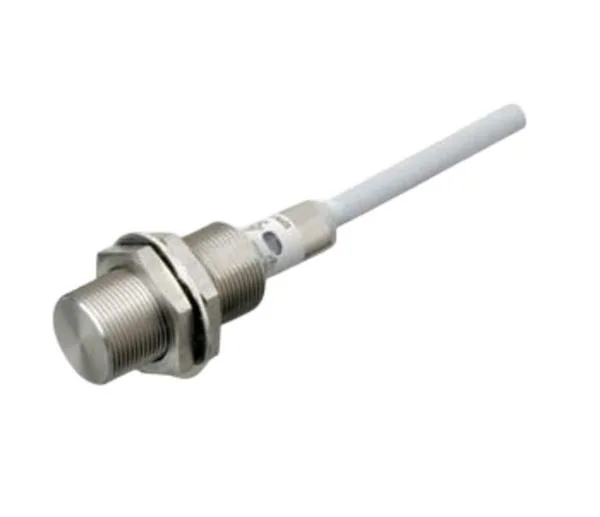
Omron E2E-X5D1-M1TGJ-T 0.3M Inductive Proximity Sensor
| Feature | Value |
|---|---|
| Sensor Type | Inductive Proximity Sensor |
| Series | E2E NEXT |
| Housing Size | M18 |
| Mounting Type | Flush Shielded |
| Sensing Distance | 5 mm |
| Output Type | DC 2-Wire |
| Operation Mode | Normally Open (NO) |
| Connection Method | M12 Pigtail Smartclick Connector |
| Cable Length | 0.3 m |
| Housing Material | Nickel-Plated Brass |
| Sensor Length | 54.3 mm |
| Thread Length | 37 mm |
| Protection Rating | IP67 / IP67G / IP69K |
The Omron E2E-X5D1-M1TGJ-T 0.3M Inductive Proximity Sensor is a cylindrical M18 sensing device designed for reliable metal object detection in industrial automation systems. Built within the E2E NEXT family, this sensor combines a compact flush-mounted structure with durable environmental protection, making it suitable for demanding production environments where consistent detection performance is required.
The sensor uses a nickel-plated brass housing and a 0.3-meter pigtail connection with an M12 Smartclick connector. This configuration supports simplified installation and replacement procedures while maintaining dependable electrical connectivity in industrial machinery.
Technical Description
The Omron E2E-X5D1-M1TGJ-T 0.3M Inductive Proximity Sensor is engineered as a shielded inductive sensing device with a 5 mm sensing distance. Its flush mounting design allows installation directly into metal surfaces while minimizing the influence of surrounding metallic structures.
The sensor incorporates a DC 2-wire output configuration with normally open operation. This arrangement enables integration into a wide range of control circuits, PLC inputs, machine monitoring systems, and automated production equipment.
The robust enclosure provides IP67, IP67G, and IP69K protection, supporting operation in environments exposed to dust, moisture, cleaning agents, and washdown procedures.
Working Principle
Like other inductive proximity sensors, the Omron E2E-X5D1-M1TGJ-T 0.3M Inductive Proximity Sensor generates an electromagnetic field at its sensing face. When a conductive metallic target enters the sensing zone, eddy currents are induced in the target material.
These eddy currents alter the oscillation characteristics within the sensing circuit. The internal electronics continuously monitor these changes and switch the output state when the detection threshold is reached.
Because the detection process is contactless, the sensor experiences minimal mechanical wear and supports long-term operation in repetitive industrial applications.
Typical Applications
- Metal part positioning systems
- Automated assembly equipment
- Packaging machinery
- Conveyor monitoring systems
- Machine tool automation
- Industrial material handling equipment
- Transfer line position verification
- Robotic end-of-travel detection
Industrial Use Cases
In automated manufacturing cells, the Omron E2E-X5D1-M1TGJ-T 0.3M Inductive Proximity Sensor can verify the presence of machined metal components before a robotic handling sequence begins.
Within conveyor-based transport systems, the sensor can monitor pallet positions and confirm that metallic carriers have reached designated process stations.
In packaging environments, it may be used to detect metal machine components and moving mechanisms that coordinate product transfer operations.
Metalworking facilities often deploy inductive sensors for fixture confirmation, tool positioning, and machine status monitoring due to their resistance to contamination and vibration.
Advantages
- Flush mounting capability for compact installation
- Durable nickel-plated brass housing
- 5 mm sensing distance for reliable metal detection
- Oil-resistant cable construction
- M12 Smartclick connector for simplified maintenance
- High environmental protection ratings
- Contactless sensing technology
- Suitable for demanding industrial environments
Sector-Specific Examples
Automotive Manufacturing
Used for detecting metal brackets, fixtures, and body assembly components throughout production lines.
Food Processing Equipment
The IP69K protection rating allows deployment near washdown areas where equipment is regularly cleaned.
Material Handling Facilities
Supports position verification of metallic transport carriers and conveyor system components.
Machine Building
Provides feedback for moving machine assemblies, slides, and mechanical actuators.
Selection Considerations
When selecting the Omron E2E-X5D1-M1TGJ-T 0.3M Inductive Proximity Sensor, engineers should verify that the target material is metallic and compatible with the specified sensing distance.
Installation space should accommodate the M18 threaded body and flush mounting requirements. Environmental conditions, including exposure to liquids, oils, and cleaning processes, should also be evaluated to ensure the selected protection level matches application requirements.
For projects requiring additional sensing technologies and product families, engineers can review Omron sensor products for related automation solutions.
The Omron E2E-X5D1-M1TGJ-T 0.3M Inductive Proximity Sensor is commonly selected where robust metal detection and environmental resistance are necessary. The Omron E2E-X5D1-M1TGJ-T 0.3M Inductive Proximity Sensor also supports maintenance-friendly installation through its connector-based design.
Frequently Asked Questions
What type of sensor is this product?
It is a shielded inductive proximity sensor designed to detect metallic objects without physical contact.
Omron E2E-X5D1-M1TGJ-T 0.3M What is the sensing distance?
The specified sensing distance is 5 mm.
Can it be mounted flush in metal?
Yes. The sensor is designed for flush mounting applications.
What output configuration does it use?
It uses a DC 2-wire normally open output configuration.
What protection ratings are provided?
The sensor is rated IP67, IP67G, and IP69K.
What connection method is used?
The device features a 0.3-meter pigtail cable with an M12 Smartclick connector.
Which industries commonly use this sensor?
Automotive, packaging, machine building, material handling, and general manufacturing sectors frequently use inductive proximity sensors of this type.
Does the sensor require physical contact with the target?
No. Detection occurs through an electromagnetic sensing field, eliminating mechanical contact.