
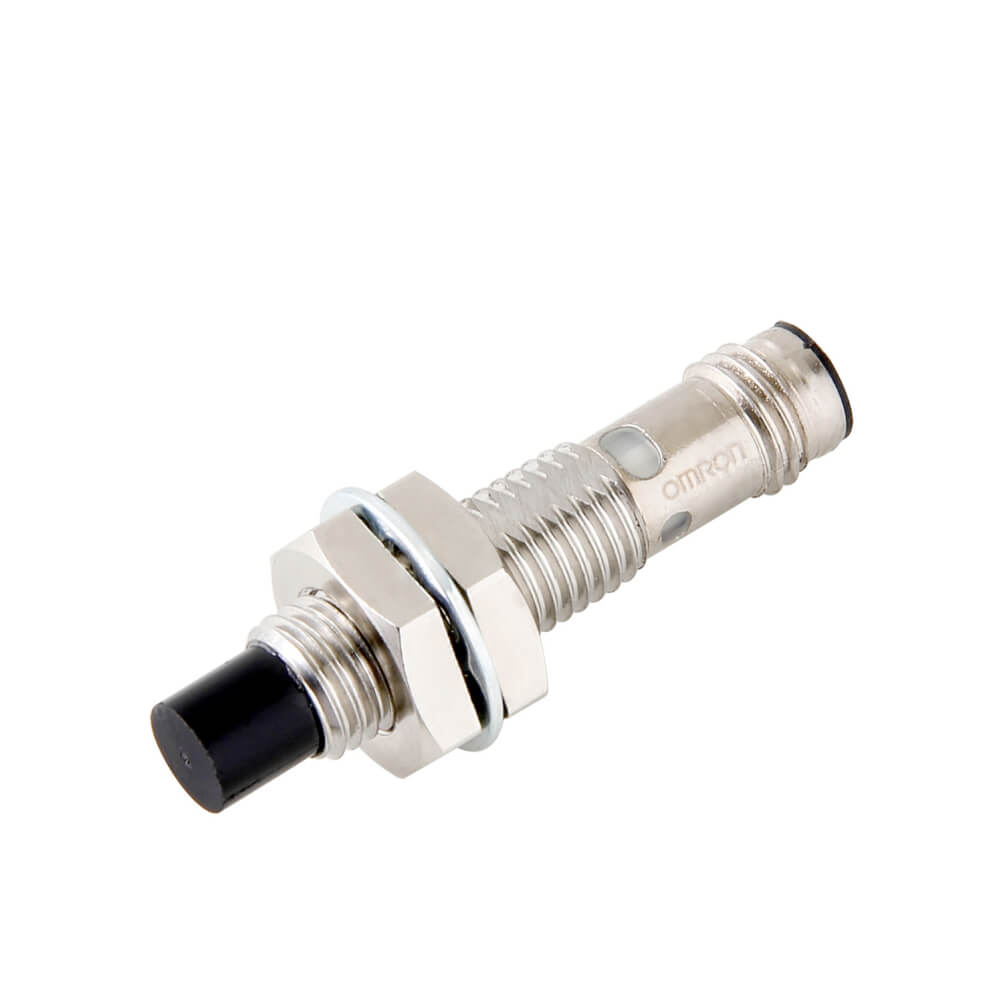
Omron E2E-X4MB28-M5 Inductive Proximity Sensor
| Feature | Value |
|---|---|
| Sensor Type | Inductive Proximity Sensor |
| Series | E2E NEXT |
| Housing Size | M8 |
| Mounting Type | Non-Flush |
| Sensing Distance | 4 mm |
| Output Type | PNP |
| Operation Mode | Normally Closed (NC) |
| Connection Method | M8 Connector, 3-Pin |
| Housing Material | Stainless Steel |
| Sensor Length | 39 mm |
| Thread Length | 20 mm |
| Protection Rating | IP67 / IP69K |
Technical Description
Industrial automation systems frequently require reliable metal object detection without mechanical contact. The Omron E2E-X4MB28-M5 Inductive Proximity Sensor is designed for this purpose, providing stable detection of metallic targets within a compact M8 stainless-steel housing. As part of the E2E NEXT family, the sensor combines a non-flush sensing design with a 4 mm sensing distance, making it suitable for installations where additional sensing range is beneficial despite limited mounting space.
The Omron E2E-X4MB28-M5 Inductive Proximity Sensor uses a PNP normally closed output configuration and a connector-based interface that simplifies installation and maintenance activities. Its stainless-steel construction and high ingress protection ratings allow deployment in demanding industrial environments where exposure to dust, moisture, vibration, and cleaning procedures is common.
Working Principle
An inductive proximity sensor operates by generating an electromagnetic field from an internal oscillator circuit. When a conductive metal object enters this field, eddy currents are induced within the target material. These currents absorb energy from the oscillating field and alter the sensor’s electrical characteristics.
The sensor electronics continuously monitor these changes and switch the output state once the detection threshold is reached. Since no physical contact occurs between the sensor and the target, wear-related failures associated with mechanical switches are eliminated. This operating principle allows the Omron E2E-X4MB28-M5 Inductive Proximity Sensor to perform repetitive detection tasks with consistent results.
Main Features
- Compact M8 threaded housing
- 4 mm sensing distance
- PNP output configuration
- Normally closed switching function
- Stainless-steel housing construction
- M8 three-pin connector connection
- IP67 and IP69K environmental protection
- Designed for industrial automation systems
Typical Applications
This sensor can be integrated into numerous automation processes where metallic objects must be detected accurately and repeatedly.
Machine Position Monitoring
Production machinery often requires confirmation of actuator positions, moving components, and tooling locations. The sensor provides feedback signals that can be used by PLCs and control systems.
Conveyor Automation
Metal carriers, pallets, and transfer components moving through conveyor systems can be detected without physical contact, supporting efficient material flow monitoring.
Assembly Equipment
Automated assembly stations use proximity sensors to verify part presence and confirm that machine mechanisms have reached their intended positions.
Packaging Machinery
Packaging systems utilize inductive sensors to monitor mechanical movements, tooling positions, and metal machine components during operation.
Industrial Applications
The Omron E2E-X4MB28-M5 Inductive Proximity Sensor is widely used across different manufacturing sectors.
- Automotive manufacturing facilities
- Material handling systems
- Packaging production lines
- Machine tool equipment
- Electronics assembly operations
- Metal fabrication facilities
- Warehouse automation systems
- Industrial robotics installations
Additional sensing solutions can be explored through Omron sensor series.
Advantages
- Non-contact sensing minimizes mechanical wear
- Compact dimensions support flexible installation
- Stainless-steel housing enhances durability
- Connector interface simplifies replacement procedures
- High ingress protection supports operation in harsh environments
- Suitable for continuous industrial operation
Sector-Specific Usage Examples
Automotive Production
Used to detect fixture locations, metal workpiece positioning, and transfer mechanism movement within automated assembly lines.
Food Processing Equipment
Installed on machinery requiring robust sensors capable of operating in environments exposed to regular washdown procedures.
Warehouse Systems
Applied for monitoring lift mechanisms, shuttle equipment, and automated transport devices containing metallic components.
Machine Building Industry
Integrated into custom-built equipment where reliable proximity feedback is required for process control and safety monitoring.
Considerations When Selecting a Sensor
Several technical factors should be reviewed before choosing an inductive proximity sensor:
- Required sensing distance
- Mounting configuration
- Electrical output requirements
- Environmental exposure conditions
- Connector and wiring preferences
- Protection rating requirements
- Target material characteristics
- Mechanical space limitations
Evaluating these parameters helps ensure compatibility with the intended application and control system architecture.
Frequently Asked Questions
What type of sensor is the Omron E2E-X4MB28-M5 Inductive Proximity Sensor?
It is an inductive proximity sensor designed for non-contact detection of metallic objects.
What is the sensing distance of this sensor?
The nominal sensing distance is 4 mm.
What output type does the sensor provide?
The sensor uses a PNP output configuration.
What does the NC operating mode indicate?
NC stands for Normally Closed, describing the output state during standard operating conditions.
Is the sensor suitable for wet industrial environments?
Yes. Its IP67 and IP69K ratings support use in environments exposed to moisture and cleaning procedures.
What material is used for the housing?
The housing is manufactured from stainless steel.
How is the sensor connected?
The sensor uses an M8 three-pin connector connection method.
Where is the Omron E2E-X4MB28-M5 Inductive Proximity Sensor commonly installed?
It is commonly used in automated machinery, conveyor systems, packaging equipment, robotics, and material handling applications.