
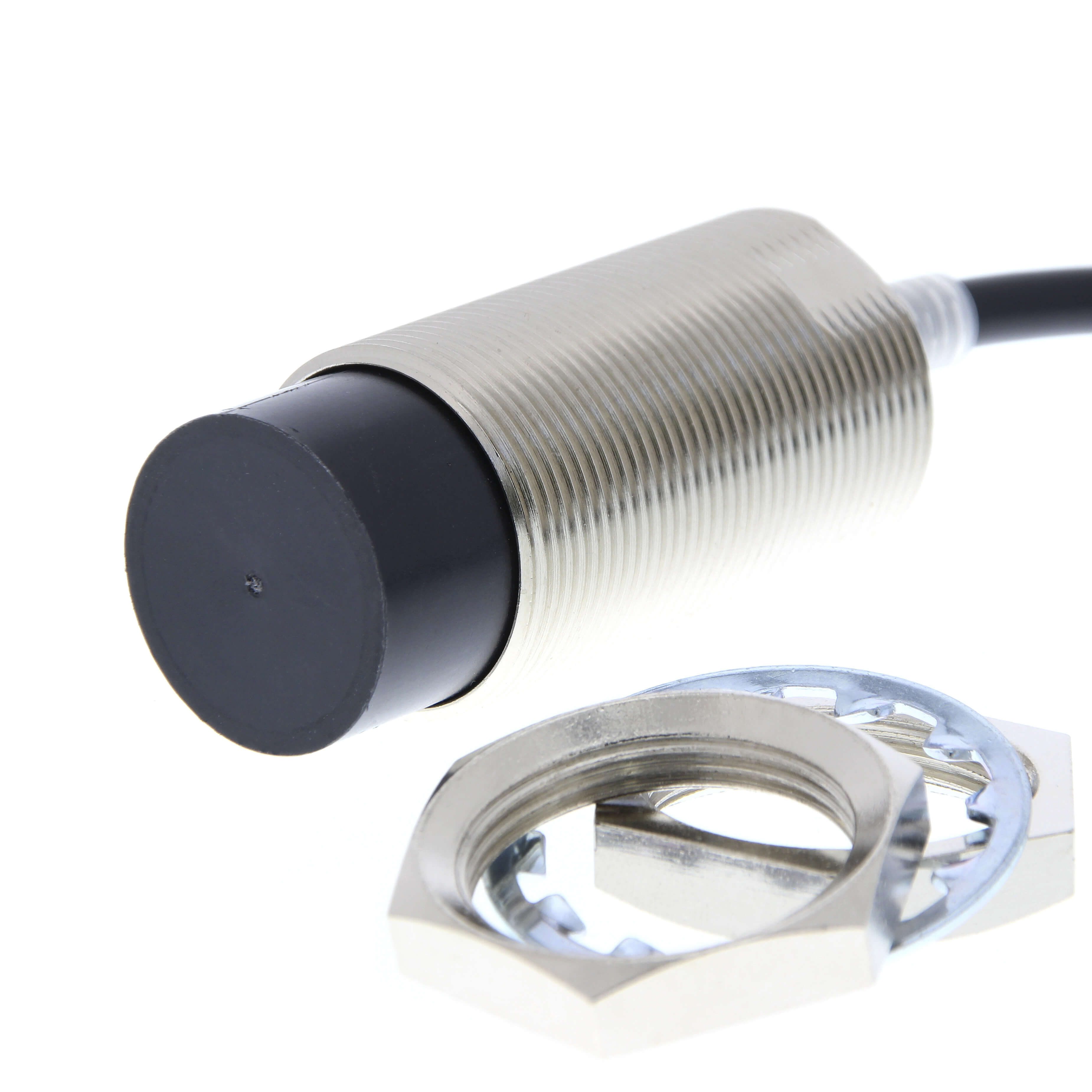
Omron E2E-X40MD1L30-T 2M Inductive Proximity Sensor
| Feature | Value |
|---|---|
| Sensor Type | Inductive Proximity Sensor |
| Series | Omron E2E NEXT |
| Housing Size | M30 |
| Mounting Type | Non-flush |
| Sensing Distance | 40 mm |
| Output Type | 3-wire DC PNP |
| Operation Mode | NO (Normally Open) |
| Supply Voltage | 10 to 30 VDC |
| Cable Length | 2 m |
| Housing Material | Nickel-Plated Brass |
| Protection Rating | IP67 / IP67G / IP69K |
| Switching Frequency | 100 Hz |
| Connection Method | Pre-wired Cable |
| Operating Temperature | -25°C to +70°C |
Introduction to the Sensor
Industrial automation systems often require dependable object detection without relying on mechanical contact. The Omron E2E-X40MD1L30-T 2M Inductive Proximity Sensor is designed to detect metallic targets at extended distances while maintaining stable performance in production environments. Its M30 cylindrical housing and 40 mm sensing range make it suitable for equipment where larger installation tolerances are required.
As a member of the E2E NEXT series, this sensor incorporates long-range inductive sensing technology and a rugged mechanical design intended for industrial use. The model is equipped with a 2-meter pre-wired cable and a PNP normally open output configuration commonly used in PLC-controlled systems.
Technical Description
The Omron E2E-X40MD1L30-T 2M Inductive Proximity Sensor utilizes electromagnetic induction to identify the presence of conductive metallic objects. The sensing element creates an oscillating electromagnetic field at the front face of the sensor.
When a metal target enters the sensing zone, eddy currents are generated within the object. These currents alter the oscillation characteristics of the sensor circuit, causing the output state to switch once the detection threshold is reached.
The non-flush mounting structure allows a larger sensing distance compared to flush-mounted alternatives, making it suitable for installations where greater detection range is required.
Working Principle
Inductive sensing technology operates through electromagnetic field interaction rather than optical or mechanical methods. The sensor continuously generates a high-frequency field. Metallic materials entering this field absorb energy and influence the oscillator amplitude.
The internal electronics monitor this change and activate the output signal when detection conditions are satisfied. Since no moving parts are involved, wear is significantly reduced compared to mechanical limit switches.
The Omron E2E-X40MD1L30-T 2M Inductive Proximity Sensor can therefore provide stable detection performance even in applications involving repetitive machine cycles.
Common Areas of Use
- Production line automation
- Conveyor tracking systems
- Material transfer equipment
- Industrial assembly stations
- Machine position verification
- Metal component counting systems
- Packaging machinery
- Automated storage systems
Industrial Application Examples
Assembly Line Monitoring
Manufacturing plants often require confirmation that metal fixtures and workpieces are correctly positioned before process execution. The sensor can verify these positions without physical contact.
Transfer Mechanisms
Automated transfer units use proximity sensors to detect carriers and machine elements moving between workstations. Extended sensing distance can simplify installation and alignment.
Packaging Equipment
Packaging machines frequently employ metal guides, brackets, and actuators. The sensor can monitor these components to support synchronized machine operation.
Robotic Manufacturing Cells
In robotic systems, proximity sensing may be used for tool positioning confirmation, fixture detection, and workpiece verification before automated operations begin.
Advantages
- Long 40 mm sensing distance
- PNP normally open output configuration
- Durable nickel-plated brass housing
- High environmental protection ratings
- Reliable non-contact detection
- Suitable for industrial automation environments
- Reduced maintenance compared to mechanical switches
- Simple integration with modern control systems
Omron E2E-X40MD1L30-T 2M Engineers evaluating additional sensing technologies may also review Omron sensor series for broader automation projects.
Factors to Consider During Selection
- Required sensing distance
- Target material composition
- Output type compatibility
- Available installation space
- Cable routing requirements
- Environmental protection needs
- Switching frequency requirements
- Machine operating conditions
Omron E2E-X40MD1L30-T 2M The Omron E2E-X40MD1L30-T 2M Inductive Proximity Sensor is particularly suitable where long sensing range and PNP output compatibility are required.
Frequently Asked Questions
What is the sensing distance of this sensor?
The nominal sensing distance is 40 mm.
What output type does the sensor provide?
The sensor provides a 3-wire DC PNP normally open output.
Can it detect non-metallic materials?
Inductive sensors are designed specifically for metallic target detection.
Is the sensor suitable for washdown environments?
Its IP67, IP67G and IP69K ratings support use in demanding industrial environments.
What cable length is supplied?
This version includes a 2-meter pre-wired cable.
Can the sensor replace a mechanical limit switch?
Many automation systems use inductive sensors as a non-contact alternative to mechanical switching devices.
Where is the Omron E2E-X40MD1L30-T 2M Inductive Proximity Sensor commonly used?
It is frequently applied in automation systems, conveyors, packaging equipment, and manufacturing machinery.
How does the Omron E2E-X40MD1L30-T 2M Inductive Proximity Sensor operate?
It detects metallic objects by monitoring changes in an electromagnetic field generated at the sensing face.