
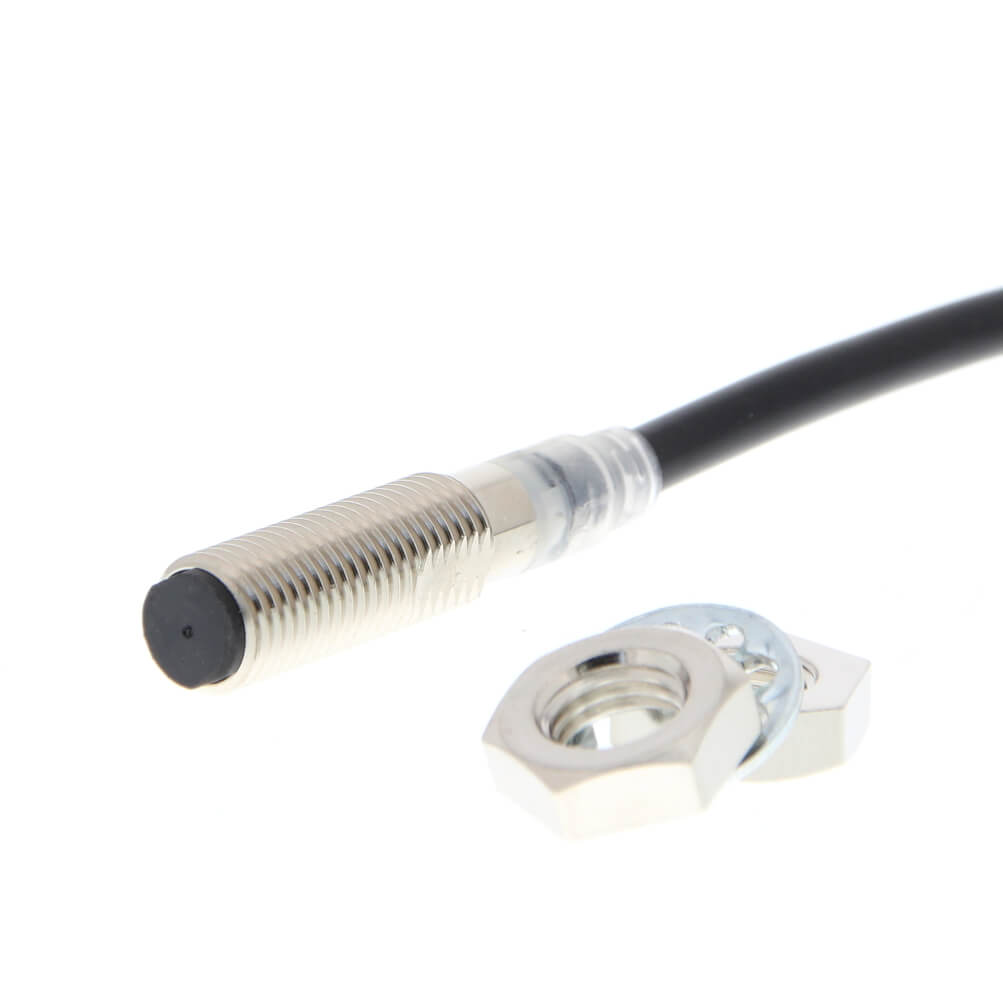
Omron E2E-X3D28-R 2M Inductive Proximity Sensor
| Feature | Value |
|---|---|
| Manufacturer | Omron |
| Series | E2E NEXT |
| Sensor Type | Inductive Proximity Sensor |
| Housing Size | M8 |
| Sensing Distance | 3 mm |
| Mounting Style | Shielded |
| Output Type | 2-wire DC |
| Operation Mode | NC (Normally Closed) |
| Connection Method | Pre-wired Cable |
| Cable Length | 2 m |
| Housing Material | Nickel-Plated Brass |
| Protection Rating | IP67 / IP67G / IP69K |
| Thread Length | 21 mm |
| Overall Length | 37.8 mm |
Industrial sensing applications frequently require dependable object detection under challenging environmental conditions. The Omron E2E-X3D28-R Inductive Proximity Sensor is developed to provide stable metallic target detection in automated systems where mechanical switches may be exposed to wear, contamination, or vibration. Its compact M8 housing and integrated 2-meter cable make it suitable for installations where direct connector access is limited.
The Omron E2E-X3D28-R Inductive Proximity Sensor belongs to the E2E NEXT family and incorporates advanced inductive sensing technology within a rugged metal enclosure. The sensor supports reliable operation across a wide range of industrial sectors including manufacturing, logistics, material handling, and machinery construction.
Omron E2E-X3D28-R Technical Description
This model is designed for non-contact detection of conductive metal targets. The shielded sensing structure allows installation near surrounding metal surfaces while maintaining a controlled sensing field and predictable switching behavior.
- M8 cylindrical threaded housing
- 3 mm sensing distance
- Normally Closed output operation
- 2-wire DC electrical configuration
- Integrated 2-meter connection cable
- Nickel-plated brass construction
- High environmental protection ratings
- Designed for industrial automation systems
Omron E2E-X3D28-R Working Principle
The sensing face generates a high-frequency electromagnetic field. When a metallic object enters the detection zone, eddy currents are induced within the target. These currents absorb energy from the oscillator circuit and alter its operating characteristics.
The internal electronics evaluate these changes and switch the output when the target reaches the specified sensing distance. Because the sensing process does not require physical contact, the sensor avoids mechanical wear associated with conventional limit switches.
Applications in Automation Systems
The sensor is suitable for applications requiring compact installation dimensions combined with reliable metal object detection.
- Position monitoring systems
- Machine automation equipment
- Conveyor transfer stations
- Packaging machinery
- Material handling systems
- Automated storage equipment
- Robotic production cells
- Industrial assembly machinery
Engineers searching for additional proximity sensing technologies can review Omron sensor products for related automation requirements.
Industrial Application Examples
Conveyor Automation
The sensor can verify the position of metallic pallets, carriers, and transfer components moving throughout automated transport systems.
Automated Warehousing
Storage and retrieval systems often rely on compact sensors for position verification of moving mechanical assemblies.
Production Machinery
Manufacturing equipment can utilize the sensor to monitor machine states, actuator positions, and moving mechanical components.
Assembly Equipment
The sensor supports workpiece detection and fixture position monitoring during automated assembly operations.
Advantages
- Reliable non-contact sensing technology
- Compact M8 installation size
- Extended sensing distance for the housing category
- High resistance to oil and industrial contaminants
- IP69K protection for demanding environments
- Integrated cable for simplified wiring
- Durable metal housing construction
- Stable operation near surrounding metal structures
Sector-Based Usage Scenarios
Logistics facilities may use the sensor to monitor transfer mechanisms and metallic carrier movement within automated sorting systems.
Machine builders can integrate the device into compact equipment where limited mounting space requires a small yet robust sensing solution.
Automotive component manufacturers often employ proximity sensors for fixture verification and actuator monitoring.
Industrial packaging systems can use the sensor to verify the position of metallic machine components before cycle initiation.
Selection Considerations
Several factors should be reviewed before selecting an inductive proximity sensor for an automation project.
- Target material characteristics
- Required sensing range
- Electrical interface requirements
- Installation environment
- Cable routing requirements
- Protection rating requirements
- Available mounting space
The Omron E2E-X3D28-R Inductive Proximity Sensor is particularly suitable where a compact sensor with an integrated cable connection is preferred.
Frequently Asked Questions
1. What is the sensing distance of the sensor?
The rated sensing distance is 3 mm.
2. What output configuration does the sensor use?
The sensor uses a 2-wire DC output design.
3. Is the output Normally Open or Normally Closed?
This model provides Normally Closed (NC) operation.
4. What cable length is included?
The sensor is supplied with a 2-meter pre-wired cable.
5. Can it detect non-metallic objects?
No. Inductive sensors are designed for metallic target detection.
6. Is it suitable for washdown applications?
Yes. The sensor carries IP67, IP67G, and IP69K protection ratings.
7. What housing material is used?
The housing is manufactured from nickel-plated brass.
8. Where is the Omron E2E-X3D28-R Inductive Proximity Sensor commonly installed?
It is widely used in conveyors, automated machinery, robotics, packaging systems, and industrial handling equipment.
9. What is the benefit of a shielded sensing design?
Shielded construction allows installation closer to surrounding metal without significantly affecting sensing performance.
10. Why is the Omron E2E-X3D28-R Inductive Proximity Sensor used in industrial automation?
Its compact dimensions, durable housing, non-contact operation, and environmental protection characteristics support reliable machine operation.