
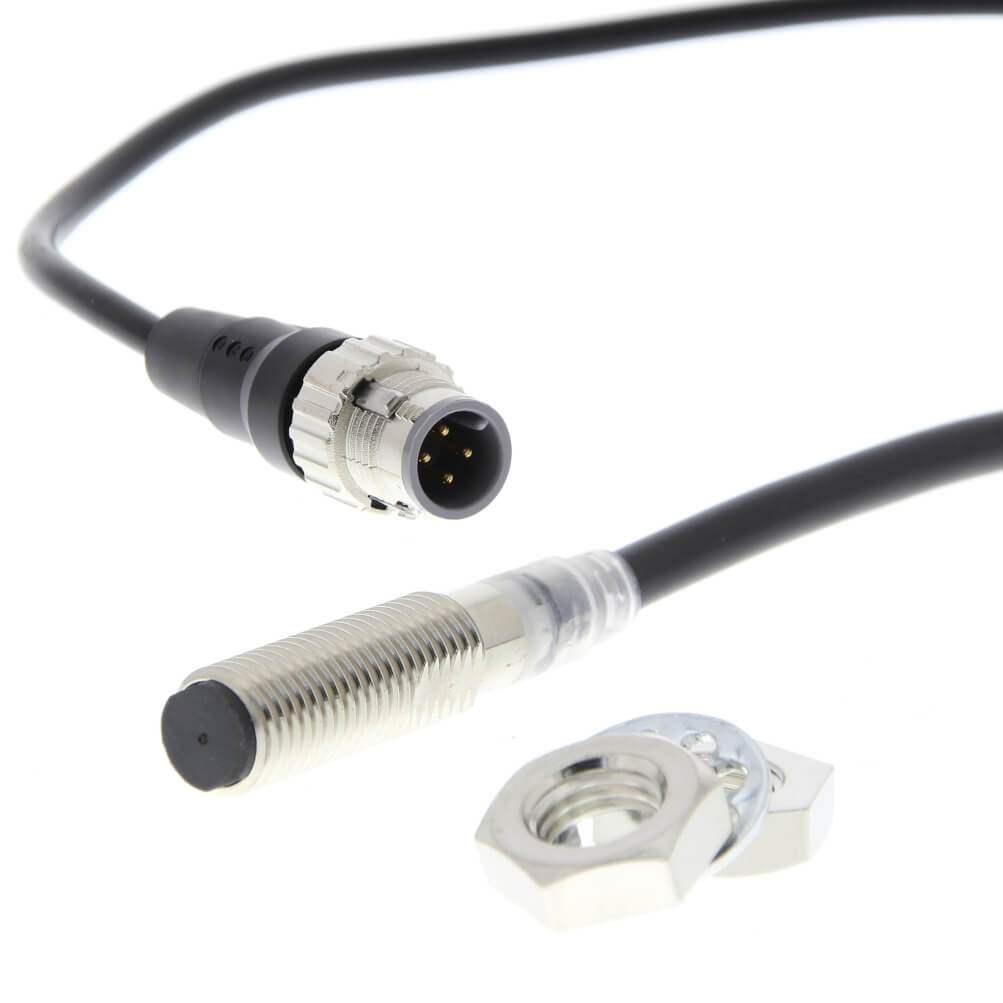
Omron E2E-X3D28-M1TGJ 0.3M Inductive Proximity Sensor
| Feature | Value |
|---|---|
| Manufacturer | Omron |
| Series | E2E NEXT |
| Sensor Type | Inductive Proximity Sensor |
| Housing Size | M8 |
| Sensing Distance | 3 mm |
| Mounting Type | Quasi-flush (Shielded) |
| Output Type | 2-wire DC |
| Operation Mode | NC (Normally Closed) |
| Connection Method | M12 Pigtail Smartclick Connector |
| Cable Length | 0.3 m |
| Housing Material | Nickel-Plated Brass |
| Thread Length | 21 mm |
| Overall Length | 37.8 mm |
| Protection Rating | IP67 / IP67G / IP69K |
The Omron E2E-X3D28-M1TGJ Inductive Proximity Sensor is designed for reliable non-contact detection of metallic objects in industrial automation systems. As part of the E2E NEXT family, this sensor combines a compact M8 housing with an extended sensing distance of 3 mm, making it suitable for machinery where installation space is limited while maintaining stable detection performance.
The Omron E2E-X3D28-M1TGJ Inductive Proximity Sensor incorporates a shielded sensing structure and a durable nickel-plated brass housing. These characteristics help maintain consistent operation in environments exposed to oil, moisture, vibration, and frequent washdown procedures.
Technical Overview
This sensor operates using inductive sensing technology, allowing the detection of metallic targets without physical contact. The compact M8 threaded housing simplifies installation in confined machine assemblies and automation equipment.
- 3 mm sensing distance
- Normally Closed (NC) switching operation
- 2-wire DC output configuration
- M12 Smartclick pigtail connection
- Oil-resistant cable construction
- High environmental protection ratings
- Shielded sensing design for precise detection zones
Working Principle
The sensor generates a high-frequency electromagnetic field at the sensing face. When a conductive metal target enters this field, eddy currents are induced within the target material. These currents absorb energy from the oscillator circuit, causing a measurable change in amplitude.
The internal detection circuit continuously monitors this variation and changes the output state when the target reaches the specified sensing distance. Since operation is entirely contactless, wear of mechanical components is eliminated and long-term switching reliability can be maintained.
Typical Areas of Use
The compact dimensions of the sensor make it suitable for machinery where multiple sensing points must be installed in restricted spaces.
- Packaging machinery
- Automated assembly systems
- Conveyor monitoring
- Material handling equipment
- Robotic end-of-arm tooling
- Part presence verification
- Industrial transport systems
- Machine tool automation
For engineers working with proximity sensing solutions, additional Omron sensor products can be reviewed for broader machine automation requirements.
Omron E2E-X3D28-M1TGJ Industrial Applications
Packaging Equipment
The sensor can verify the position of metallic machine components, guiding sequencing operations during filling, sealing, and labeling processes.
Automotive Manufacturing
In production lines, it can monitor fixture positions, metallic carrier locations, and transfer mechanism status without direct contact.
Machine Tools
The rugged housing and high protection ratings support operation near cutting fluids and lubricants commonly used in machining centers.
Material Handling Systems
Conveyor sections often require reliable detection of metal pallets, carriers, or transfer components. The sensor provides consistent switching performance for these tasks.
Advantages
- Compact M8 design suitable for limited installation space
- Extended sensing distance compared with conventional M8 sensors
- High resistance to industrial contaminants
- Reliable operation without mechanical wear
- IP69K protection for demanding washdown environments
- Durable nickel-plated brass construction
- Stable detection performance with shielded sensing technology
Sector-Specific Examples
Food processing facilities may use the sensor to monitor machine positioning systems where frequent cleaning procedures are required.
Logistics centers can integrate the sensor into automated transfer stations to verify metal carrier movement.
Electronics assembly plants may install multiple sensors within compact production fixtures where installation space is limited.
Metalworking operations often use proximity sensors to verify actuator positions and machine states before cycle execution.
Considerations When Selecting This Sensor
Before implementing the sensor, engineers should evaluate the target material, available mounting space, environmental conditions, and control system requirements.
- Verify that the target object is metallic.
- Confirm the required sensing distance.
- Consider shielded mounting requirements.
- Check compatibility with 2-wire DC control circuits.
- Review connector and cable routing constraints.
- Evaluate washdown and contamination exposure levels.
Omron E2E-X3D28-M1TGJ Frequently Asked Questions
1. What type of sensor is the Omron E2E-X3D28-M1TGJ 0.3M?
It is a shielded inductive proximity sensor designed to detect metallic targets without physical contact.
2. What is the sensing distance?
The rated sensing distance is 3 mm.
3. What output configuration does it use?
The sensor uses a 2-wire DC output configuration with Normally Closed operation.
4. Is the sensor suitable for wet environments?
Yes. Its IP67, IP67G, and IP69K ratings support operation in demanding industrial environments.
5. What housing material is used?
The housing is manufactured from nickel-plated brass for mechanical durability and corrosion resistance.
6. Can it detect non-metallic materials?
No. Inductive sensing technology is intended for metallic targets.
7. Where is this sensor commonly installed?
It is frequently used in packaging machines, conveyors, assembly equipment, and machine tools.
8. What connection method is provided?
The sensor includes an M12 Smartclick pigtail connector with a 0.3 m cable.
9. Why choose a shielded sensing design?
Shielded sensors provide a more controlled sensing field, enabling installation close to surrounding metal structures.
10. What makes the Omron E2E-X3D28-M1TGJ Inductive Proximity Sensor suitable for automation systems?
Its compact dimensions, non-contact operation, robust protection ratings, and stable sensing performance support reliable industrial machine operation.