
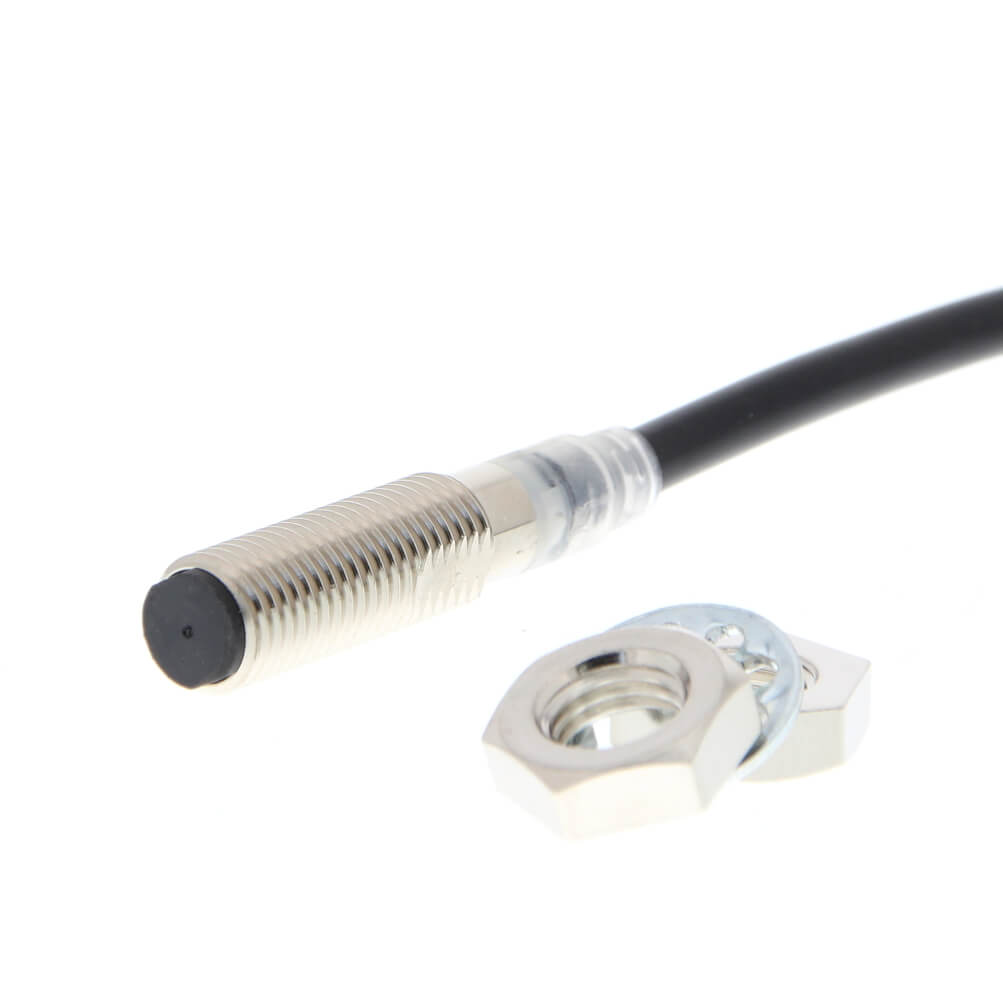
Omron E2E-X3D18-R 2M Inductive Proximity Sensor
| Feature | Value |
|---|---|
| Sensor Type | Inductive Proximity Sensor |
| Sensing Distance | 3 mm |
| Housing Size | M8 Threaded Cylindrical |
| Mounting Type | Shielded |
| Output Configuration | Normally Closed (NC) |
| Electrical Design | DC 2-Wire |
| Supply Voltage | 10 to 30 VDC |
| Cable Length | 2 m |
| Response Frequency | 350 Hz |
| Housing Material | Nickel-Plated Brass |
| Protection Rating | IP67, IP67G, IP69K |
| Operating Temperature | -25°C to +70°C |
| Protection Functions | Short-Circuit Protection |
The Omron E2E-X3D18-R 2M is an inductive proximity sensor developed for reliable metallic object detection in industrial automation environments. Designed as part of the E2E NEXT series, this model combines compact dimensions with a Normally Closed switching configuration and a durable cable connection, making it suitable for machinery that requires continuous monitoring of component presence and machine status.
Industrial systems frequently rely on non-contact sensing devices to improve reliability and reduce maintenance requirements. The Omron E2E-X3D18-R Inductive Proximity Sensor addresses these requirements by delivering stable detection performance while operating under demanding environmental conditions.
Technical Description
The sensor features a shielded M8 threaded housing with a rated sensing distance of 3 mm. The shielded design allows installation near surrounding metallic structures while maintaining predictable sensing characteristics.
This model uses a DC two-wire configuration and operates within a voltage range of 10 to 30 VDC. The integrated 2-meter cable supports direct installation into machine control systems where connector-based wiring is not preferred.
The nickel-plated brass housing contributes to mechanical durability while protecting the sensor from exposure to oils, coolants, and industrial contaminants.
Working Principle
The Omron E2E-X3D18-R Inductive Proximity Sensor operates using electromagnetic induction technology. An oscillator continuously generates a magnetic field at the sensing face.
When a conductive metallic object enters the sensing zone, eddy currents are created inside the target. These currents alter the oscillator behavior, allowing the sensor electronics to recognize the presence of the object.
The internal switching circuit responds to these changes and updates the Normally Closed output state accordingly. Since no physical contact occurs during detection, wear-related failures are minimized.
This sensing approach enables consistent operation in applications involving repetitive movement, high cycle counts, and continuous production schedules.
Common Usage Areas
Machine Safety Monitoring
Normally Closed outputs are frequently used in monitoring circuits where fault detection is important. The sensor can provide continuous confirmation of machine component presence.
Linear Actuator Position Detection
Industrial actuators often require feedback regarding end-of-travel positions and operating status.
Production Equipment Interlocks
Manufacturing systems may utilize proximity sensors to confirm proper positioning before process steps are initiated.
Transfer and Handling Systems
Material handling equipment can employ metallic target detection to coordinate movement between stations.
Industrial Applications
- Automated assembly systems
- CNC machinery
- Conveyor automation
- Material handling equipment
- Machine tool installations
- Packaging machinery
- Warehouse automation systems
- Automotive production equipment
In automated assembly facilities, sensors may monitor fixture positions before robotic processes begin. In machine tool applications, proximity sensing can verify tooling positions and machine readiness conditions.
Advantages
- Reliable 3 mm sensing performance.
- Normally Closed switching configuration.
- Compact M8 threaded housing.
- Integrated cable connection.
- High resistance to environmental exposure.
- Non-contact sensing operation.
- Industrial-grade protection ratings.
- Reduced maintenance requirements.
The Omron E2E-X3D18-R Inductive Proximity Sensor is particularly useful in installations where continuous circuit monitoring is required and fault detection strategies benefit from Normally Closed outputs.
Industry-Specific Examples
Automotive Fixture Verification
Production cells can use the sensor to confirm fixture engagement before welding or assembly operations begin.
CNC Machine Monitoring
Machine tools may rely on inductive sensors to detect tool holder positions and moving mechanical assemblies.
Automated Warehousing
Transfer systems can identify metallic carriers during routing and storage processes.
Packaging Line Coordination
Packaging equipment can utilize position feedback from proximity sensors to synchronize indexing operations.
Factors to Consider During Selection
- Required switching logic.
- Target material properties.
- Available mounting dimensions.
- Electrical supply requirements.
- Cable routing requirements.
- Environmental protection needs.
- Machine operating speed.
- Maintenance accessibility.
When a Normally Closed output configuration is preferred for monitoring applications, the Omron E2E-X3D18-R 2M provides a practical solution for metallic target detection.
Omron E2E-X3D18-R Additional sensing technologies and related products can be explored through Omron sensor products.
Omron E2E-X3D18-R Frequently Asked Questions
What is the rated sensing distance?
The sensor provides a rated sensing distance of 3 mm.
What output configuration does this model use?
This version utilizes a Normally Closed output.
Can the sensor detect non-metallic objects?
No. The sensing technology is designed for metallic targets.
What cable length is supplied?
The sensor includes a permanently attached 2-meter cable.
What voltage range is supported?
The operating voltage range is 10 to 30 VDC.
Is it suitable for washdown environments?
Its IP67, IP67G, and IP69K ratings support operation in demanding industrial environments.
Which industries commonly use this sensor?
Automotive, machine building, packaging, material handling, and manufacturing sectors commonly utilize this model.
What housing material is used?
The housing is manufactured from nickel-plated brass.
Does the sensor include protection circuitry?
Yes. Integrated short-circuit protection is included.