
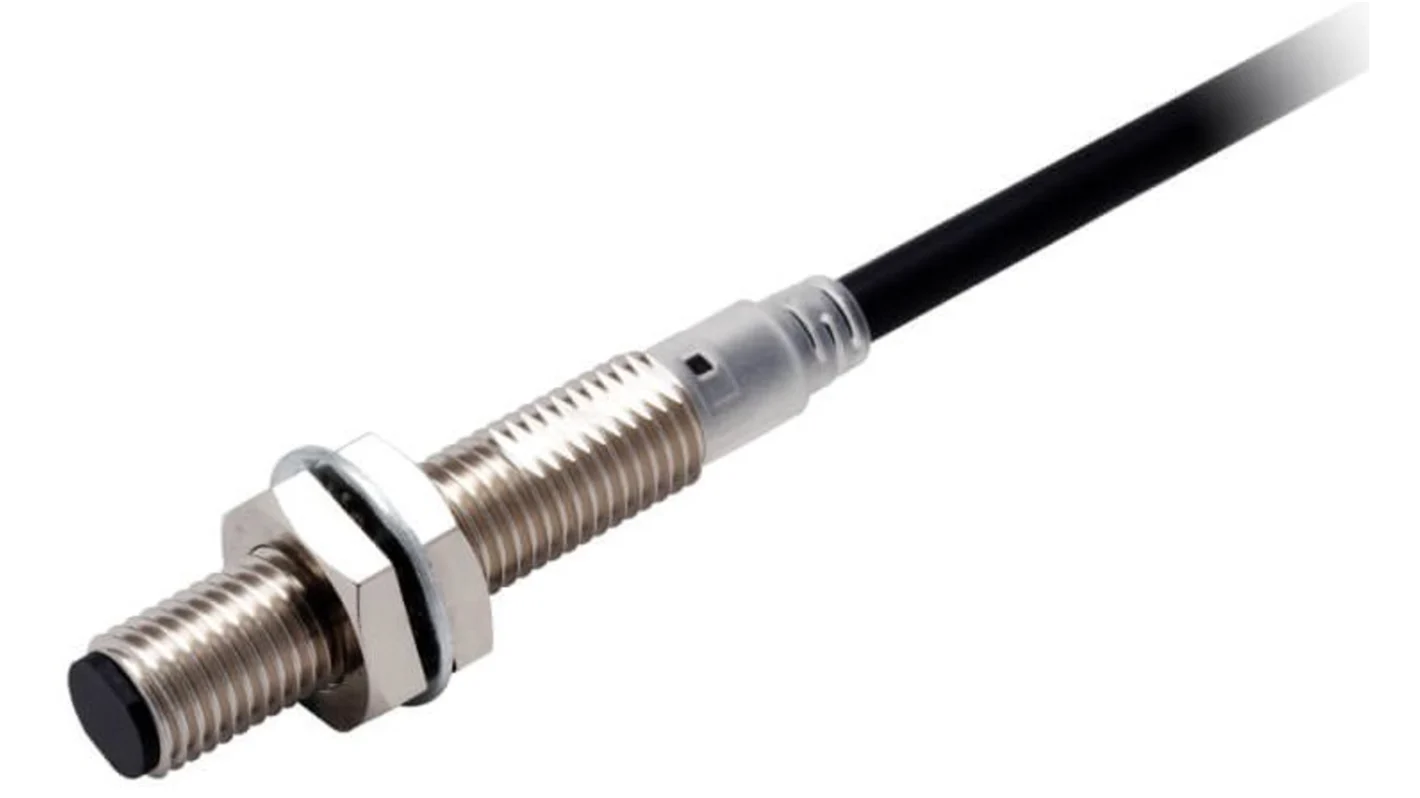
Omron E2E-X3B2L8-M3 Inductive Proximity Sensor
| Feature | Value |
|---|---|
| Sensor Type | Inductive Proximity Sensor |
| Series | E2E NEXT |
| Housing Size | M8 |
| Sensing Distance | 3 mm |
| Mounting Type | Quasi-flush (Shielded) |
| Output Type | PNP |
| Operation Mode | NC (Normally Closed) |
| Supply Voltage | 10 to 30 VDC |
| Connection Method | M8 4-pin Connector |
| Housing Material | Nickel-Plated Brass |
| Overall Length | 49 mm |
| Thread Length | 35 mm |
| Response Frequency | 1 kHz |
| Protection Rating | IP67 / IP69K |
| Operating Temperature | -25°C to +70°C |
The Omron E2E-X3B2L8-M3 Inductive Proximity Sensor is designed for reliable non-contact detection of metallic objects in industrial automation systems. As part of the E2E NEXT family, this sensor combines a compact M8 cylindrical housing with a 3 mm sensing range, making it suitable for installations where space is limited but consistent detection performance is required.
Its nickel-plated brass housing provides mechanical durability, while the IP67 and IP69K protection ratings allow operation in environments exposed to dust, moisture, washdown procedures, and industrial contaminants. The sensor utilizes a PNP normally closed output configuration and a standard M8 4-pin connector for straightforward integration into automation architectures.
Omron E2E-X3B2L8-M3 Technical Description
The Omron E2E-X3B2L8-M3 Inductive Proximity Sensor is a shielded inductive sensing device developed for detecting conductive metallic targets without physical contact. The quasi-flush mounting design allows installation in machinery where surrounding metal structures are present while maintaining stable sensing characteristics.
The sensor operates from a 10 to 30 VDC power supply and supports high-speed switching applications with a response frequency of up to 1 kHz. Its compact dimensions make it particularly suitable for robotic equipment, assembly fixtures, positioning mechanisms, and conveyor automation systems.
Working Principle
Like other inductive sensors, the Omron E2E-X3B2L8-M3 Inductive Proximity Sensor generates a high-frequency electromagnetic field at the sensing face. When a metallic object enters this field, eddy currents are induced within the target material.
The resulting energy loss alters the oscillation characteristics of the sensor circuit. Internal electronics detect this change and switch the output accordingly. Since no physical contact is required, the sensing process minimizes wear and contributes to long operational life.
This operating principle is particularly effective for steel, iron, and other conductive metals commonly found in manufacturing environments.
Typical Areas of Use
- Automated assembly stations
- Material handling systems
- Packaging equipment
- Robotic positioning systems
- Conveyor line monitoring
- Machine tool automation
- Transfer and indexing mechanisms
- Part presence verification systems
Because of its compact M8 design, the sensor can be installed close to moving machine elements where larger sensors may not fit.
Industrial Applications
Automotive Manufacturing
Production lines frequently use inductive sensors to verify metal component positioning before welding, fastening, or assembly operations. The Omron E2E-X3B2L8-M3 Inductive Proximity Sensor can support these verification processes by providing repeatable detection signals.
Packaging Machinery
Packaging systems often require monitoring of metallic actuators, guides, and machine positions. The sensor can detect moving mechanical components and provide status information to PLC-controlled systems.
Metal Processing Equipment
Machining centers, stamping machines, and metal fabrication equipment rely on proximity sensing for tool positioning and safety interlocks. The sensor’s robust construction supports operation in demanding industrial environments.
Automated Warehousing
Storage and retrieval systems use inductive sensors to monitor carrier positions, shuttle movements, and mechanical stops. Compact dimensions simplify installation in confined spaces.
Advantages
- Non-contact metal detection
- Compact M8 cylindrical design
- IP67 and IP69K environmental protection
- Durable nickel-plated brass housing
- Standard M8 connector interface
- Suitable for high-speed switching applications
- Reduced maintenance requirements
- Reliable operation in industrial environments
Omron E2E-X3B2L8-M3 Factors to Consider During Product Selection
When selecting an inductive proximity sensor, engineers should evaluate the target material, sensing distance requirements, output configuration, mounting conditions, and environmental exposure.
The Omron E2E-X3B2L8-M3 Inductive Proximity Sensor provides a 3 mm sensing distance and a PNP NC output. Therefore, compatibility with the PLC input architecture and control logic should be verified before implementation.
Applications involving frequent washdowns, coolant exposure, or airborne contaminants may benefit from the sensor’s IP69K-rated housing. Additional information about Omron sensor series can be useful when evaluating alternative sensing distances or output configurations.
Frequently Asked Questions
1. What type of objects can this sensor detect?
The sensor is designed to detect metallic objects using inductive sensing technology.
2. What is the nominal sensing distance?
The specified sensing distance is 3 mm.
3. Does the sensor require physical contact with the target?
No. Detection occurs through an electromagnetic field and does not require contact.
4. What output configuration does it use?
The device provides a PNP normally closed (NC) output.
5. Is the sensor suitable for washdown environments?
Yes. The IP67 and IP69K ratings support operation in environments exposed to water and cleaning procedures.
6. What connector type is used?
The sensor uses a standard M8 4-pin connector.
7. Where is this sensor commonly installed?
It is commonly installed in assembly machinery, conveyors, robotic systems, packaging equipment, and metal processing machines.
8. What is the benefit of the shielded design?
A shielded construction allows installation near surrounding metal structures while maintaining stable sensing performance.
9. What operating voltage is required?
The sensor operates with a DC supply voltage ranging from 10 VDC to 30 VDC.
10. Why is non-contact sensing important?
Non-contact operation reduces mechanical wear, minimizes maintenance requirements, and improves long-term reliability.