
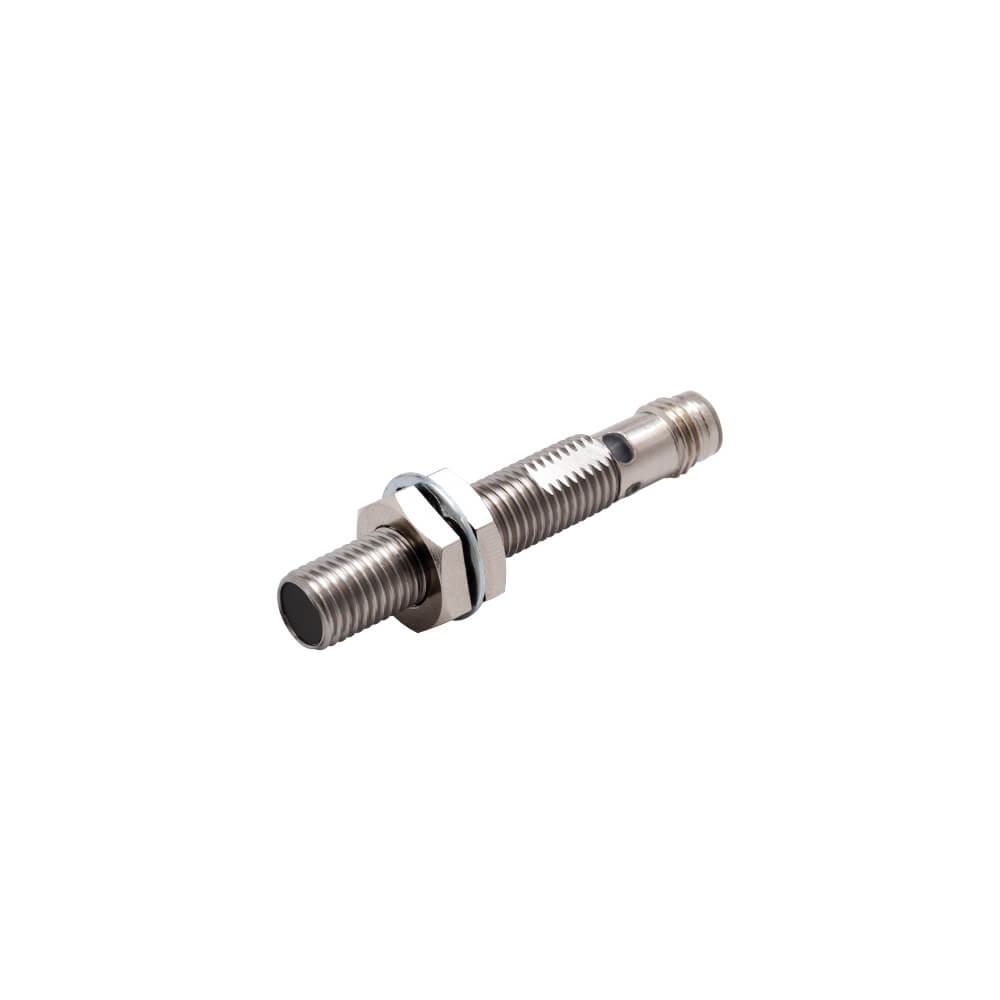
Omron E2E-X2C2L8-M3 Inductive Proximity Sensor
| Feature | Value |
|---|---|
| Sensor Type | Inductive Proximity Sensor |
| Series | E2E NEXT |
| Housing Diameter | M8 |
| Mounting Style | Flush (Shielded) |
| Sensing Distance | 2 mm |
| Output Configuration | NPN Normally Closed (NC) |
| Supply Voltage | 10 to 30 VDC |
| Connection Type | M12 Connector |
| Cable Length | 3 m Pre-wired Connector Cable |
| Response Frequency | 1.5 kHz |
| Housing Material | Stainless Steel |
| Protection Rating | IP67 / IP67G / IP69K |
| Operating Temperature | -25°C to +70°C |
| Thread Length | 36 mm |
| Overall Length | Approx. 46 mm |
Introduction to the Sensor
Modern automation systems frequently rely on compact sensing devices capable of detecting metallic objects with high repeatability. The Omron E2E-X2C2L8-M3 Inductive Proximity Sensor has been developed for such applications, combining a miniature cylindrical housing with robust environmental protection and stable switching performance.
As a member of the E2E NEXT sensor family, this model is intended for machine builders, system integrators, and maintenance engineers seeking reliable position monitoring and object detection within limited installation spaces. The sensor utilizes inductive technology, allowing contactless detection of metal targets while minimizing wear-related issues.
The Omron E2E-X2C2L8-M3 Inductive Proximity Sensor incorporates a 3-meter cable assembly connected through an M12 connector interface, offering flexibility in machine design and cable routing.
Technical Overview
This sensor features an M8 stainless-steel threaded housing and a rated sensing distance of 2 mm. Its shielded design allows flush installation inside metal machine structures while maintaining stable detection performance.
The NPN normally closed output configuration enables integration with various industrial control systems including PLCs, machine controllers, distributed I/O modules, and automation networks. The sensor operates within a voltage range of 10 to 30 VDC and supports switching frequencies up to 1.5 kHz.
Its durable construction and advanced sealing technology contribute to protection ratings of IP67, IP67G, and IP69K, supporting operation in environments exposed to moisture, dust, oils, and high-pressure washdown procedures.
Operating Principle
The Omron E2E-X2C2L8-M3 Inductive Proximity Sensor generates an electromagnetic field from its sensing face. When a metallic object enters this field, eddy currents are induced within the target material.
The interaction between the target and the electromagnetic field alters the oscillation characteristics of the sensor. Internal electronics continuously monitor these changes and trigger the output when the detection threshold is reached.
This method eliminates the need for mechanical contact between the sensor and the target object. As a result, the sensor can provide long-term operation with minimal maintenance requirements while maintaining consistent sensing performance.
Applications in Automation Systems
Compact inductive sensors are widely used throughout industrial automation due to their reliability and ease of integration. The Omron E2E-X2C2L8-M3 Inductive Proximity Sensor is suitable for numerous applications involving metallic object detection.
- Part presence verification
- Mechanical position sensing
- Conveyor system monitoring
- Automated assembly processes
- Transfer mechanism detection
- Industrial robotics
- Machine tool positioning
- Packaging line automation
The combination of compact dimensions and a 3-meter cable assembly makes this model useful when the control cabinet is located farther from the sensing point.
Industrial Application Examples
Metal Fabrication Facilities
Production equipment can use the sensor to verify workpiece positions before machining, punching, or forming operations begin.
Automated Packaging Lines
Packaging machinery often requires accurate monitoring of guide rails, actuators, and transfer mechanisms. Inductive sensors provide reliable position confirmation without physical contact.
Robotics and Material Handling
Robotic cells use proximity sensors to confirm gripper positions, detect tooling components, and monitor automated transfer equipment.
Assembly Automation
Production lines can implement the sensor to ensure metallic components are correctly positioned before subsequent assembly operations occur.
Advantages of the Sensor
- Compact M8 cylindrical housing
- Reliable non-contact metal detection
- High environmental protection ratings
- Flush mounting capability
- Stainless-steel construction
- Long 3-meter connection cable
- Fast switching response
- Suitable for demanding industrial environments
Additional information about related sensing technologies can be found within Omron sensor solutions used across industrial automation sectors.
Sector-Specific Usage Scenarios
Automotive Manufacturing
Detecting fixture positions and confirming metal part placement before automated assembly operations.
Warehouse Automation
Monitoring transfer stations and conveyor mechanisms within automated storage systems.
Machine Building
Providing reliable feedback from moving machine components and positioning mechanisms.
Industrial Processing
Supporting production systems that require dependable metal detection under varying environmental conditions.
Selection Considerations
When selecting an inductive proximity sensor, engineers should evaluate target material characteristics, installation requirements, sensing distance, output configuration, and environmental conditions.
The Omron E2E-X2C2L8-M3 Inductive Proximity Sensor is particularly suitable when a compact form factor and extended cable reach are required. Users should also verify controller compatibility with the NPN normally closed output design.
Environmental exposure, maintenance accessibility, and mounting constraints should be reviewed during the design phase to ensure optimal performance.
Frequently Asked Questions
1. What is the rated sensing distance?
The sensor provides a rated sensing distance of 2 mm.
2. Which output configuration is available?
This model uses an NPN normally closed output.
3. Can the sensor be mounted flush in metal?
Yes. Its shielded design supports flush mounting installations.
4. What connection method does it use?
The sensor uses an M12 connector with a 3-meter cable assembly.
5. What supply voltage is required?
The operating voltage range is 10 to 30 VDC.
6. Is the sensor suitable for washdown environments?
Yes. Protection ratings include IP67, IP67G, and IP69K.
7. What materials can be detected?
The sensor is designed to detect metallic targets.
8. What industries commonly use this sensor?
Automotive, logistics, machine building, robotics, packaging, and manufacturing industries commonly implement this model.
9. How does the Omron E2E-X2C2L8-M3 Inductive Proximity Sensor work?
It detects changes in an electromagnetic field caused by nearby metallic objects and switches its output accordingly.
10. Why is a 3-meter cable beneficial?
The longer cable provides additional installation flexibility when the sensor location is far from the control panel or I/O system.