
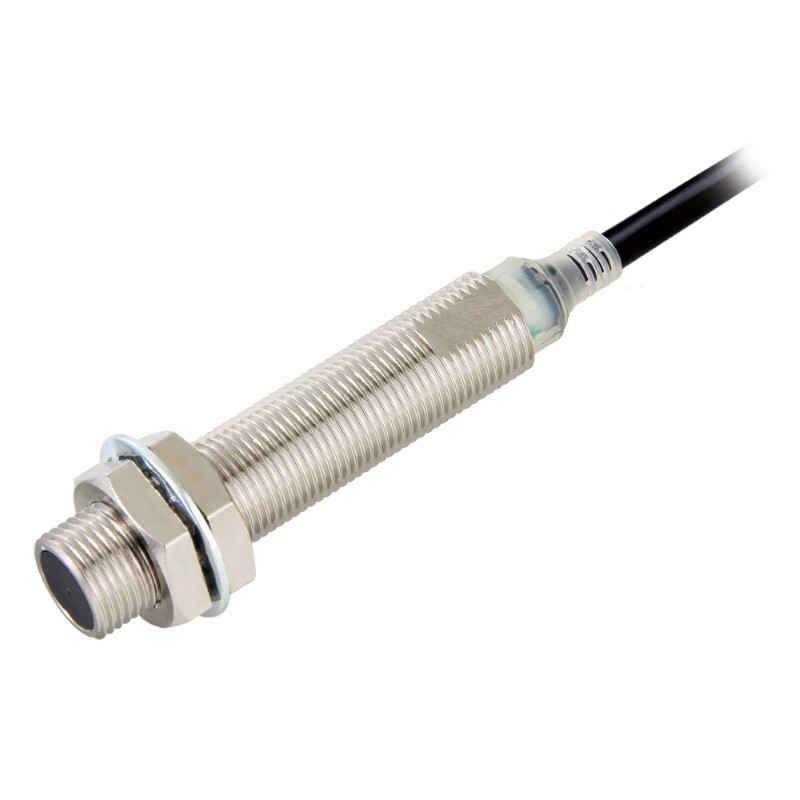
Omron E2E-X2C2L12 2M Inductive Proximity Sensor
| Feature | Value |
|---|---|
| Sensor Type | Inductive Proximity Sensor |
| Series | E2E NEXT |
| Sensing Distance | 2 mm |
| Housing Diameter | M8 |
| Mounting Style | Flush Shielded |
| Output Type | NPN |
| Operation Mode | NO |
| Supply Voltage | 10 to 30 VDC |
| Connection Type | 2 m Pre-wired Cable |
| Response Frequency | 1.5 kHz |
| Protection Rating | IP67 / IP69K |
| Housing Material | Stainless Steel |
| Operating Temperature | -25°C to +70°C |
| Cable Length | 2 m |
The Omron E2E-X2C2L12 2M Inductive Proximity Sensor is designed for precise non-contact detection of metallic objects in industrial automation systems. Its compact cylindrical housing and cable connection make it suitable for installations where connector space is limited or where direct wiring is preferred. The sensor belongs to the E2E NEXT family, a series developed for stable sensing performance under challenging environmental conditions.
Technical Description
The Omron E2E-X2C2L12 2M Inductive Proximity Sensor utilizes electromagnetic induction technology to detect metallic targets without requiring physical contact. The sensor incorporates an M8 threaded stainless-steel housing and a flush mounting design that allows installation within metallic machine structures.
The device provides a 2 mm sensing distance and an NPN normally open output. A factory-attached 2-meter cable simplifies integration into industrial control cabinets, machine frames, and distributed automation systems.
Because the sensor is protected to IP67 and IP69K standards, it can operate in environments exposed to dust, coolant splashes, moisture, and routine washdown procedures.
Operating Principle
The sensing face continuously generates a high-frequency electromagnetic field. When a metallic object enters this field, eddy currents are induced within the target material. These currents absorb energy from the oscillator circuit inside the sensor.
The internal electronics monitor changes in oscillator amplitude and switch the output once the predefined sensing threshold is reached. This non-contact detection method eliminates mechanical wear and supports long-term operational stability.
The Omron E2E-X2C2L12 2M Inductive Proximity Sensor is optimized for detecting ferrous and conductive metallic components commonly used in automated production systems.
Applications and Usage Areas
- Metal component presence detection
- Automated machine positioning
- Assembly line monitoring
- Industrial conveyor systems
- Pneumatic cylinder position verification
- Packaging machine automation
- Production line control systems
- Robotic handling equipment
The cable-connected design is particularly useful in installations where vibration or restricted access may complicate connector-based wiring.
Industrial Applications
Robotics and Automated Cells
Industrial robots frequently require confirmation of fixture positions and metal workpiece presence. Inductive sensors provide reliable feedback signals for process control.
Assembly Equipment
Assembly systems use proximity sensors to confirm component placement before automated fastening, pressing, or joining operations begin.
Material Transfer Systems
Transfer conveyors and automated handling systems employ sensors to verify carrier locations and machine stop positions.
Process Manufacturing
Production equipment uses inductive sensing technology to monitor mechanical movements and maintain repeatable machine cycles.
Advantages
- Compact M8 housing design
- Non-contact metal detection
- Integrated 2-meter cable connection
- Stainless-steel mechanical construction
- High environmental protection ratings
- Suitable for demanding industrial environments
- Fast switching response
- Reduced maintenance requirements
The Omron E2E-X2C2L12 2M Inductive Proximity Sensor offers stable detection performance while minimizing the effects of mechanical wear associated with contact-based sensing devices.
Sector-Specific Examples
In electronics manufacturing facilities, the sensor can monitor metal fixtures and tooling positions during assembly processes. In logistics centers, it can provide feedback for automated sorting equipment and transfer mechanisms.
Metal fabrication workshops often use the Omron E2E-X2C2L12 2M Inductive Proximity Sensor to verify machine component positions during cutting, forming, or handling operations.
Automated packaging facilities may integrate the sensor into machine frames to monitor moving assemblies and ensure repeatable operating sequences.
Factors to Consider During Sensor Selection
- Verify that the target material is metallic.
- Confirm the required sensing distance.
- Check compatibility with NPN control inputs.
- Evaluate cable routing requirements.
- Review environmental exposure conditions.
- Consider available installation space.
- Verify power supply compatibility.
Omron E2E-X2C2L12 2M Additional Omron Sensor Solutions
Engineers evaluating automation sensing technologies can explore Omron sensör ürünleri for additional inductive, photoelectric, and specialized industrial sensing solutions.
Omron E2E-X2C2L12 2M Frequently Asked Questions
What type of sensing technology does this product use?
It uses inductive sensing technology for non-contact detection of metallic targets.
What is the rated sensing distance?
The sensor provides a 2 mm sensing distance.
What output configuration is available?
The sensor uses an NPN normally open output.
Does the sensor include a cable?
Yes. It is supplied with a factory-attached 2-meter cable.
Can it detect plastic materials?
No. Inductive sensors are intended for metallic object detection.
What protection ratings are available?
The sensor is rated IP67 and IP69K.
Which industries commonly use this sensor?
Manufacturing, robotics, logistics, packaging, and machine-building industries commonly use inductive proximity sensors.
What supply voltage is required?
The operating voltage range is 10 to 30 VDC.
Why is a cable-connected sensor preferred in some applications?
A fixed cable can simplify installation in areas where connector access is limited or where vibration is present.