
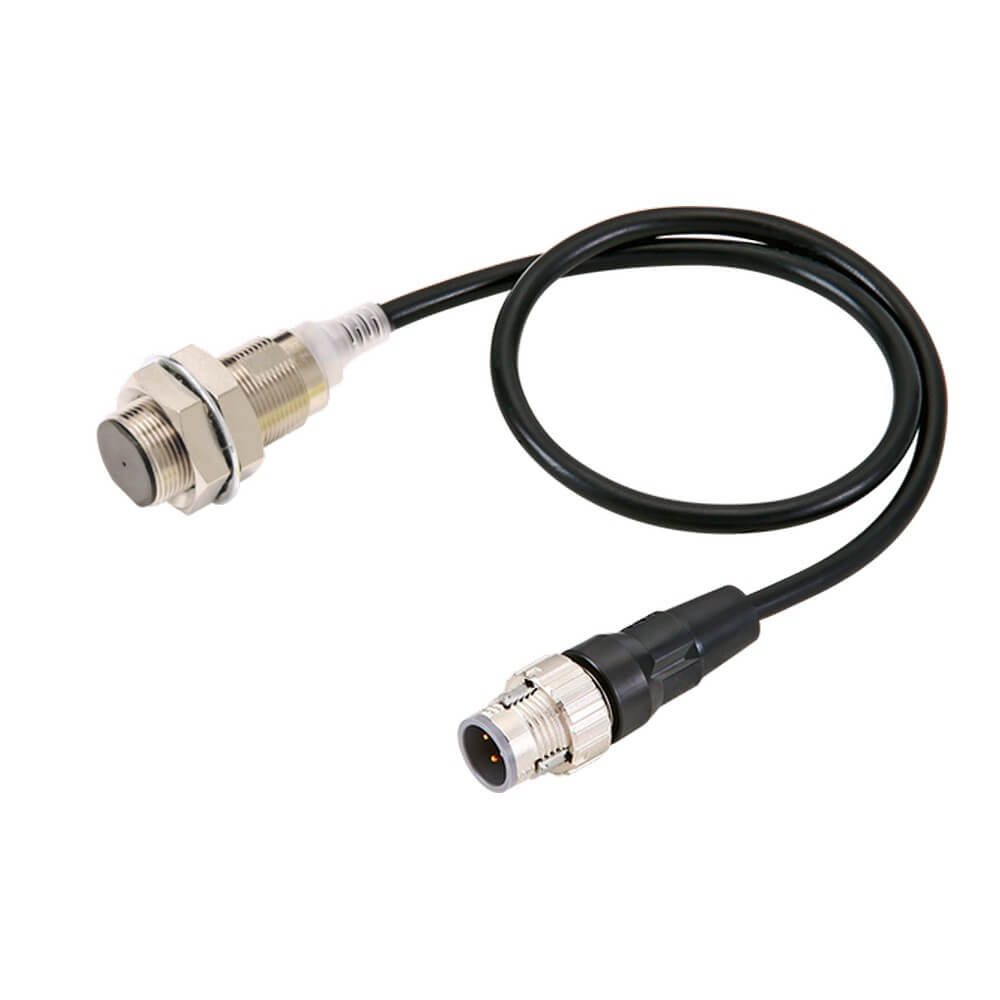
Omron E2E-X12B3D18-M1TJ 0.3M Inductive Proximity Sensor
| Specification | Value |
|---|---|
| Sensor Type | Inductive Proximity Sensor |
| Series | E2E NEXT |
| Housing Size | M18 |
| Mounting Type | Shielded |
| Sensing Distance | 12 mm |
| Output Type | PNP |
| Operation Mode | NO |
| Connection Method | 0.3 m Pigtail Cable with M12 Connector |
| Supply Voltage | 10 to 30 VDC |
| Response Frequency | 500 Hz |
| Housing Material | Nickel-Plated Brass |
| Protection Rating | IP67 / IP69K |
| Operating Temperature | -25°C to +70°C |
Technical Description
The Omron E2E-X12B3D18-M1TJ 0.3M Inductive Proximity Sensor is designed for industrial environments where reliable metallic object detection and flexible installation options are required. The sensor combines the sensing performance of the E2E NEXT family with a practical pigtail connection design that simplifies cable management inside machinery and automation systems.
Unlike conventional connector-only models, this version includes a short 0.3-meter cable section terminated with an M12 connector. This arrangement provides additional flexibility during installation while maintaining compatibility with standard industrial connector systems.
The Omron E2E-X12B3D18-M1TJ 0.3M Inductive Proximity Sensor features a shielded sensing structure and a nominal sensing distance of 12 mm. These characteristics support stable detection performance even when the sensor is installed near metallic machine components.
Its nickel-plated brass housing provides mechanical durability, while IP67 and IP69K protection ratings support operation in environments exposed to dust, moisture, washdown procedures, and industrial contaminants.
Operating Principle
The sensor generates a high-frequency electromagnetic field at the sensing face. When a conductive metallic object enters this field, eddy currents are induced within the target material.
These currents influence the oscillator circuit and cause measurable changes in the electromagnetic field. Internal electronics monitor these variations and activate the output when the sensing threshold is reached.
The non-contact sensing method eliminates mechanical wear and allows consistent operation during continuous industrial production cycles.
Usage Areas
- Industrial automation systems
- Robotic assembly cells
- Packaging equipment
- Conveyor monitoring systems
- Machine tool automation
- Material transfer equipment
- Warehouse automation systems
- Production machinery
Industrial Applications
Robotic Manufacturing
The sensor can verify the presence of metallic workpieces before robotic handling, assembly, or fastening operations begin.
Packaging Systems
Packaging machinery uses inductive sensors to monitor mechanical positions and ensure synchronized machine operation.
Automated Warehousing
Warehouse automation systems utilize proximity sensors to detect carrier positions and monitor automated transfer equipment.
Machine Building
Equipment manufacturers integrate sensors into machine frames to monitor actuator movements and process sequences.
Advantages
- 12 mm sensing distance
- Flexible pigtail cable connection
- M12 connector compatibility
- PNP normally open output
- Shielded sensing structure
- IP67 and IP69K protection ratings
- Reduced maintenance requirements
- Reliable non-contact detection
Sector-Specific Usage Examples
The Omron E2E-X12B3D18-M1TJ 0.3M Inductive Proximity Sensor can be used in robotic production cells to verify metal component positioning before automated manufacturing processes begin.
In logistics systems, the sensor can monitor transfer mechanisms and conveyor positions to support efficient material flow management.
The Omron E2E-X12B3D18-M1TJ 0.3M Inductive Proximity Sensor is also suitable for machine builders seeking flexible wiring solutions combined with connector-based maintenance advantages.
Engineers can review additional Omron sensor products for related automation applications.
Selection Considerations
When selecting an inductive sensor, factors such as installation constraints, cable routing requirements, sensing distance, environmental exposure, and electrical compatibility should be considered.
This model is particularly useful where a short cable section improves installation flexibility while retaining the convenience of M12 connectivity.
Frequently Asked Questions
1. What is the sensing distance?
The nominal sensing distance is 12 mm.
2. What output type does the sensor use?
The sensor provides a PNP normally open output.
3. What is the benefit of the pigtail connection?
It provides greater installation flexibility while maintaining M12 connector compatibility.
4. What voltage range is supported?
The sensor operates between 10 and 30 VDC.
5. What protection ratings are available?
The sensor is rated IP67 and IP69K.
6. Which materials can be detected?
The sensor is intended for conductive metallic targets.
7. Is the sensor suitable for automated machinery?
Yes. It is widely used in industrial automation systems.
8. Does the sensor require physical contact?
No. Detection is performed through electromagnetic induction.
9. Which industries commonly use this model?
Automotive, logistics, packaging, manufacturing, and machine-building industries.
10. Why choose a shielded sensing design?
It helps maintain a controlled sensing field and reduces interference from surrounding metal structures.