
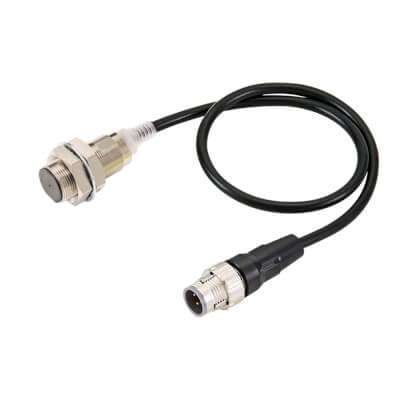
Omron E2E-X14B1T18-M1 Inductive Proximity Sensor
| Feature | Value |
|---|---|
| Sensor Type | Inductive Proximity Sensor |
| Series | E2E NEXT |
| Sensing Distance | 14 mm |
| Housing Size | M18 |
| Mounting Type | Quasi-Flush (Shielded) |
| Output Type | PNP Normally Open (NO) |
| Communication | IO-Link COM3 (230.4 kbps) |
| Supply Voltage | 10 to 30 VDC |
| Connection Method | M12 Connector |
| Housing Material | Nickel-Plated Brass |
| Response Frequency | 350 Hz |
| Protection Rating | IP67 / IP69K |
| Operating Temperature | -25°C to +70°C |
| Overall Length | 53 mm |
| Thread Length | 33 mm |
Technical Overview
The Omron E2E-X14B1T18-M1 Inductive Proximity Sensor is designed for non-contact detection of metallic targets in industrial automation environments. Built within the E2E NEXT family, this sensor combines extended sensing performance, digital communication capability, and a compact M18 threaded housing. The device incorporates IO-Link COM3 communication, enabling access to diagnostic information and sensor parameterization within modern automation architectures.
Its 14 mm sensing distance allows reliable detection while providing additional installation flexibility compared with conventional inductive sensors. The nickel-plated brass housing offers mechanical durability for demanding industrial applications, while the IP67 and IP69K protection ratings support operation in environments exposed to moisture, dust, and frequent washdown procedures. The Omron E2E-X14B1T18-M1 Inductive Proximity Sensor is frequently integrated into automated production systems where stable metal detection is required.
Working Principle
The sensor operates using an electromagnetic field generated at the sensing face. When a conductive metallic object enters the sensing zone, eddy currents are induced within the target material. These currents affect the oscillation characteristics of the sensor’s internal circuit, allowing the device to identify the presence of the object.
Once detection occurs, the PNP normally open output changes state and communicates the signal to a PLC, industrial controller, or IO-Link master. Through IO-Link communication, process values and diagnostic information can also be exchanged with higher-level control systems.
Key Features and Functional Characteristics
- 14 mm sensing distance for metallic target detection
- Shielded construction for controlled sensing zones
- PNP normally open switching output
- IO-Link COM3 communication capability
- M12 connector interface for simplified installation
- Nickel-plated brass housing for industrial durability
- IP67 and IP69K environmental protection
- 350 Hz response frequency for dynamic applications
Typical Areas of Use
The Omron E2E-X14B1T18-M1 Inductive Proximity Sensor is used in applications where metallic components must be detected without physical contact. It can be integrated into assembly lines, machine tools, robotic workstations, and conveyor systems.
- Metal component presence verification
- Position monitoring on automated machinery
- Transfer line detection points
- Automated packaging equipment
- Material handling systems
- Robotic end-effector positioning
- Fixture and tooling confirmation
Industrial Applications
Automotive Manufacturing
Production lines often require confirmation of metal brackets, fasteners, and structural components before assembly operations continue. The sensor can be installed at transfer stations to verify part presence and positioning.
Machine Building
Equipment manufacturers use inductive sensors to monitor moving machine elements, indexing mechanisms, and actuator positions while maintaining non-contact operation.
Packaging Systems
The sensor can monitor metallic machine components and mechanical positions throughout filling, sealing, and transport processes.
Material Handling
Conveyor-based transport systems frequently require accurate position feedback of carriers, pallets, and metallic transport fixtures.
Advantages
- Reliable detection independent of surface color and lighting conditions
- Reduced mechanical wear due to non-contact sensing
- Integration with Industry 4.0 infrastructures through IO-Link
- Enhanced environmental resistance with IP67/IP69K protection
- Compact installation within M18 mounting locations
- Stable operation across a wide industrial temperature range
Industry-Specific Use Cases
In automotive body assembly facilities, the sensor can verify the arrival of metal carriers before robotic welding operations begin. In food processing equipment, its high ingress protection allows use in washdown environments where machine positions must be monitored. Within logistics automation systems, it can detect metallic transport elements moving through conveyor networks. In CNC machining centers, it may be applied for fixture verification and workpiece presence monitoring.
Selection Considerations
When selecting an inductive proximity sensor, engineers should evaluate sensing distance, mounting configuration, target material, communication requirements, environmental protection, and controller compatibility. Applications requiring digital diagnostics and parameter management may benefit from the IO-Link functionality available in the Omron E2E-X14B1T18-M1 Inductive Proximity Sensor.
For additional product families and sensing technologies, see Omron sensor product ranges.
Frequently Asked Questions
1. What type of sensor is the Omron E2E-X14B1T18-M1 Inductive Proximity Sensor?
It is a shielded inductive proximity sensor designed for non-contact detection of metallic objects.
2. What is the sensing distance?
The rated sensing distance is 14 mm.
3. Which output configuration does the sensor provide?
The sensor features a PNP normally open (NO) output.
4. Does the sensor support industrial communication?
Yes. It supports IO-Link COM3 communication with a baud rate of 230.4 kbps.
5. What protection ratings are available?
The device is rated IP67 and IP69K for demanding industrial environments.
6. Which industries commonly use this sensor?
Automotive manufacturing, machine building, logistics automation, packaging, and material handling industries frequently use this model.
7. What is the operating temperature range?
The sensor operates between -25°C and +70°C.
8. How is the sensor connected?
Connection is achieved through an M12 industrial connector interface.
9. Can it detect non-metallic objects?
No. Inductive sensing technology is intended primarily for conductive metallic targets.
10. What benefits does IO-Link provide?
IO-Link enables parameter configuration, diagnostics, device identification, and process monitoring through compatible automation systems.