
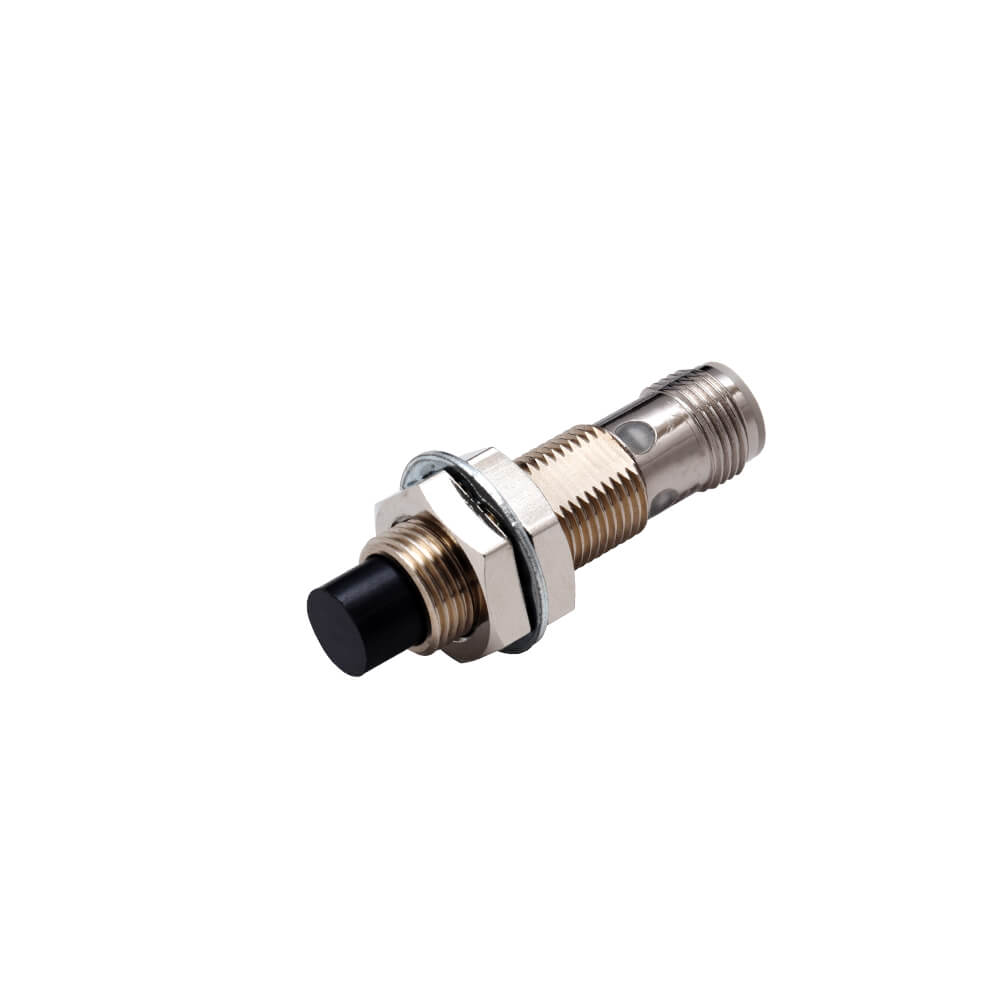
Omron E2E-X10MB212-M1 Inductive Proximity Sensor
| Feature | Value |
|---|---|
| Manufacturer | Omron |
| Product Series | E2E NEXT |
| Product Type | Inductive Proximity Sensor |
| Model | E2E-X10MB212-M1 |
| Housing Size | M12 |
| Mounting Type | Non-flush |
| Sensing Distance | 10 mm |
| Output Type | PNP |
| Operation Mode | NC |
| Connection Method | M12 Connector |
| Housing Material | Nickel-Plated Brass |
| Power Supply | DC 3-wire |
| Degree of Protection | IP67 / IP69K |
| IO-Link Function | Not Applicable |
Technical Description
The Omron E2E-X10MB212-M1 Inductive Proximity Sensor is a DC 3-wire inductive sensor developed for detecting metallic objects without physical contact. It uses an M12 cylindrical threaded body, non-flush mounting structure, 10 mm sensing distance, PNP output, and NC operation mode. The M12 connector configuration is especially useful in systems where fast replacement, modular wiring, and structured maintenance procedures are required.
This sensor belongs to the E2E NEXT series and is built with a nickel-plated brass housing. Its compact short-body construction supports installation in automated machines where available space is limited. The Omron E2E-X10MB212-M1 Inductive Proximity Sensor is suitable for control panels, conveyor frames, indexing mechanisms, actuator position checks, and machine condition monitoring points that require stable metallic target detection.
Working Principle
The sensor creates an electromagnetic field at the sensing face. When a conductive metal target enters this field, eddy currents are generated in the object. These eddy currents change the oscillation condition inside the sensor circuit. The internal electronics interpret this change and switch the output signal.
Because the operating principle does not require contact with the target, the sensor avoids the mechanical wear associated with limit switches. This makes it suitable for repetitive detection tasks in automated production equipment, where thousands of cycles may occur during a single shift.
Usage Areas
- Metal part presence detection
- Actuator end-position monitoring
- Conveyor stop position control
- Rotary table indexing confirmation
- Machine door or fixture position sensing
- Metal carrier and pallet detection
- Assembly station feedback
- Automated handling equipment
For related sensing technologies, engineers may also review Omron sensor products used in industrial automation systems.
Industrial Applications
Automated Assembly Equipment
In assembly machines, the sensor can confirm whether a metal fixture has reached its intended position before the next process step begins. This helps prevent incorrect sequencing in pneumatic, hydraulic, or servo-driven mechanisms.
Material Handling Systems
The M12 connector version is practical for conveyor modules and transfer units where sensors may need to be replaced during scheduled maintenance. Connector wiring reduces downtime compared with hardwired sensor replacement.
Machine Tool Monitoring
The sensor can be used to detect the position of metallic slides, clamps, guards, or tool-changing components. Its non-contact design helps maintain signal consistency in applications where vibration and repeated movement are present.
Packaging Machinery
Packaging systems often rely on compact sensors for detecting metal cams, machine stops, or positioning elements. The 10 mm sensing distance provides a useful detection margin when exact mechanical alignment may vary slightly during operation.
Advantages
- Non-contact sensing reduces mechanical wear
- M12 connector supports fast replacement
- PNP NC output is suitable for many industrial control inputs
- Nickel-plated brass housing supports industrial installation
- 10 mm sensing distance provides practical installation tolerance
- IP67 and IP69K protection support demanding environments
- Short-body design helps in space-limited machinery
- Stable metallic object detection in repetitive automation tasks
Sector-Specific Usage Examples
In automotive component production, the sensor may detect whether a metal jig is locked before a press cycle starts. In intralogistics systems, it can identify the arrival of metal carriers at transfer points. In machine building, it can provide feedback from mechanical stops, cylinder rods, or indexing plates. In packaging equipment, it may monitor rotating machine elements used for timing and position confirmation.
Selection Considerations
Before selecting the Omron E2E-X10MB212-M1 Inductive Proximity Sensor, the control architecture and mechanical installation conditions should be checked carefully. The PLC input must be compatible with PNP NC output logic. The target must be metallic, and the mounting environment must allow a non-flush M12 sensor installation.
- Confirm that the application requires PNP NC output.
- Check whether the machine uses M12 connector wiring.
- Verify that the target material is suitable for inductive detection.
- Provide correct mounting clearance for a non-flush sensor.
- Review environmental exposure, including moisture, oil, and washdown conditions.
- Confirm that the 10 mm sensing distance matches the mechanical design.
- Use compatible connector cables for reliable signal transmission.
- Inspect cable routing to reduce stress on the connector area.
Frequently Asked Questions
What does the Omron E2E-X10MB212-M1 Inductive Proximity Sensor detect?
It detects conductive metallic objects using inductive sensing technology.
What is the sensing distance of this model?
The specified sensing distance is 10 mm.
What output type does the sensor use?
It uses a PNP output with NC operation mode.
What is the main benefit of the M12 connector version?
The M12 connector allows faster replacement and cleaner modular wiring compared with a permanently attached cable.
Can this sensor detect plastic or glass?
No. Inductive sensors are intended for metallic targets and do not detect non-conductive materials directly.
Where is this sensor commonly installed?
It is commonly installed on conveyors, assembly machines, transfer units, machine tools, and automated handling equipment.
Is the sensor suitable for wet industrial environments?
The IP67 and IP69K ratings support use in demanding environments when the sensor is installed with compatible connector hardware.
What should be checked before installation?
Engineers should verify mounting clearance, target material, PLC input compatibility, connector type, and environmental conditions.
Does the sensor require frequent maintenance?
Maintenance is generally limited to checking the sensing face, connector tightness, cable condition, and mounting stability.