
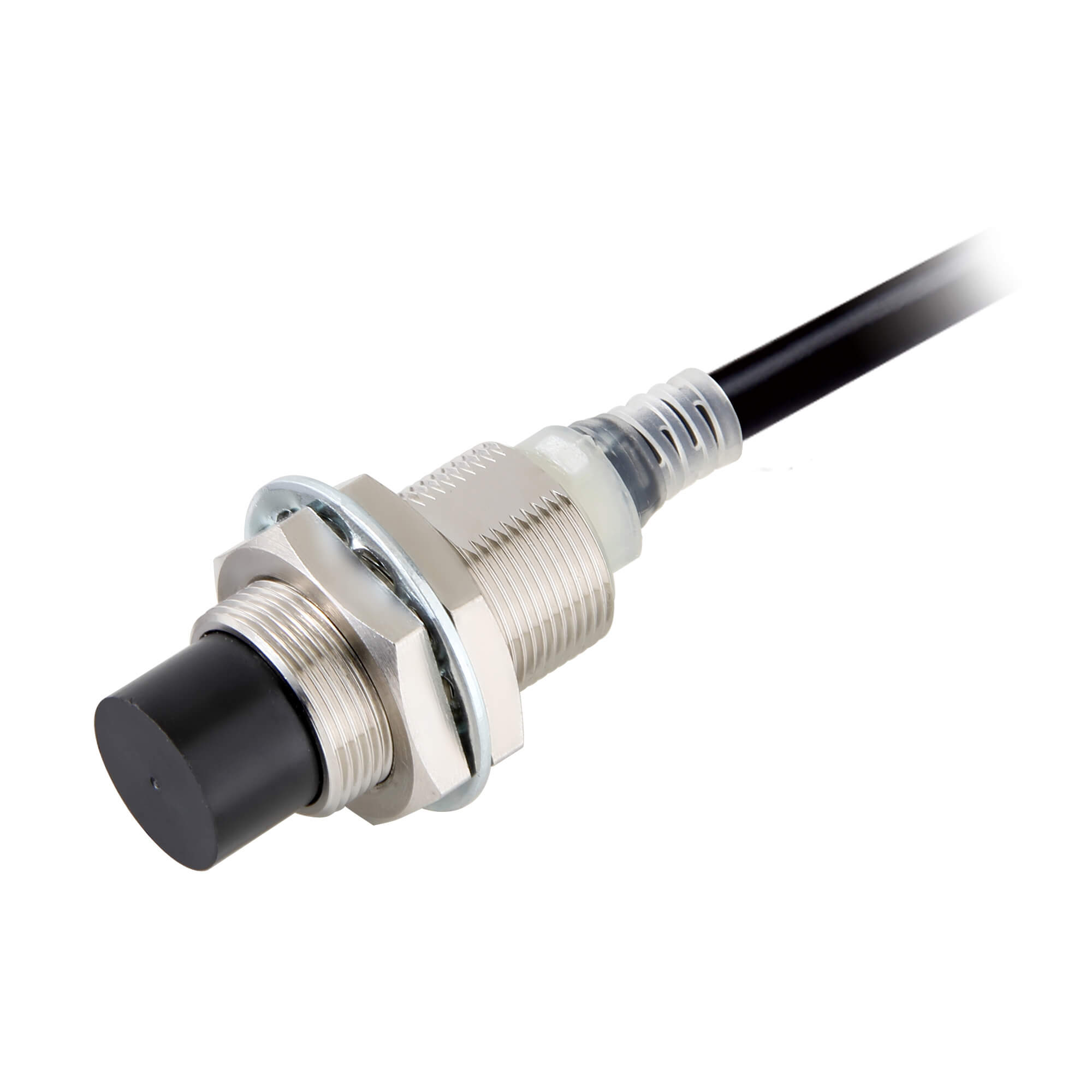
Omron E2E-X10MB218 Inductive Proximity Sensor Series
| Feature | Value |
|---|---|
| Manufacturer | Omron |
| Series | E2E NEXT |
| Sensor Type | Inductive Proximity Sensor |
| Housing Diameter | M12 Threaded Cylindrical |
| Mounting Style | Non-flush (Unshielded) |
| Sensing Distance | 10 mm |
| Output Type | NPN |
| Operation Mode | Normally Open (NO) |
| Supply Voltage | 10 to 30 VDC |
| Response Frequency | 400 Hz |
| Housing Material | Nickel-Plated Brass |
| Protection Rating | IP67 / IP67G / IP69K |
| Operating Temperature | -25°C to +70°C |
| Connection Versions | 2 m Cable, 5 m Cable, M12 Connector |
Technical Description
The Omron E2E-X10MB218 Inductive Proximity Sensor family is designed for reliable detection of metallic objects in industrial automation systems. This product group includes E2E-X10MB218 2M, E2E-X10MB218 5M, and E2E-X10MB218-M1 variants, offering different connection options for diverse installation requirements.
As part of the E2E NEXT series, these sensors incorporate Omron’s advanced inductive sensing technology to provide stable switching performance in environments where mechanical switches may be exposed to wear, contamination, or vibration. The sensor’s non-flush construction allows a longer sensing range while maintaining consistent detection characteristics.
Operating Principle
The Omron E2E-X10MB218 Inductive Proximity Sensor creates an electromagnetic field around the sensing face. When a conductive metal target enters this field, induced eddy currents alter the oscillator characteristics inside the sensor. The electronic circuit detects this change and switches the output accordingly.
Because the sensing process occurs without physical contact, the sensor eliminates mechanical wear associated with traditional limit switches. This operating principle contributes to long-term reliability in repetitive industrial processes.
The Omron E2E-X10MB218 Inductive Proximity Sensor utilizes an NPN normally open output configuration, making it compatible with a wide range of PLCs, controllers, and industrial input modules.
Main Features
- 10 mm sensing distance
- M12 cylindrical threaded housing
- NPN normally open output
- Non-flush mounting design
- IP67, IP67G, and IP69K protection ratings
- 400 Hz response frequency
- Visible operating status indicator
- Industrial-grade nickel-plated brass housing
- Available in cable and connector versions
- Designed for demanding factory environments
Typical Usage Areas
The E2E-X10MB218 series is commonly implemented in systems requiring dependable metal object detection and position monitoring.
- Automated conveyor systems
- Machine tool positioning
- Material transfer equipment
- Automated packaging lines
- Industrial robotics
- Pallet transport systems
- Metal component detection
- Assembly process monitoring
Engineers evaluating additional sensing technologies can review Omron sensor series for related automation applications.
Industrial Applications
Warehouse Automation
The sensor can verify the arrival of steel carriers, automated transfer carts, and mechanical positioning devices used in distribution centers and storage facilities.
Packaging Equipment
Packaging machinery often requires accurate position feedback from moving assemblies. The sensor provides reliable metal target detection without requiring physical contact.
Manufacturing Cells
Production stations use inductive sensors to confirm fixture positions, detect machine states, and monitor automated movement sequences.
Metal Processing Operations
In machining and fabrication environments, the sensor can detect workpiece carriers, machine components, and transfer mechanisms while resisting exposure to industrial contaminants.
Advantages in Automation Systems
- Non-contact sensing minimizes wear
- Suitable for high-cycle industrial processes
- Stable detection performance
- Flexible installation options
- High environmental protection ratings
- Reduced maintenance compared to mechanical devices
- Compatibility with modern control architectures
Sector-Specific Examples
In logistics facilities, the sensor may be installed to monitor metal shuttle positioning. In pharmaceutical packaging systems, it can verify machine component movement. In automotive component production, it may detect fixture locations before automated assembly operations begin. In industrial assembly equipment, it can monitor actuator positions throughout a production cycle.
Important Selection Criteria
Selecting the correct model requires evaluation of both electrical and mechanical requirements.
- Required output type
- Control system compatibility
- Available mounting space
- Environmental exposure conditions
- Required cable length
- Maintenance accessibility
- Target material characteristics
- Installation geometry
Applications that require rapid replacement may benefit from the E2E-X10MB218-M1 connector version. Fixed installations often utilize the E2E-X10MB218 2M or E2E-X10MB218 5M cable configurations.
Omron E2E-X10MB218 Frequently Asked Questions
What type of object can this sensor detect?
The sensor is designed to detect conductive metallic targets using inductive sensing technology.
What is the rated sensing distance?
The nominal sensing distance is 10 mm.
Which output type is provided?
The sensor uses an NPN normally open output configuration.
Can it be used in washdown environments?
Its IP67, IP67G, and IP69K protection ratings support installation in applications requiring high levels of environmental protection.
What connection options are available?
The series is available with 2 m cable, 5 m cable, and M12 connector configurations.
What industries commonly use this sensor?
It is widely used in manufacturing, logistics, packaging, machine building, and automated material handling systems.
How does the sensing technology work?
The sensor detects changes in an electromagnetic field caused by nearby metallic objects and converts those changes into an electrical switching signal.
What housing material is used?
The sensor body is constructed from nickel-plated brass for industrial durability.
Does the sensor require regular maintenance?
Routine maintenance generally consists of inspection, cleaning, and verification of electrical connections and mounting integrity.