
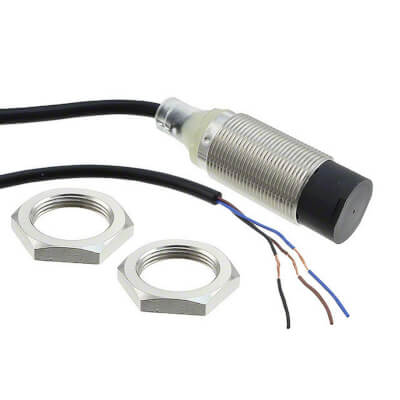
Omron E2B-M18KN16-WP-C1 5M Inductive Proximity Sensor
| Feature | Value |
|---|---|
| Sensor Type | Inductive Proximity Sensor |
| Series | E2B |
| Housing Size | M18 |
| Mounting Type | Non-flush (Unshielded) |
| Sensing Distance | 16 mm |
| Output Type | NPN |
| Operation Mode | Normally Open (NO) |
| Connection Method | 5 m PVC Cable |
| Supply Voltage | 10 to 30 VDC |
| Response Frequency | 400 Hz |
| Housing Material | Nickel-Plated Brass |
| Protection Rating | IP67 |
| Operating Temperature | -25°C to 70°C |
| Overall Length | 56 mm |
| Thread Length | 26 mm |
Technical Overview
The Omron E2B-M18KN16-WP-C1 5M Inductive Proximity Sensor is designed for non-contact detection of metallic targets in industrial automation systems. Built with an M18 threaded nickel-plated brass housing, this sensor provides a 16 mm sensing distance and utilizes an NPN normally open output configuration. The device belongs to the E2B series, which is developed for reliable operation in standard industrial environments requiring dependable position monitoring and object detection.
Its unshielded sensing design allows a longer detection range compared to flush-mounted alternatives. The integrated 5-meter cable simplifies installation where control panels and input modules are positioned away from sensing points. The sensor housing and sealing structure provide IP67 protection, enabling operation in environments exposed to dust and water splashes.
Working Principle
The Omron E2B-M18KN16-WP-C1 5M Inductive Proximity Sensor operates by generating an electromagnetic field at the sensing face. When a conductive metal object enters this field, eddy currents are induced within the target material. These currents alter the oscillator characteristics inside the sensor.
The internal detection circuit continuously monitors these changes and activates the NPN output once the target reaches the specified sensing range. Because detection occurs without physical contact, mechanical wear is minimized and long-term operational stability can be maintained.
Key Features and Construction
- M18 cylindrical threaded housing
- 16 mm sensing distance
- Non-flush installation design
- NPN normally open output
- 10 to 30 VDC operating voltage
- 400 Hz response frequency
- Nickel-plated brass construction
- IP67 environmental protection
- 5 m PVC cable connection
- Operating temperature range from -25°C to 70°C
Typical Applications
The Omron E2B-M18KN16-WP-C1 5M Inductive Proximity Sensor is commonly used in automation systems where reliable metal object detection is required. Its sensing distance and robust construction make it suitable for continuous operation in production facilities.
- Position detection on conveyor systems
- Machine tool position monitoring
- Automated assembly equipment
- Material transfer systems
- Packaging machinery
- Pallet handling equipment
- Metal component counting systems
- Industrial gate and actuator position sensing
Industrial Applications
Manufacturing facilities often require sensors capable of detecting metallic machine components without physical contact. The Omron E2B-M18KN16-WP-C1 5M Inductive Proximity Sensor is frequently integrated into automated production cells where moving mechanical parts must be monitored with repeatable accuracy.
In packaging operations, the sensor can verify machine positions before product transfer sequences begin. In material handling systems, it can monitor the location of carriers, lifting mechanisms, or metal fixtures. The sensor is also suitable for assembly lines where automated equipment requires position feedback from metal targets.
Additional Omron sensing technologies can be explored through Omron sensor product ranges for applications requiring different sensing distances, housing sizes, or output configurations.
Advantages
- Non-contact detection reduces mechanical wear
- Long 16 mm sensing distance for flexible installation
- IP67 protection supports industrial environments
- Robust nickel-plated brass housing
- Extended 5 m cable simplifies wiring layouts
- Suitable for high-cycle automation processes
- Reliable metal target detection
- Compact M18 mounting format
Omron E2B-M18KN16-WP-C1 5M Industry-Specific Examples
Automotive Manufacturing
The Omron E2B-M18KN16-WP-C1 5M Inductive Proximity Sensor can monitor fixture positions and metal component transfer stations in automated assembly lines.
Packaging Industry
Packaging equipment can utilize the sensor for detecting machine positions, indexing mechanisms, and metallic guide components.
Material Handling Facilities
Conveyor-based logistics systems frequently employ proximity sensors to verify carrier locations and transfer points.
General Machinery
Industrial machinery often relies on sensors such as the Omron E2B-M18KN16-WP-C1 5M Inductive Proximity Sensor for position confirmation and motion sequence control.
Considerations When Selecting a Proximity Sensor
- Required sensing distance
- Target material characteristics
- Output type compatibility
- Available mounting space
- Environmental protection requirements
- Cable length requirements
- Response speed requirements
- Control system input specifications
Omron E2B-M18KN16-WP-C1 5M Frequently Asked Questions
What type of targets can this sensor detect?
The sensor is designed for detecting metallic objects through inductive sensing technology.
What is the sensing distance?
The rated sensing distance is 16 mm under specified operating conditions.
Does the sensor require physical contact with the target?
No. Detection occurs without contact through an electromagnetic sensing field.
What output configuration does it use?
The device provides an NPN normally open output.
What voltage range is supported?
The operating voltage range is 10 to 30 VDC.
Can it be used in dusty environments?
Yes. The IP67 protection rating helps protect against dust ingress and temporary water exposure.
What is the cable length?
The sensor is supplied with a 5-meter PVC cable.
Where is the Omron E2B-M18KN16-WP-C1 5M Inductive Proximity Sensor typically installed?
It is commonly installed in automation equipment, conveyor systems, machine tools, packaging machinery, and material handling systems.
What is the benefit of a non-flush mounting design?
A non-flush design enables a longer sensing distance compared with many flush-mounted inductive sensors.
What housing material is used?
The sensor housing is manufactured from nickel-plated brass for mechanical durability in industrial environments.