
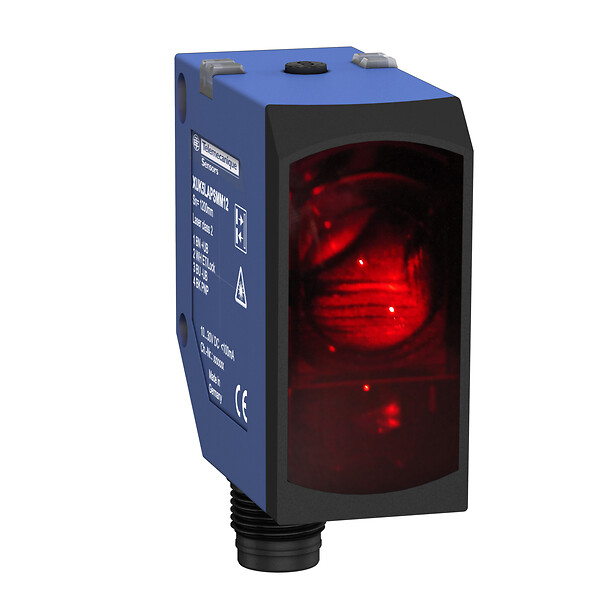
Telemecanique XUK5LAPSMM12 Laser Photoelectric Sensor Technical Guide
The Telemecanique XUK5LAPSMM12 laser photoelectric sensor is part of the widely used XUK compact sensor family developed for industrial automation systems requiring precise object detection and stable optical sensing performance. The sensor combines compact housing dimensions with laser-based optical technology, making it suitable for applications where accurate alignment and dependable long-distance sensing are important.
Technical Features of XUK5LAPSMM12
The XUK5LAPSMM12 is designed as a laser photoelectric sensor for industrial machine automation. Manufacturer references identify this model as part of the XUK sensor series using a compact rectangular housing format with M12 connectivity for simplified installation and maintenance.
Laser-based sensing provides a narrow and focused beam compared with conventional LED optical sensors. In industrial environments, this can improve small-object detection performance and support more accurate positioning on conveyor systems, assembly equipment, packaging lines, and automated production machines.
The sensor operates on DC voltage commonly used in industrial control systems and is compatible with PLC-controlled automation environments. The compact body allows installation in machinery with limited available space while still maintaining strong optical performance.
Industrial Applications
The Telemecanique XUK5LAPSMM12 laser photoelectric sensor is frequently used in packaging equipment, material handling systems, pallet conveyors, robotic cells, automated storage systems, and industrial transfer lines. Laser photoelectric sensing is especially valuable when production systems require consistent detection over controlled distances.
Because the beam is concentrated, the sensor can help improve repeatability in environments where standard diffuse sensing may struggle with inconsistent target reflection. Industries including logistics, food processing, automotive manufacturing, and electronics assembly often use laser photoelectric technology for precision automation tasks.
Installation Recommendations
Correct installation is important for reliable performance. The sensor should be mounted securely on a rigid bracket to minimize vibration. Optical alignment should be checked during commissioning, especially when the sensing distance is extended.
The sensing face should remain clean during operation because dust or contamination can reduce optical efficiency. Cable routing should avoid high electromagnetic interference areas whenever possible. Using proper shielding and stable power supply conditions can improve long-term reliability.
More industrial automation information is available through Telemecanique.
Performance Advantages
One of the major advantages of the XUK5LAPSMM12 is its compact design combined with laser precision. Machine builders often select laser photoelectric sensors when applications involve narrow detection areas, small components, or repeatable object positioning.
In high-speed automation systems, stable signal response is important for reducing false detections and improving process consistency. Laser technology can help improve detection reliability when aligned correctly and used within the rated sensing conditions.
Telemecanique XUK5LAPSMM12 (FAQ)
What is the Telemecanique XUK5LAPSMM12 used for?
It is used for industrial object detection in automation systems such as conveyors, packaging equipment, robotic cells, and assembly machines.
Does XUK5LAPSMM12 use laser sensing technology?
Yes. This model belongs to the laser photoelectric sensor category within the XUK series.
Why are laser photoelectric sensors preferred in automation?
Laser sensors provide a more focused optical beam, which can support precise detection and stable positioning performance in demanding applications.
Is the XUK5LAPSMM12 suitable for compact machinery?
Yes. Its compact rectangular housing is designed for industrial machines where installation space is limited.
Can this sensor work with PLC systems?
Yes. It is designed for industrial DC automation environments and is commonly integrated into PLC-controlled systems.