
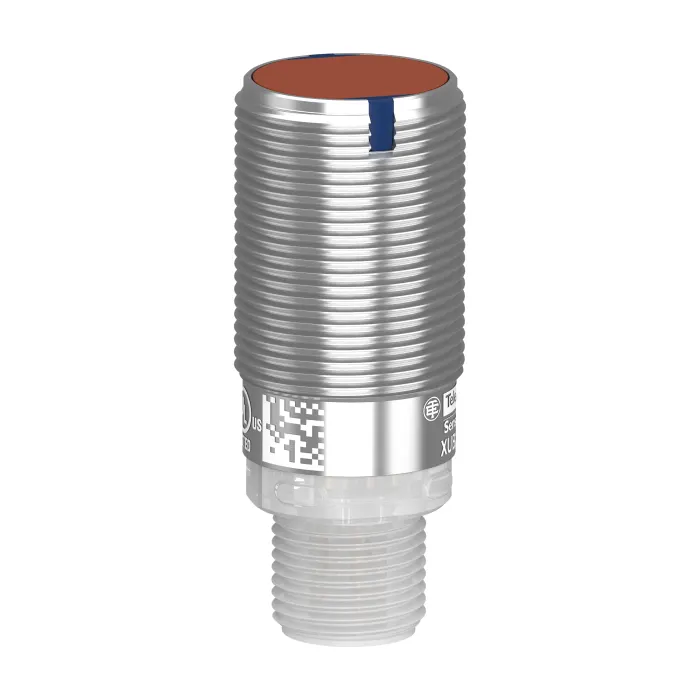
Telemecanique XUB2BKXNM12T Photoelectric Sensor: Technical Overview
The Telemecanique XUB2BKXNM12T photoelectric sensor is a thru-beam photoelectric transmitter designed for industrial detection tasks requiring long sensing distance, compact installation, and convenient connector-based wiring. It belongs to the Telemecanique XU range and is commonly used with a compatible receiver in automation systems.
Product Type and Operating Method
The XUB2BKXNM12T functions as a transmitter in a thru-beam sensor pair. It sends a light beam toward a receiver positioned opposite the transmitter. When a target object breaks the beam, the receiver detects the interruption and changes state. This simple principle is highly effective in many production environments because the sensor pair does not depend on light reflected from the object surface.
This model is typically listed with a sensing range up to 30 m and a nominal operating distance around 20 m, depending on the receiver and installation conditions. That makes it suitable for wide conveyor lines, packaging equipment, handling systems, and machine openings where compact but long-range detection is needed.
Technical Characteristics
The Telemecanique XUB2BKXNM12T is described as a straight photoelectric transmitter with a metal or brass cylindrical body, axial sensing direction, red LED emission, DC supply circuit type, and M12 male connector. The connector version is useful when fast sensor replacement, modular wiring, and cleaner machine cabling are priorities.
Its M18-style cylindrical construction is easy to mount using standard industrial brackets. The metal body supports durability in demanding conditions, while the connector interface improves maintenance efficiency. The model is also associated with IP65 and IP67 protection, making it suitable for many industrial areas where dust or occasional moisture may be present.
Application Areas
The Telemecanique XUB2BKXNM12T photoelectric sensor is suitable for conveyor detection, product counting, package tracking, material handling, machine sequencing, and production line monitoring. It is particularly useful where targets may be dark, glossy, uneven, or inconsistent, because thru-beam detection focuses on beam interruption rather than surface reflection.
In a packaging line, the sensor can detect whether a product has passed into a wrapping or labeling station. In warehouse automation, it can monitor totes, cartons, or bins moving through conveyor zones. In machinery, it can provide a reliable signal before a mechanical or robotic action begins.
Installation and Maintenance
Correct alignment between transmitter and receiver is the most important installation requirement. Both units should be mounted firmly, facing each other across the intended detection path. The M12 connector should be properly secured, and the cable should be routed to avoid vibration stress, crushing, or electrical interference.
Maintenance should include lens cleaning, alignment checks, cable inspection, and verification of mounting stability. Even rugged industrial photoelectric sensors perform best when the optical path is protected from heavy contamination and mechanical movement.
Telemecanique XUB2BKXNM12T For related product references, visit Telemecanique.
Telemecanique XUB2BKXNM12T Frequently Asked Questions
What is the Telemecanique XUB2BKXNM12T?
It is a photoelectric thru-beam transmitter used with a compatible receiver for industrial object detection.
What is the maximum sensing range?
The model is commonly listed with a range up to 30 m, depending on installation quality and the matching receiver.
What connection type does this sensor use?
The XUB2BKXNM12T uses an M12 connector, which supports fast installation and easier replacement during maintenance.
Is it suitable for conveyor systems?
Yes. It is well suited for conveyor monitoring, product passage detection, object counting, and packaging automation.
Why is this model useful in industrial automation?
It combines long-range thru-beam detection, compact cylindrical mounting, metal construction, and connector-based wiring, making it practical for reliable machine integration.