
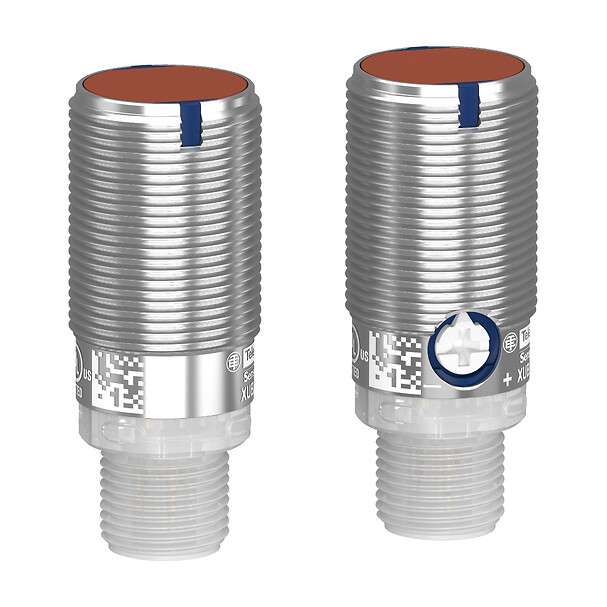
Telemecanique XUB2BPXNM12 Photoelectric Sensor Guide
The Telemecanique XUB2BPXNM12 photoelectric sensor is an industrial thru-beam receiver designed for accurate object detection in automated machinery, conveyors, packaging lines, and production equipment. It belongs to the Telemecanique XU photoelectric sensor family, a widely used range in factory automation where reliable sensing performance is essential.
This model is typically used with a matching thru-beam emitter. The operating principle is simple but highly dependable: the emitter sends a light beam to the receiver, and the receiver changes state when an object interrupts that beam. This makes the sensor useful in applications where product presence, movement, counting, or positioning must be detected with consistency.
Technical Characteristics
The XUB2BPXNM12 is commonly recognized as a cylindrical M18 photoelectric receiver with a PNP output and an M12 connector. The M18 cylindrical housing is a familiar industrial format, allowing easy installation on machine brackets, sensor mounts, and conveyor frames.
The PNP output is suitable for many PLC input systems that use sourcing logic. In practical terms, the sensor sends a positive signal to the control system when the detection condition is met. This makes it compatible with many standard automation architectures, provided the supply voltage and wiring configuration are correctly matched.
Application Areas
The Telemecanique XUB2BPXNM12 photoelectric sensor can be used in conveyor monitoring, product counting, carton detection, material handling systems, assembly machines, and packaging automation. Because it operates as a thru-beam receiver, it is especially useful when target color, surface finish, or reflectivity may vary during production.
Unlike diffuse sensors, which rely on light reflected from the target, a thru-beam setup detects the interruption of a direct beam. This usually provides stronger detection stability, especially across longer sensing distances or in applications involving dark, shiny, transparent, or irregularly shaped objects.
M12 Connector Advantage
The M12 connector is one of the key practical benefits of this model. It supports quick replacement, standardized wiring, and easier maintenance. In production facilities where downtime has a direct operational cost, connectorized sensors help technicians replace a unit quickly without rewiring the entire connection.
This feature is also valuable for machine builders. Modular cabling improves assembly quality, reduces wiring errors, and supports cleaner electrical design. For equipment that may be shipped, installed, or serviced in different locations, the M12 connection format provides a professional and service-friendly solution.
Why Choose a Thru-Beam Receiver?
A thru-beam receiver such as the XUB2BPXNM12 is selected when detection reliability is more important than having a one-piece sensor. Since the emitter and receiver are positioned opposite each other, the system forms a clear detection gate. Any object passing through that gate can be detected as it blocks the beam.
This makes the sensor valuable in high-speed lines, automated packaging systems, and process control points where missed detection could affect product flow or machine timing. For additional product family context, visit Telemecanique industrial sensor information.
Telemecanique XUB2BPXNM12 FAQ
What is the Telemecanique XUB2BPXNM12?
It is a photoelectric thru-beam receiver used in industrial automation. It detects objects by receiving a beam from a separate emitter and changing output state when the beam is interrupted.
What product type is the XUB2BPXNM12?
The product type is a photoelectric sensor, specifically a thru-beam receiver with a cylindrical body and PNP output.
Does this model use an M12 connector?
Yes. The XUB2BPXNM12 is associated with an M12 connector, making installation and replacement easier in industrial environments.
What does PNP output mean?
PNP output means the sensor switches a positive voltage signal to the connected input when activated. This is common in many PLC-based automation systems.
Is the sensor suitable for detecting different object colors?
Yes. Since it is used in a thru-beam arrangement, detection is based on beam interruption rather than reflected light, making it less sensitive to object color than many diffuse sensors.
Where is this sensor commonly installed?
It is commonly installed on conveyors, packaging machines, automated handling systems, assembly equipment, and production lines where object detection is required.
Is alignment important for this sensor?
Yes. Proper alignment between the receiver and its matching emitter is essential for stable detection, especially when the sensing distance is long or the machine environment includes vibration.