
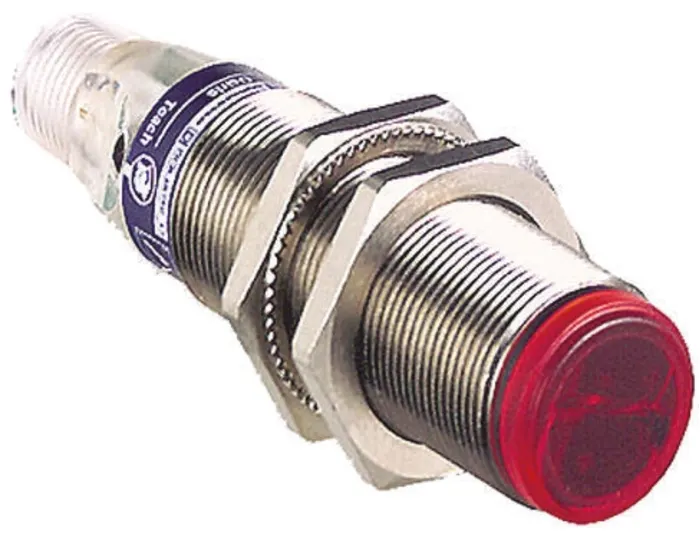
Telemecanique XUB2BPXNM12R Photoelectric Sensor Guide
The Telemecanique XUB2BPXNM12R photoelectric sensor is a cylindrical thru-beam receiver designed for industrial object detection where accuracy, repeatability, and clean PLC integration are important. It is part of the Telemecanique XU sensor family and is commonly used in automated production lines, packaging machinery, conveyor systems, and material handling equipment.
This model is notable for its M12 connector, PNP output, cylindrical design, and long sensing capability when paired with the correct thru-beam transmitter. In a thru-beam arrangement, the transmitter sends a beam of light toward the receiver. When an object blocks that beam, the receiver changes output state and sends a signal to the control system.
Technical Overview
The XUB2BPXNM12R is generally described as a cylindrical M18 photoelectric receiver with axial detection and a maximum sensing distance of up to 30 meters. It uses a PNP discrete output, making it suitable for many automation systems where sourcing inputs are required.
The M12 connector is a major practical advantage. It allows quick installation, easier sensor replacement, and cleaner wiring in modular machine designs. For maintenance teams, connectorized sensors can reduce downtime because a damaged unit can be replaced without rewiring a full cable run.
Industrial Applications
The Telemecanique XUB2BPXNM12R photoelectric sensor is often used where objects must be detected across a defined path. Typical applications include carton detection, product counting, conveyor gap monitoring, tray positioning, machine cycle verification, and object presence confirmation before downstream processing.
Because it uses thru-beam detection, it is especially effective in situations where object color, reflectivity, or surface finish changes frequently. Compared with diffuse sensors, thru-beam systems often deliver more stable performance because detection depends on interruption of a direct beam rather than light reflected from the target.
Connection Benefits
The M12 connector format is widely used in industrial automation. It supports fast connection, standardized cabling, and easier troubleshooting. In plants where sensors are frequently replaced or machinery is reconfigured, M12 connectivity can make the installation more service-friendly.
Correct wiring remains essential. The supply voltage, output type, pin assignment, and PLC input configuration should be verified before commissioning. This helps prevent incorrect switching behavior and protects both the sensor and the control system.
Why This Model Is Useful
The XUB2BPXNM12R offers a strong balance of long-range detection, rugged cylindrical mounting, and modern connectorized wiring. It is a sensible option when a machine builder needs a compact receiver for reliable beam-break detection across a controlled distance.
For additional brand and product family information, review Telemecanique automation sensor details.
Telemecanique XUB2BPXNM12R FAQ
What is the Telemecanique XUB2BPXNM12R used for?
It is used for detecting objects in industrial automation systems. As a thru-beam receiver, it works with a transmitter and detects when an object blocks the light path.
Does the XUB2BPXNM12R have an M12 connector?
Yes. This model is associated with an M12 connector, which supports faster installation, easier replacement, and standardized machine wiring.
Is this sensor suitable for conveyor applications?
Yes. It is commonly suitable for conveyor detection tasks such as object counting, presence detection, gap monitoring, and product flow control.
What is the advantage of PNP output?
PNP output provides a positive switched signal to a compatible controller input. It is widely used in many industrial PLC systems, especially in sourcing input configurations.
How is this model different from a diffuse photoelectric sensor?
A diffuse sensor detects light reflected from the target, while the XUB2BPXNM12R works as part of a thru-beam system. Thru-beam sensing is often more stable over longer distances and with variable target surfaces.
Is alignment important?
Yes. The receiver and transmitter must be aligned correctly. Poor alignment can reduce sensing stability, especially over longer distances or in environments with vibration.