
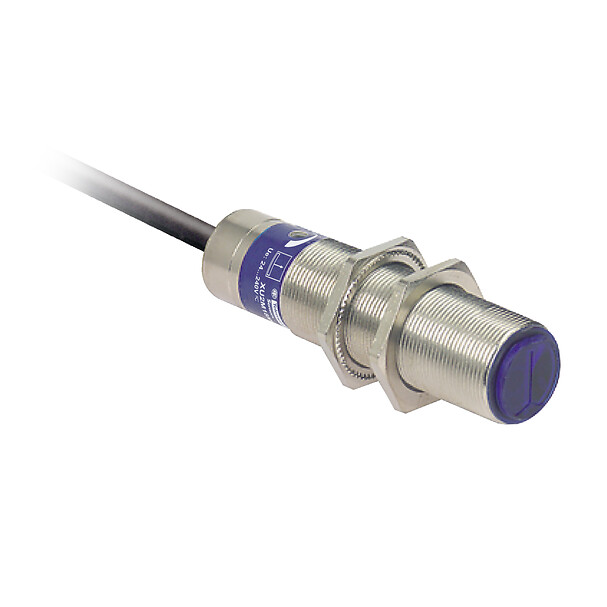
Telemecanique XU8M18MA230 Photoelectric Sensor: Background Suppression Guide
The Telemecanique XU8M18MA230 photoelectric sensor is an M18 cylindrical photoelectric sensor designed for precise short-range object detection in industrial automation. It is part of the Telemecanique XU range and is built for applications where standard diffuse sensing may be affected by background surfaces.
This model uses background suppression detection, often called BGS. Background suppression helps the sensor detect a target within a defined sensing range while reducing the influence of objects or surfaces located behind the target. This is especially useful when parts move in front of machine frames, conveyor rails, panels, or other fixed backgrounds.
Technical Characteristics
The XU8M18MA230 has a cylindrical M18 metal design and a nominal sensing distance of 0.12 m. It operates from a 24 to 240 V AC/DC supply, making it compatible with a wide range of industrial electrical systems. The sensor uses a 2-wire connection and provides a 1 NO discrete output function.
The axial sensing format helps simplify installation where the sensor must face directly toward the detection point. Its compact M18 body makes it suitable for machine panels, brackets, conveyor frames, and localized inspection points.
Why Background Suppression Is Useful
In many industrial applications, a sensor must detect an object without being falsely triggered by a surface behind it. A conventional diffuse sensor may respond to background reflection, especially when the background is bright or reflective. The Telemecanique XU8M18MA230 photoelectric sensor is designed to reduce that problem by focusing on a defined sensing zone.
This makes the sensor well suited for detecting small packages, machine parts, plastic components, labels, containers, and objects passing in front of nearby structures. It is particularly helpful where the target and background are close together.
Common Applications
The XU8M18MA230 is commonly used in packaging machines, conveyor systems, automated assembly cells, material handling equipment, and part-present detection points. It can help confirm that an item is positioned correctly before a machine cycle begins.
Because the sensing distance is 120 mm, this model is best suited for close-range detection rather than long-distance monitoring. In the right application, that shorter range can improve control and reduce unwanted detection from objects outside the intended zone.
Installation Guidance
The sensor should be installed so the target passes through the active sensing area at a predictable distance. The sensing face should be kept clean, and the unit should be protected from heavy impact or misalignment. During commissioning, the real target material should be tested because color, gloss, and shape can still influence photoelectric performance.
Correct 2-wire AC/DC wiring is essential. The control circuit should be checked for load compatibility, fuse protection, and switching logic before the sensor is placed into service.
Telemecanique XU8M18MA230 Selection Perspective
The XU8M18MA230 is a strong option when a normally open output and background suppression are needed in a compact M18 sensor format. It is especially valuable in short-range applications where background reflection must be controlled without overcomplicating the mechanical design.
Telemecanique XU8M18MA230For additional product context, visit Telemecanique sensor information.
Telemecanique XU8M18MA230 FAQ
What is the Telemecanique XU8M18MA230?
It is an M18 cylindrical photoelectric sensor with background suppression detection for short-range industrial object sensing.
What does BGS mean?
BGS means background suppression. It helps the sensor detect a target while reducing unwanted response from objects behind the target.
What is the sensing distance?
The nominal sensing distance is 0.12 m, or 120 mm.
What output type does it use?
The XU8M18MA230 provides a 1 NO discrete output function.
Does it support AC and DC power?
Yes. It operates with a 24 to 240 V AC/DC supply.
Where is this sensor most useful?
It is useful in close-range detection points on packaging equipment, conveyors, machine tools, assembly systems, and material handling lines.
Is it better than a standard diffuse sensor?
It can be better when a nearby background could cause false detection. Background suppression gives more control over the active detection zone.
Does target color still matter?
Yes, target color and surface finish can still affect performance, so testing with the real object is recommended.