
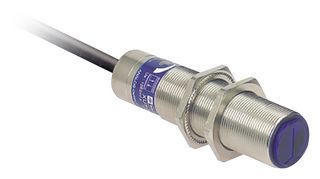
Telemecanique XU5M18MB230 Photoelectric Sensor: Diffuse Detection Explained
The Telemecanique XU5M18MB230 photoelectric sensor is an industrial M18 cylindrical sensor designed for short-range object detection in automated equipment. It belongs to the Telemecanique XU photoelectric sensor range and is built for general-purpose applications where a compact, durable, and easy-to-wire detection device is required.
This model uses a diffuse photoelectric detection system. In this sensing method, the sensor emits a light beam toward the target and detects the light reflected back from the object. Because the emitter and receiver are contained in one housing, installation is straightforward and does not require an opposite receiver or reflector.
Telemecanique XU5M18MB230 Technical Overview
The XU5M18MB230 features a cylindrical M18 metal housing, an axial optical path, and a nominal sensing distance of 0.4 m. It operates with a 24 to 240 V AC/DC power supply, which makes it adaptable for many machine control panels and field wiring conditions.
The sensor uses a 2-wire wiring technique and provides a 1 NC discrete output function. A normally closed output is often selected when the control system expects a closed circuit during normal conditions and a state change when detection occurs or when the signal is interrupted.
Industrial Use Cases
The Telemecanique XU5M18MB230 photoelectric sensor is suitable for detecting objects on conveyors, confirming product presence, monitoring part flow, and identifying items at machine entry points. Its diffuse detection system is useful when only one side of the detection zone is accessible.
Common examples include packaging machines, assembly stations, sorting equipment, feeder systems, and compact automation cells. The 0.4 m sensing distance gives enough reach for many localized detection tasks while keeping the sensor practical for machine-mounted installations.
Advantages of Diffuse Detection
Diffuse sensors are valued because they simplify mechanical layout. There is no need to align two separate devices across a machine frame, and there is no reflector to install or maintain. This can reduce installation time and make the sensor easier to integrate into tight spaces.
However, diffuse sensing should always be evaluated against the target material. Highly reflective surfaces may increase response distance, while dark or angled surfaces may reduce it. For best results, the sensor should be tested with the actual target object during commissioning.
Installation and Maintenance
The sensor should be mounted firmly using a suitable M18 bracket or threaded mounting point. The optical face should be aimed toward the target path and kept clean during operation. In dusty or oily environments, scheduled inspection can help maintain consistent detection.
Electrical installation should follow the official 2-wire AC/DC wiring diagram. Load current limits and circuit protection should be verified before the sensor is connected to the final control system.
Practical Selection Insight
The XU5M18MB230 is often selected when a maintenance team or machine builder needs a compact diffuse sensor with a normally closed output. Its wide voltage range, metal body, and short-range sensing capability make it a reliable choice for many standard industrial detection points.
For additional product context, visit Telemecanique sensor information.
FAQ
What is the Telemecanique XU5M18MB230?
It is an M18 cylindrical photoelectric sensor using diffuse detection for industrial object sensing.
What is the sensing range?
The nominal sensing distance is 0.4 m, which is suitable for short-range machine detection tasks.
What output does the XU5M18MB230 provide?
It provides a 1 NC discrete output, meaning it uses a normally closed switching function.
Does this sensor work with AC and DC power?
Yes. It supports 24 to 240 V AC/DC, making it flexible for different industrial control systems.
Is a reflector required?
No. The sensor uses diffuse detection, so it detects light reflected directly from the target object.
What should be considered during installation?
The sensor should be aimed correctly, mounted securely, and tested with the real target material to confirm reliable detection.
Can surface color change the sensing result?
Yes. Dark, matte, angled, or low-reflective surfaces may reduce the practical sensing distance compared with light or reflective targets.
Why choose the NC version?
A normally closed output can be preferred when the control system is designed around closed-circuit logic during normal operation.