
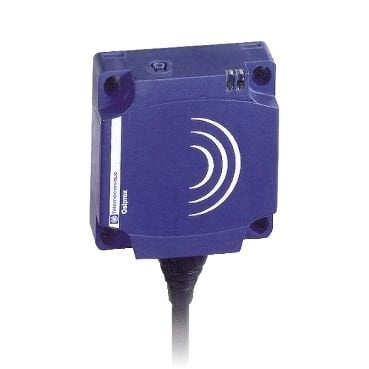
Telemecanique XS8C1A1NAL2 Inductive Proximity Sensor Guide
The Telemecanique XS8C1A1NAL2 inductive proximity sensor is a flat-form XS8 sensor designed for non-contact metal detection in industrial automation environments. It uses an inductive sensing principle, which means it detects metallic targets without requiring physical contact. This makes it useful in applications where repeatable detection, reduced mechanical wear, and stable operation are important.
According to the manufacturer data, the XS8C1A1NAL2 belongs to the Telemecanique XS inductive proximity sensor range and uses a flat 40 x 40 x 15 mm PBT body. It is a 3-wire DC sensor with NPN discrete output, normally open function, 12 to 24 V DC rated supply, cable connection, and IP68 protection. The nominal sensing distance is listed as 25 mm, with non-flush mounting required for correct performance. :contentReference[oaicite:0]{index=0}
What Is the Telemecanique XS8C1A1NAL2 Used For?
This sensor is commonly selected for machinery where metal parts need to be detected before, during, or after a movement sequence. Typical examples include conveyors, packaging machines, handling systems, automated gates, machine tools, lifting equipment, and position monitoring assemblies. Because it is a non-contact device, it can help reduce the risk of mechanical degradation compared with limit switches that require direct actuation.
The flat body design is useful where a rectangular sensor fits more naturally than a cylindrical sensor. In many machines, the sensor must sit along a rail, inside a compact bracket, or near a moving metal plate. The XS8 format gives engineers a broad sensing face and a practical shape for installation in panel-style or surface-mounted applications.
Key Technical Features
- Product type: Inductive proximity sensor
- Series: Telemecanique XS8
- Body format: Flat 40 x 40 x 15 mm
- Housing material: PBT plastic
- Output: NPN, normally open
- Wiring: 3-wire DC
- Supply voltage: 12 to 24 V DC
- Connection: 2 m cable
- Protection rating: IP68
- Mounting: Non-flush
Telemecanique XS8C1A1NAL2 Why NPN Output Matters
The NPN output configuration is important when matching the sensor with PLC input architecture. In simple terms, an NPN sensor typically switches the load toward the negative side of the DC supply. This makes it suitable for control systems designed around sinking input logic. Before replacement or new installation, the input module type should be checked carefully because NPN and PNP sensors are not interchangeable in every control circuit.
Telemecanique XS8C1A1NAL2 Installation Notes
The XS8C1A1NAL2 is specified as non-flush mountable, so it should not be embedded directly into surrounding metal. Adequate clearance around the sensing face helps maintain the intended sensing distance and reduces the risk of false triggering. The PBT enclosure supports use in demanding industrial spaces, while the IP68 rating makes the sensor suitable for environments where dust and moisture protection are essential.
For more product context, visit Telemecanique sensors.
Telemecanique XS8C1A1NAL2 FAQ
What type of sensor is the Telemecanique XS8C1A1NAL2?
It is an inductive proximity sensor. It detects metallic objects without physical contact, making it suitable for industrial position sensing, object detection, and automation feedback applications.
What is the output type of the XS8C1A1NAL2?
The XS8C1A1NAL2 uses an NPN normally open discrete output. This should be matched with compatible PLC or control input logic before installation.
What voltage does the XS8C1A1NAL2 require?
It is designed for 12 to 24 V DC operation. This voltage range is common in industrial control cabinets and machine automation systems.
Can the XS8C1A1NAL2 be mounted flush in metal?
No. It is specified for non-flush mounting. Enough free space around the sensing face should be maintained to avoid performance issues caused by nearby metal surfaces.
Is the XS8C1A1NAL2 suitable for harsh environments?
Yes, the IP68 rating and PBT body make it suitable for many demanding industrial environments where dust, moisture, and mechanical exposure may be present.
What is the main advantage of using an inductive proximity sensor?
The main advantage is contactless detection of metal targets. This reduces mechanical wear, improves repeatability, and supports reliable automation in repetitive machine cycles.