
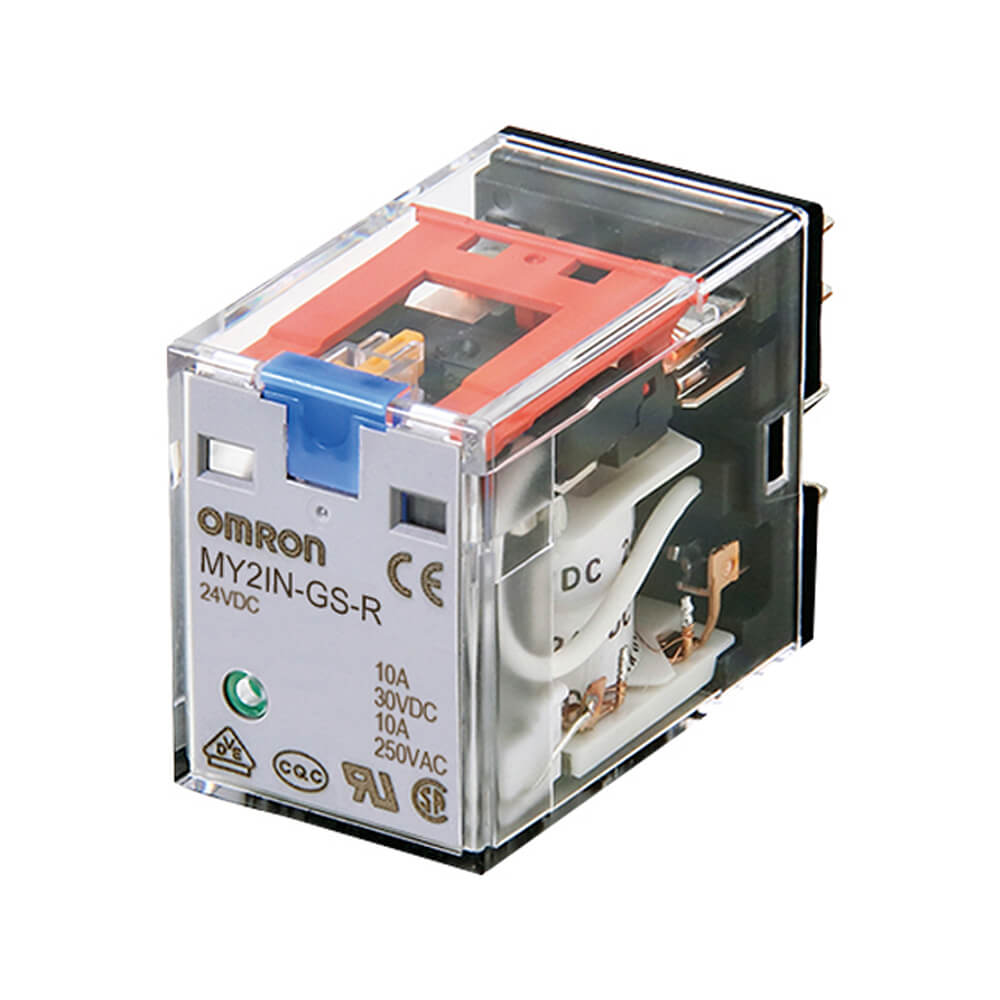
Omron MY2IN-GS 220VDC Miniature Power Relay Guide
The Omron MY2IN-GS 220VDC miniature power relay is a plug-in electromechanical relay designed for control circuits that use a 220 VDC coil supply. It offers a compact relay body, DPDT switching capability, visual operation indication, and socket-based installation for industrial control panels and automation systems.
Product Overview
This relay is intended for applications where a higher DC control voltage is required. Unlike low-voltage DC relay coils, the 220 VDC version is selected for control systems built around elevated DC control supplies. These environments may include industrial automation cabinets, process control equipment, machine control panels, and legacy systems where 220 VDC control voltage is already standardized.
The DPDT contact design allows two circuits to be switched at the same time. This is useful when one control signal must change two separate electrical paths, such as command signaling, auxiliary status switching, control interlocking, or dual-channel circuit management.
Technical Profile
The Omron MY2IN-GS 220VDC relay is commonly listed as a plug-in relay with an 8-pin format, DPDT contacts, mechanical and LED indicators, a lockable push-test function, and a 220 VDC coil. Some distributor references list the contact current differently depending on the product generation, region, and load conditions, so the final selection should always be confirmed against the latest datasheet and the actual circuit load.
Its mechanical indicator gives a direct visual reference of relay movement, while the LED indicator helps confirm coil energization. In high-voltage DC control panels, these features are particularly valuable because fast fault identification improves safety and reduces downtime.
Why the 220 VDC Coil Matters
A 220 VDC coil relay is not interchangeable with 12 VDC, 24 VDC, or AC coil versions. The coil must match the control supply. Using the wrong voltage can prevent operation, overheat the coil, or damage the relay. For this reason, voltage verification is one of the most important steps before installation.
Typical Use Cases
This relay may be used in industrial control systems, auxiliary switching circuits, DC control panels, signal routing, alarm systems, relay logic panels, equipment status circuits, and maintenance-friendly machine control assemblies. Its plug-in design makes it practical in panels where components must be replaced without rewiring the entire circuit.
Installation Considerations
Correct socket selection is essential. The relay should be installed in a compatible 8-pin socket, with wiring sized for the load and control circuit. DC switching can be demanding because arcs may persist longer than in AC circuits. When switching inductive DC loads, suppression and proper contact rating verification are important for service life.
For additional relay family information, visit Omron industrial components.
FAQ
What is the Omron MY2IN-GS 220VDC?
It is a miniature plug-in power relay with a 220 VDC coil and DPDT switching contacts. It is used in control systems that require relay operation from a high DC control voltage.
Can I replace a 220 VDC coil relay with a 220 VAC relay?
No. AC and DC coils are different. A replacement relay must match the required coil voltage and current type unless the circuit is redesigned by a qualified engineer.
Why is DC switching more sensitive than AC switching?
DC arcs do not naturally pass through zero as AC arcs do. This can make DC load switching harder on contacts, especially with inductive loads.
What does DPDT allow this relay to do?
DPDT allows the relay to switch two separate circuits. Each pole has a changeover contact path, giving the designer more control flexibility.
Omron MY2IN-GS 220VDC Does the relay have diagnostic features?
Common listings describe mechanical and LED indicators. These features help confirm relay status during commissioning, inspection, and fault finding.
What should be checked before installation?
Check coil voltage, socket compatibility, contact rating, load type, ambient temperature, wiring method, and required safety approvals before using the relay in a live system.