
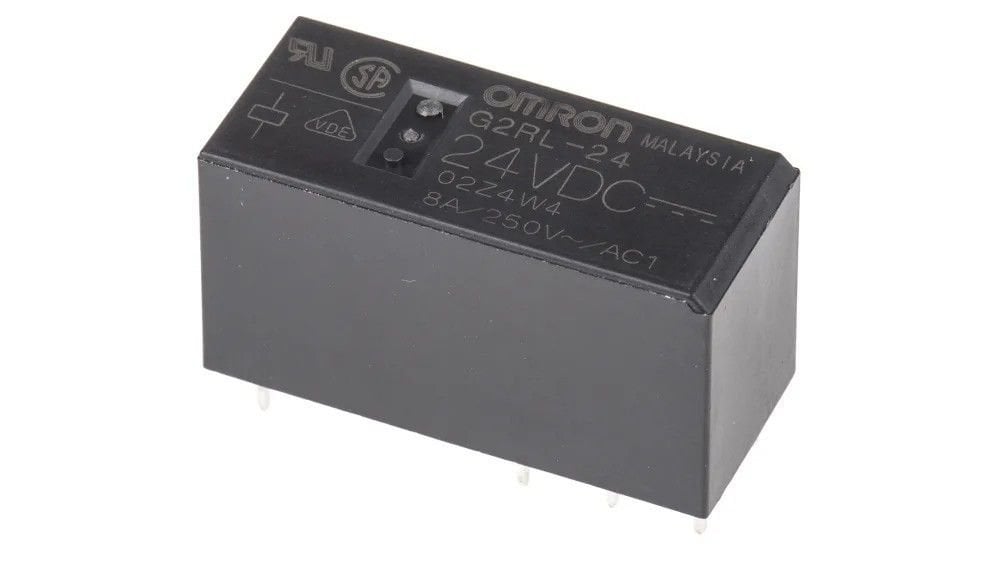
Omron G2RL-24 24VDC PCB Power Relay Technical Guide
The Omron G2RL-24 24VDC PCB power relay is a compact relay designed for printed circuit board applications where reliable switching, low-profile construction, and dependable electrical isolation are important. It belongs to Omron’s G2RL PCB power relay family, a series commonly used in control electronics, home appliances, office equipment, and industrial machinery.
This relay is especially relevant for designs that require a 24 VDC coil and a DPDT contact arrangement. According to Omron’s technical documentation, G2RL-24 is listed as a sealed, two-pole model with 5, 12, 24, and 48 VDC coil options, while the 24 VDC coil version has a rated current of 16.7 mA and a coil resistance of 1,440 ohms. The same technical table identifies the two-pole relay family with DPDT contact capability and an 8 A class switching profile for standard two-pole versions. :contentReference[oaicite:0]{index=0}
Key Technical Characteristics
The Omron G2RL-24 24VDC PCB power relay is built for PCB mounting and compact electrical assemblies. Its 24 VDC coil makes it suitable for low-voltage control circuits, while its two-pole contact design allows two circuits to be switched at the same time. This is useful in equipment where isolation, signal routing, or dual-load switching is required.
Omron specifies Ag-alloy cadmium-free contacts for the G2RL family, supporting stable switching performance and modern environmental expectations. The G2RL series also provides insulation and creepage/clearance characteristics intended for practical electronic control systems. Omron notes that the relay should always be evaluated under real operating conditions, because switching capacity and application behavior can vary by load type and circuit design. :contentReference[oaicite:1]{index=1}
Typical Applications
The Omron G2RL-24 24VDC PCB power relay can be used in appliance control boards, HVAC electronics, industrial controllers, office equipment, and embedded switching systems. Its PCB terminal format supports direct board integration, reducing wiring complexity and helping engineers keep assemblies compact.
For engineers comparing relay families, the G2RL series is not simply interchangeable with visually similar low-profile relays. Omron specifically advises checking actual operating conditions before replacing or substituting models. This makes load current, coil voltage, ambient temperature, contact form, and safety approval requirements essential review points before design-in.
Design Notes
When using this relay, the 24 VDC coil supply should be stable and matched to the rated coil specification. Designers should also consider contact load type. Resistive loads are generally easier to switch than inductive loads, while motors, solenoids, and coils may require surge suppression or contact protection. PCB layout should maintain suitable spacing for the intended voltage class and should respect the relay’s footprint and pin arrangement.
For additional Omron relay information, visit Omron relay resources.
FAQ
What type of relay is the Omron G2RL-24 24VDC?
It is a PCB power relay with a 24 VDC coil. The G2RL-24 model belongs to the two-pole G2RL group and is associated with DPDT switching capability, making it suitable for applications where two circuits must be controlled together.
Where is the Omron G2RL-24 24VDC commonly used?
It is commonly used in control boards, appliance electronics, HVAC controls, office automation equipment, and compact industrial control systems. Its PCB mounting format makes it practical for integrated electronic assemblies.
What should be checked before using this relay?
Engineers should check coil voltage, contact rating, load type, operating temperature, insulation requirements, PCB footprint, and expected electrical life. Omron also recommends verifying operation under actual usage conditions rather than relying only on family similarity.
Is the Omron G2RL-24 24VDC suitable for inductive loads?
It may be used in circuits involving inductive loads only when the load rating and protection strategy are properly reviewed. Inductive loads can create voltage spikes, so suppression components may be required depending on the circuit.
Why choose a PCB power relay instead of a plug-in relay?
A PCB power relay is preferred when the relay must be soldered directly onto a circuit board. This supports compact product design, reduces external wiring, and can improve assembly consistency in high-volume electronic equipment.