
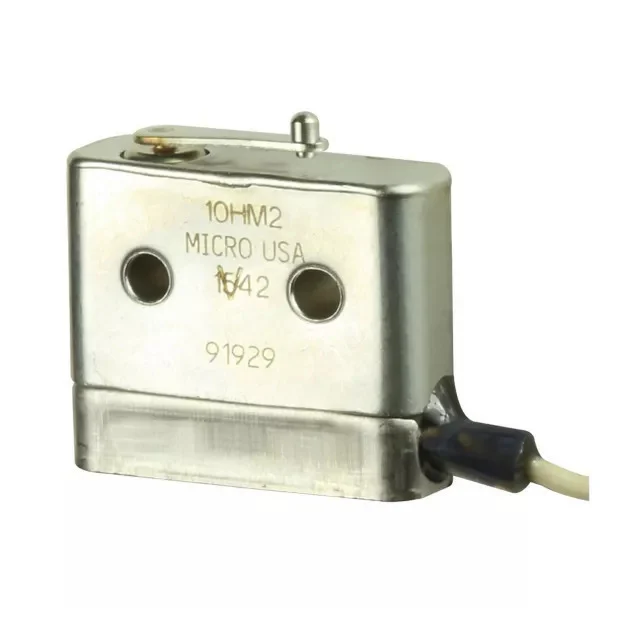
Honeywell 16HM32 Sealed Switch for Harsh Environments
The Honeywell 16HM32 sealed switch is a specialized industrial switch intended for environments where dependable switching must be maintained under challenging operating conditions. Within the broader Honeywell HM family, sealed and hermetic switch designs are known for their durability, compact construction, and suitability for applications exposed to contamination, temperature stress, and demanding duty cycles. The Honeywell 16HM32 sealed switch is therefore a relevant option for engineers who are not looking for a generic snap-action component, but for a product with proven environmental resilience.
Understanding the 16HM32 Sealed Switch
The Honeywell 16HM32 industrial sealed switch is typically referenced as an SPDT chassis-mount switch with wire lead connections. Market listings and datasheet references identify it as part of Honeywell’s sealed switch offering, and Honeywell support documentation specifically points to this model for users checking lead exit orientation. That level of product-code-specific research is common when maintenance teams need an exact replacement or when design teams must confirm installation compatibility before finalizing a bill of materials.
Technical Profile of the 16HM32 Industrial Switch
For technical review, the Honeywell 16HM32 switch is associated with SPDT configuration, wire leads, and an operating temperature range of -65°C to 260°C. That immediately places it in a category suitable for more aggressive conditions than many general-purpose commercial switches. The broader HM Series also uses compact stainless steel hermetic-sealed construction and is designed to resist dust, water, particulate contamination, and corrosive gases in demanding applications.
One practical point that matters in real installations is lead routing. Honeywell’s own support material for the 16HM32 specifically references the need to verify how the leads exit the switch, which highlights how important physical integration can be in compact equipment layouts. In other words, the Honeywell 16HM32 sealed switch is not chosen only for electrical performance, but also for fit, routing, and environmental reliability.
Typical Use Cases for the Honeywell 16HM32 Sealed Switch
This Honeywell sealed switch can be relevant in aerospace support systems, industrial motion monitoring, harsh-duty machinery, and compact control assemblies that require dependable actuation feedback. It is especially useful in applications where switch failure due to contamination or thermal stress would create maintenance risk or operational interruption.
For more information, visit Honeywell.
FAQ About the Honeywell 16HM32 Sealed Switch
What type of configuration does the Honeywell 16HM32 use?
The Honeywell 16HM32 is commonly listed as an SPDT sealed switch with wire lead connections. That makes it suitable for compact assemblies where flexible lead routing is required.
Is the Honeywell 16HM32 suitable for high-temperature environments?
Yes. Available technical references list the Honeywell 16HM32 with an operating temperature range up to 260°C, which is significantly above the range of many standard industrial switches.
Why is the Honeywell 16HM32 searched by exact part number?
Because engineers often need to confirm exact mounting, lead exit direction, circuitry, and environmental fit before approving a direct replacement. Exact code matching helps prevent mechanical or electrical mismatch in the field.
Is the 16HM32 a general-purpose switch?
No. It is better understood as a specialized sealed switch intended for harsh-duty environments. It is typically used where environmental protection and performance stability are more important than low-cost commodity switching.
What makes the 16HM32 industrial switch valuable in maintenance planning?
Its value comes from predictable performance, sealed construction, and traceable product-code identification. For maintenance teams, that can reduce uncertainty during replacement sourcing and technical documentation review.