
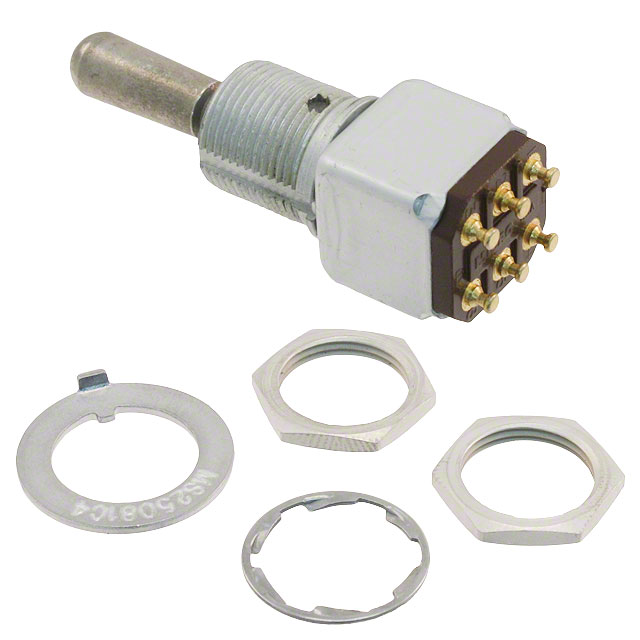
Honeywell 12TW70-514N Operator Controls: Technical Overview and Application Guide
The Honeywell 12TW70-514N operator controls model belongs to the respected MICRO SWITCH TW family, a series widely referenced in aerospace, industrial control, and harsh-environment panel applications. Engineers often look for this part when they need a compact toggle solution with dependable switching action, environmental sealing, and a configuration that fits demanding control panels. In practical terms, the Honeywell 12TW70-514N toggle switch is used where a robust manual interface matters just as much as electrical performance.
What Makes the Honeywell 12TW70-514N Different?
One of the reasons the Honeywell 12TW70-514N operator control switch stands out is its combination of DPDT switching architecture, three-position functionality, and a locking lever design. This makes it relevant for applications where accidental actuation must be reduced and where operators need a clear, deliberate switching feel. In many control environments, that matters more than appearance or panel convenience alone.
The design is especially useful in compact panels because TW Series products are known for their miniature military-grade format. That means designers can integrate a highly durable switch into systems that already have tight dimensional limits. The Honeywell 12TW70-514N operator controls format is therefore often discussed in relation to mission-critical interfaces, transportation panels, specialized machinery, and equipment exposed to vibration or environmental stress.
Technical Characteristics of the 12TW70-514N
This model is typically identified as a DPDT 3-position toggle switch with solder-style terminals and a 15/32 inch bushing. It is also associated with a keyed seal ring and a short mushroom-style locking lever, which supports controlled actuation in more sensitive operating conditions. That locking behavior is important because it helps create a more intentional user interaction, particularly where the wrong switch position could affect system logic or equipment behavior.
Another advantage is the sealed construction style seen across the TW Series. In real-world installations, panel-mounted operator controls are often exposed to dust, splashing, mechanical shock, and temperature variation. A switch family built with those conditions in mind tends to stay relevant across sectors for many years.
Typical Use Cases
The Honeywell 12TW70-514N operator controls part is commonly researched for aerospace panels, defense-related equipment, industrial machinery, instrumentation consoles, and other applications where panel space is limited but reliability expectations are high. It is not simply a generic toggle. It is chosen when the manual control point must feel precise, mechanically solid, and electrically trustworthy.
For more information about Honeywell, it helps to review the broader product ecosystem and compatibility options around panel components and control hardware.
FAQ
What type of switch is the Honeywell 12TW70-514N?
It is generally identified as a DPDT, three-position toggle switch in the Honeywell TW Series. That matters because DPDT switching gives designers more control flexibility than simpler single-pole alternatives.
Why is the locking lever important on the Honeywell 12TW70-514N operator controls unit?
A locking lever helps reduce unintended movement. In panels used for transport, industrial systems, or sensitive equipment, preventing accidental switching can be just as important as the electrical rating itself.
Is the Honeywell 12TW70-514N suitable for harsh environments?
The TW Series is widely known for sealed and military-oriented construction options, so this model is regularly associated with demanding environments where shock, vibration, and moisture resistance are relevant selection factors.
Where is the Honeywell 12TW70-514N operator control typically installed?
It is commonly considered for panel-mounted use in control stations, instrumentation panels, aerospace interfaces, and specialized equipment where a compact but durable switch is required.
Why do engineers search specifically for Honeywell 12TW70-514N operator controls instead of a generic toggle switch?
Because part-specific selection is usually driven by exact circuit function, lever style, sealing method, mounting format, and expected operating reliability. In technical procurement, those details are what determine whether a switch is truly compatible with the design.