
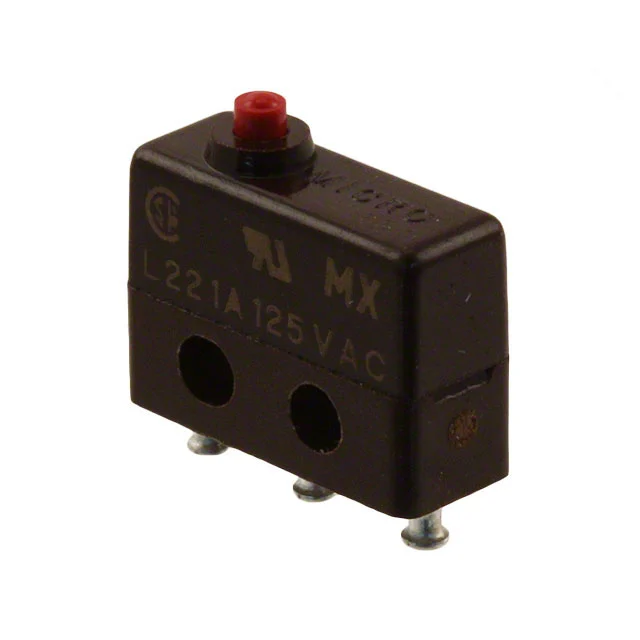
Honeywell 12SX3-T Basic Switch: Precision Performance in a Subminiature Format
The Honeywell 12SX3-T basic switch is one of the more interesting models in the SX subminiature family because it is associated with low differential travel and bifurcated gold contacts. That combination matters in applications where switch precision, contact reliability, and repeatable actuation are all essential. Engineers evaluating the Honeywell 12SX3-T basic switch are often looking for a compact switch that supports accurate switching behavior in systems where small mechanical movements need to translate into stable electrical response.
Technical Highlights of the Honeywell 12SX3-T Switch
The Honeywell 12SX3-T switch is an SPDT snap-action switch with a pin plunger actuator and chassis mount configuration. It is commonly listed with a 1 A current rating, 125 VAC and 28 VDC capability, and an operating force around 1.4 N. Honeywell’s SX documentation specifically identifies the 12SX3-T as a low differential travel variant with bifurcated gold contacts. That technical profile makes the Honeywell 12SX3-T electromechanical switch especially suitable for precision-oriented switching tasks where reliable contact behavior under low-energy conditions is important.
Low differential travel is often relevant in designs where narrow actuation tolerance matters. In practical use, it can support more repeatable switching around small mechanical movements, which is valuable in compact assemblies, precision controls, and devices with sensitive interface geometry.
Where the Honeywell 12SX3-T Basic Switch Fits Best
The Honeywell 12SX3-T basic switch can be a strong fit for instrumentation, compact industrial equipment, precision feedback mechanisms, small machine subassemblies, and specialized control hardware. Because this switch belongs to a premium subminiature family, it is often evaluated in applications where mechanical repeatability and long-term switching confidence are more important than selecting a generic commodity switch.
Switch selection is rarely just about electrical rating alone. Actuator feel, differential travel, contact type, mounting constraints, and termination style all influence performance in the final assembly. For more information about Honeywell, it can be helpful to review comparable Honeywell basic switch models within the same SX platform.
FAQ
What is the main advantage of the Honeywell 12SX3-T basic switch?
One of its standout characteristics is low differential travel combined with bifurcated gold contacts, which supports precise and reliable switching behavior.
Is the Honeywell 12SX3-T suitable for precision applications?
Yes. It is well aligned with precision switching environments where small mechanical movement and stable electrical response must work together.
What type of contact system does the Honeywell 12SX3-T use?
This model is associated with bifurcated gold contacts, commonly chosen for dependable low-energy switching.
What kind of actuator does the 12SX3-T basic switch have?
It uses a pin plunger actuator, a common choice for direct linear actuation in compact assemblies.
Why would an engineer choose the 12SX3-T over a standard switch?
It can be preferred when repeatability, compact packaging, and precision travel behavior matter more than simply meeting a basic switching requirement.