
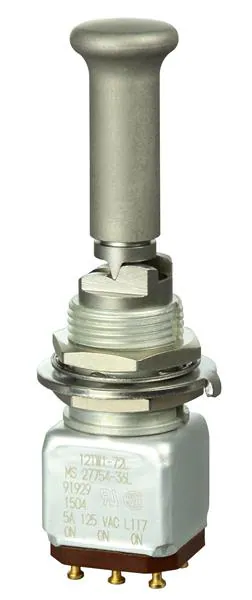
Honeywell 12TW1-72 Toggle Switch Technical Guide
The Honeywell 12TW1-72 toggle switch is a compact control component built for applications that need dependable switching performance in limited panel space. As part of the MICRO SWITCH TW family, this model is widely associated with rugged control environments where vibration resistance, mechanical stability, and long-term switching consistency matter. In practical terms, the Honeywell 12TW1-72 toggle switch is used when engineers want a reliable DPDT switching device with a three-position format and solder terminal connection.
What Makes the Honeywell 12TW1-72 Toggle Switch Different?
The technical identity of the Honeywell 12TW1-72 toggle switch is tied to its double-pole, double-throw configuration and three-position operation. This matters because a DPDT toggle switch can manage two separate circuits at once, which makes it useful in control logic, directional commands, and mode selection tasks. The 12TW1-72 version is commonly referenced as a Honeywell 12TW1-72 toggle switch with a standard lever, solder terminals, and a 15/32 inch threaded bushing for secure panel mounting.
Another important point is its special circuitry format. For designers working on aerospace support equipment, industrial controls, mobile platforms, or sealed panels, the switching sequence is often just as important as the mechanical build. That is why the Honeywell toggle switch 12TW1-72 remains relevant in applications where control precision and repeatable lever feel are expected over time.
Typical Applications and Engineering Context
The Honeywell 12TW1-72 DPDT toggle switch fits applications where compact panel design meets demanding operating conditions. It is often discussed for military-grade panels, aviation support systems, construction equipment, and industrial machinery interfaces. Engineers also value the TW platform because it is designed for environments involving shock, vibration, dust exposure, splashing water, and temperature variation.
Beyond the basic switching action, this product type is also appreciated for maintainability. Solder terminal construction gives installers a familiar and robust termination method, especially in legacy systems or projects where service technicians already work with soldered harness layouts. For more information about Honeywell components, it is useful to compare this model with other TW Series variants that change lever style or locking behavior while keeping the same general platform.
Why Specification-Level Accuracy Matters
When someone searches for a Honeywell 12TW1-72 toggle switch, they usually want more than a short catalog line. They want to know whether the part is appropriate for harsh operating conditions, whether the mounting format matches the existing panel, and whether the switching logic is aligned with the equipment function. In that respect, this model stands out as a technical, application-focused choice rather than a generic switch substitute.
FAQ
What type of switch is the Honeywell 12TW1-72?
The Honeywell 12TW1-72 is generally identified as a DPDT, three-position toggle switch in the TW Series. It uses solder terminals and a standard lever, making it suitable for panel-mounted control assemblies that need compact size and dependable switching behavior.
Is the Honeywell 12TW1-72 suitable for demanding environments?
Yes. The TW Series is known for use in applications exposed to vibration, mechanical shock, dust, moisture exposure, and temperature fluctuation. That makes the Honeywell 12TW1-72 toggle switch relevant for industrial, transportation, and aerospace-adjacent equipment where durability is important.
Why would an engineer choose a DPDT three-position toggle switch?
A DPDT three-position design can control two circuits while offering more than a simple on/off state. This supports more advanced control logic such as directional commands, operating mode changes, or intermediate switching functions in compact control panels.
Does the Honeywell 12TW1-72 use standard panel mounting?
It is commonly associated with panel mounting through a threaded bushing format. That makes it practical for equipment manufacturers and maintenance teams who need a stable, familiar installation method in metal or composite control panels.
Is this product mainly for new systems or replacement projects?
It can fit both. In new equipment, it is chosen for compact ruggedized control design. In retrofit or maintenance projects, it can also be relevant when the original system was designed around military-style or industrial-grade toggle switch footprints and solder termination methods.