
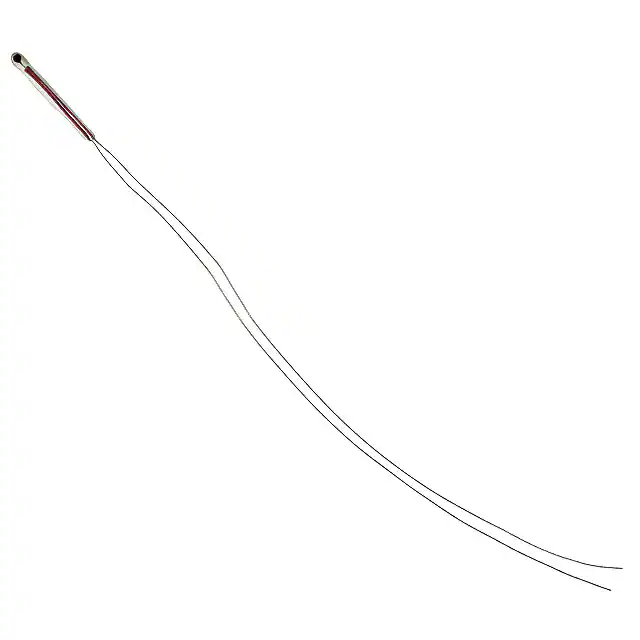
Honeywell 120-103FAJ-Q01 Temperature Sensor Guide
The Honeywell 120-103FAJ-Q01 temperature sensor is an NTC thermistor designed for engineers who need dependable thermal sensing in a compact probe-style package. As part of Honeywell’s 120 Series, this model is associated with rugged glass-encapsulated construction and a form factor that works well in assemblies where space, durability, and repeatable thermal response all matter. For design teams, the Honeywell 120-103FAJ-Q01 temperature sensor is often evaluated not just by brand reputation, but by how precisely its resistance and thermal curve align with system requirements.
Technical Overview of the Honeywell 120-103FAJ-Q01
The Honeywell 120-103FAJ-Q01 is listed as an NTC thermistor with 10k resistance at 25°C. It carries a ±20% resistance tolerance and a B25/85 value of 3669K. The part is described as a cylindrical glass probe with 31.8 mm lead length, free-hanging mounting, and a broad operating temperature range from -60°C to 300°C.
That specification mix makes the Honeywell 120-103FAJ-Q01 temperature sensor particularly relevant for thermal monitoring, compensation, or control systems that need a known 10k thermistor profile inside a rugged package.
Why Engineers Use the Honeywell 120-103FAJ-Q01 Temperature Sensor
A 10k NTC thermistor is a familiar and widely used temperature sensing format across industrial electronics and control systems. What differentiates this model is the way Honeywell packages the sensing element. The 120 Series is associated with glass encapsulation, hermetic sealing, high reliability, and durability in more demanding environments. That is important when the sensor is not just sitting on a clean lab bench, but integrated into real equipment with thermal cycling, airflow, fluid exposure, or mechanical stress.
Performance Context and Application Fit
The Honeywell 120-103FAJ-Q01 temperature sensor can be relevant in industrial controls, embedded electronics, instrumentation, and engineered systems that require thermal feedback from a physically compact probe. Because of its series-level construction approach, it is also suitable for applications where engineers value long-term material stability and rugged packaging as much as the nominal resistance value itself.
More information about Honeywell is helpful for reviewing related thermistor families and industrial sensing technologies.
What Makes This Model Worth Attention
In practice, selection often comes down to detail. The Honeywell 120-103FAJ-Q01 temperature sensor combines the familiar usability of a 10k NTC thermistor with an industrial-grade package style that supports more serious environments. That makes it a strong technical reference for professionals who need a small but credible sensing component.
FAQ
What is the resistance of the Honeywell 120-103FAJ-Q01?
The Honeywell 120-103FAJ-Q01 is specified at 10k Ohm resistance at 25°C. This is one of the most important selection criteria because many electronic control and measurement circuits are designed around standard 10k thermistor behavior.
What does the 3669K B25/85 value mean?
The B25/85 value helps describe the thermistor curve by indicating how resistance changes with temperature. For engineers, this parameter is important when calculating expected sensor behavior, calibrating circuits, or matching the component to an existing thermal design.
Is the Honeywell 120-103FAJ-Q01 a rugged sensor?
Yes. The part belongs to a Honeywell thermistor family described as rugged, glass-encapsulated, shock resistant, and hermetically sealed. Those qualities make it more suitable for demanding assemblies than a bare or lightly packaged sensing element.
What operating temperatures can this sensor handle?
The Honeywell 120-103FAJ-Q01 is listed for operation from -60°C to 300°C. That broad range supports use in both very cold and very hot sensing conditions, depending on the surrounding system design.
Where is the Honeywell 120-103FAJ-Q01 temperature sensor commonly used?
It is commonly researched for industrial sensing, instrumentation, thermal monitoring, and embedded control systems where a compact 10k NTC thermistor with durable packaging is needed. It is especially useful when designers want both a familiar electrical profile and a more robust physical construction.