
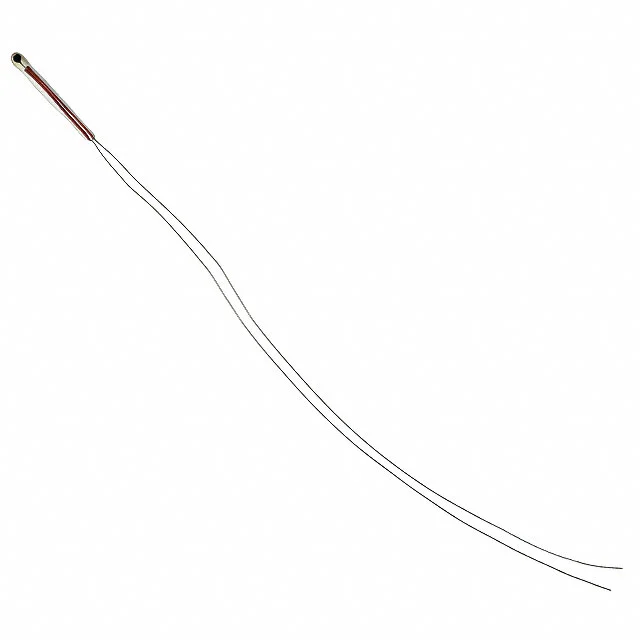
Honeywell 120-102EAJ-Q01 Temperature Sensor Explained
The Honeywell 120-102EAJ-Q01 temperature sensor is a compact NTC thermistor solution designed for applications that require stable temperature measurement in a rugged miniature format. As part of Honeywell’s 120 Series, this model is built around a mini glass probe construction, which is one of the key reasons it is often considered for demanding sensing environments. When professionals search for the Honeywell 120-102EAJ-Q01 temperature sensor, they are usually looking for reliable thermal behavior, compact dimensions, and a sensing element that integrates cleanly into engineered assemblies.
Core Technical Identity of the Honeywell 120-102EAJ-Q01
The Honeywell 120-102EAJ-Q01 is listed with 1,000 Ohm resistance, ±20% tolerance at 25°C, and a 25/85 Beta value of 3518. It also features a mini glass probe structure with a 1.5 mm diameter, Dumet leads, and a 31.8 mm lead length. In addition, it is associated with a wide operating temperature range of -60°C to 300°C, which makes it relevant well beyond low-stress indoor sensing tasks.
Why the Mini Glass Probe Design Matters
One of the defining advantages of the Honeywell 120-102EAJ-Q01 temperature sensor is its glass-encapsulated construction. Within the 120 Series, these thermistors are described as rugged, shock resistant, and hermetically sealed. That matters because temperature sensing components are often exposed to fluid contact, air stream placement, or installation environments where ordinary packaging may not perform as consistently over time.
The model’s 10.0-second time constant in air and 0.7 mW/°C dissipation constant also help frame how the sensing element behaves in practical thermal measurement scenarios. These are useful parameters for engineers evaluating response behavior and energy-related thermal characteristics.
Common Use Cases for the Honeywell 120-102EAJ-Q01
Because of its miniature form factor and wide temperature capability, the Honeywell 120-102EAJ-Q01 temperature sensor can be relevant in industrial measurement assemblies, embedded equipment, research instrumentation, and applications where rugged thermistor packaging is preferred. Honeywell also associates this family with environments such as military, aerospace, and oceanography, which speaks to the durability expectations of the series.
More information about Honeywell can be useful when comparing thermistor series, sensing formats, and industrial temperature components.
FAQ
What type of sensor is the Honeywell 120-102EAJ-Q01?
The Honeywell 120-102EAJ-Q01 is an NTC thermistor in a mini glass probe format. It belongs to the Honeywell 120 Series and is intended for temperature sensing applications where compact size and rugged construction are important.
What is the resistance value of the Honeywell 120-102EAJ-Q01 temperature sensor?
This model is specified at 1,000 Ohm resistance. That nominal resistance value is one of the main identifiers engineers use when selecting a thermistor for circuit design, compensation, or temperature monitoring tasks.
How wide is the operating temperature range?
The Honeywell 120-102EAJ-Q01 is associated with an operating range from -60°C to 300°C. That is a notably broad span for a compact thermistor assembly and helps explain why the part is evaluated for more demanding temperature environments.
Why is Beta 3518 important?
The Beta value helps describe the thermistor’s resistance-versus-temperature behavior. For designers and technical teams, this parameter is useful when estimating how the sensor responds across a temperature range and when integrating it into measurement or compensation circuits.
Is the Honeywell 120-102EAJ-Q01 suitable for rugged applications?
Yes, the 120 Series is described as shock resistant, rugged, and hermetically sealed. Those characteristics make the model relevant for installations where mechanical durability and environmental resilience matter alongside basic temperature sensing performance.