
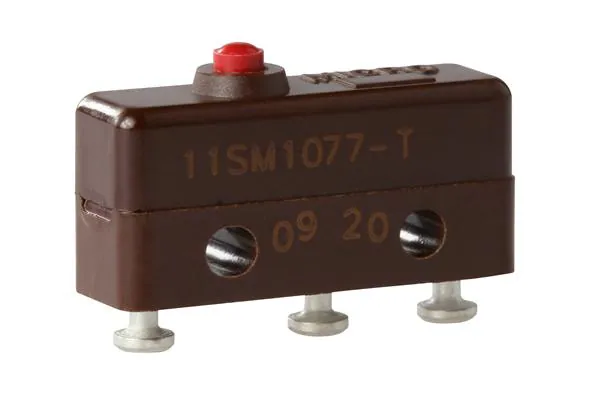
Honeywell 11SM1077-T Basic Switch Overview
The Honeywell 11SM1077-T basic switch is a compact SM Series electromechanical switch engineered for low-current, precision switching environments. It is widely searched as 11SM1077-T basic switch, Honeywell 11SM1077-T micro switch, and Honeywell 11SM1077-T SPDT switch by design engineers, buyers, and maintenance teams looking for a dependable signal-level switch with controlled actuation.
Core Technical Characteristics
The Honeywell 11SM1077-T basic switch uses an SPDT circuit with a round pin plunger actuator. It is rated at 100 mA at 125 V AC and 30 V DC, which makes it suitable for low-power electrical paths and precision input functions. The unit is designed for chassis mounting and uses a solder turret termination, a format preferred in applications where stable wiring and compact routing are important.
From a motion and force standpoint, the switch has an operating force of 141 gf and a release force of 28 gf. Its pretravel is 0.020 in (0.5 mm), differential travel is 0.004 in (0.1 mm), and overtravel is 0.005 in (0.13 mm). The operating position is 0.330 in (8.4 mm). In real-world applications, these values help engineers predict exactly when the switch changes state and how it will behave in repeated motion cycles.
Why the Honeywell 11SM1077-T Basic Switch Is Chosen
The Honeywell 11SM1077-T basic switch is a practical option for instrumentation, compact industrial devices, control assemblies, medical submodules, and equipment that uses small mechanical movements to trigger electrical feedback. Because it supports up to 10,000,000 mechanical cycles, the switch is appropriate where long-term durability matters.
Another important advantage is the operating temperature range of -55°C to 125°C. This allows the Honeywell 11SM1077-T micro switch to remain relevant in designs exposed to cold starts, enclosed equipment heat, or variable ambient conditions.
For more information about Honeywell, you can explore related switch families and actuator options that share the same engineering heritage.
FAQ
What type of applications fit the Honeywell 11SM1077-T basic switch best?
It fits applications that require low-current electrical switching with precise mechanical actuation. Examples include detection of position change, compact control modules, latch monitoring, and signal-level switching inside instruments and industrial devices.
Is the Honeywell 11SM1077-T SPDT switch suitable for high-current loads?
No. This model is intended for low-current use at 100 mA. Designers looking for heavier load handling usually evaluate other SM Series variants with higher ampere ratings.
Why do engineers value the travel data on the Honeywell 11SM1077-T micro switch?
Pretravel, differential travel, and overtravel affect how accurately the switch responds to movement. In equipment with tight tolerances, these values can determine whether the switching event happens at the right point in the mechanism.
Does the 11SM1077-T basic switch support long service life?
Yes. Its rated mechanical life of up to 10 million cycles is one of the reasons it remains relevant for repetitive switching duties. That makes it attractive for systems expected to run for long intervals with minimal maintenance interruptions.