
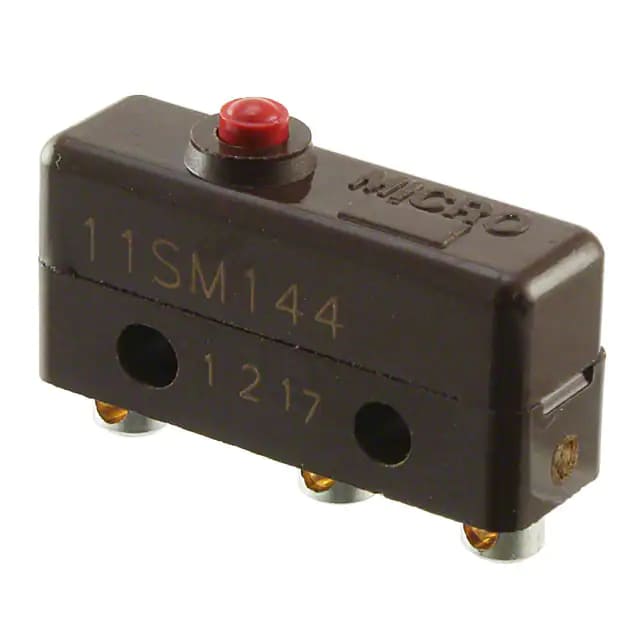
Honeywell 11SM144 Basic Switch Overview
The Honeywell 11SM144 basic switch is a subminiature SPDT snap-action switch built for compact systems that still demand strong electrical ratings and consistent mechanical response. This model is commonly searched as Honeywell 11SM144 basic switch, Honeywell 11SM144 micro switch, and Honeywell 11SM144 SPDT switch because it serves as a dependable solution for designers who need repeatable actuation in space-constrained assemblies.
Technical Specifications of the Honeywell 11SM144 Basic Switch
The 11SM144 basic switch features an SPDT contact configuration with a round pin plunger actuator. It is rated for 5 A at 250 V AC and 30 V DC, which gives it a stronger electrical load capability than low-current SM variants. The switch uses a solder lug termination and is intended for chassis mount installation.
Mechanically, the switch is designed for precise travel control. It has an operating force of 85 gf, release force of 28 gf, pretravel of 0.020 in (0.5 mm), differential travel of 0.002 in (0.05 mm), and overtravel of 0.005 in (0.13 mm). The operating position is 0.330 in (8.4 mm). These details are important for engineers who need a crisp switching point and predictable return behavior in mechanical linkages.
Where the 11SM144 Basic Switch Performs Well
The 11SM144 basic switch is well suited to industrial controls, compact machinery, instrumentation, appliance subsystems, and electromechanical assemblies that need a reliable position signal. Because the switch combines higher current handling with subminiature dimensions, it can fit projects where larger switches are difficult to integrate.
Its operating temperature range of -55°C to 125°C and mechanical life of 10,000,000 cycles make it attractive for systems expected to cycle frequently over a long period. In many cases, the 11SM144 micro switch is selected when durability, compactness, and switching consistency need to exist together.
For more information about Honeywell, it is useful to compare the broader SM Series portfolio and compatible design options.
FAQ
What distinguishes the Honeywell 11SM144 basic switch from lower-current versions?
The main difference is its higher electrical rating. At 5 A and 250 V AC, the Honeywell 11SM144 basic switch is intended for applications that require more load capacity than signal-level models such as 0.1 A variants.
Why is the low differential travel of the Honeywell 11SM144 SPDT switch important?
Low differential travel helps produce a more defined snap action and repeatable switching point. In practical use, that can improve control precision and reduce uncertainty in mechanisms that depend on exact movement feedback.
Is the Honeywell 11SM144 micro switch suitable for compact industrial equipment?
Yes. Its small form factor and strong mechanical life make it a good fit for compact industrial designs where panel space is limited but reliable switching is still required. It is often used in assemblies where size and longevity carry equal weight.
When do engineers search for Honeywell 11SM144 replacements or references?
They usually do so during redesigns, maintenance planning, service parts identification, or when validating compatibility in an existing machine. Because the switch has specific force and travel characteristics, exact reference checking is often necessary before substitution.