
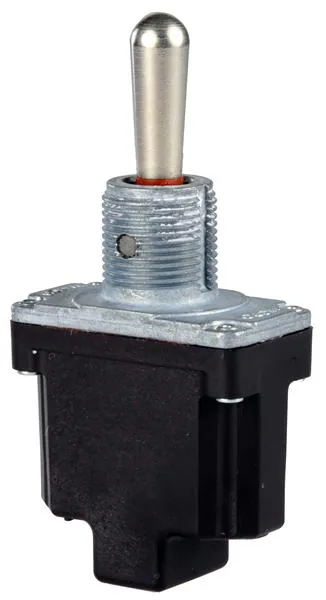
Honeywell 11NT1-7 Toggle Switch Technical Overview
The 11NT1-7 toggle switch is a practical choice for applications that require a rugged manual control with momentary functionality. As part of Honeywell’s NT Series, it belongs to a product family developed for dependable operator input in environments where sealing, durability, and consistent switching performance are important. Momentary toggle switches play a specific role in control systems because they allow commands to be initiated temporarily rather than maintained indefinitely. In equipment control, that can be essential for jog functions, directional pulses, testing operations, and temporary system commands.
What the 11NT1-7 Toggle Switch Is
The Honeywell 11NT1-7 toggle switch is commonly identified as an SPDT panel-mount toggle switch with a Mom-Off-Mom switching function. This means the lever returns from each active position back to center when released, rather than remaining latched in place. That behavior is especially useful when a control input should only be active while the operator is intentionally holding the switch. The product is generally associated with a standard round actuator and is available in sealed NT Series construction intended for demanding control panels.
Technical Characteristics of the 11NT1-7 Toggle Switch
Current product references commonly associate the Honeywell 11NT1-7 toggle switch with a 10 A AC rating at 125 V. Distributor records also show panel mounting, a 12.40 mm circular cutout, 15/32-32 bushing thread, and environmental sealing aligned with IP67/IP68 protection for NT Series versions. Depending on the listing source, terminal style for closely related variants may differ, so checking the final ordering configuration remains important. The larger NT Series documentation confirms the family’s sealed design and suitability for demanding panel environments where water splash, washdown, dust, or outdoor exposure may be a concern.
Where the 11NT1-7 Toggle Switch Is Used
The Honeywell 11NT1-7 toggle switch is well suited to control functions such as jog forward and reverse, momentary directional commands, temporary enable signals, test operations, and manual override inputs. These use cases appear in industrial machinery, transportation controls, utility equipment, agricultural systems, service tools, and operator panels where a maintained switch state would not be appropriate. In those applications, a momentary toggle helps reduce operational errors by automatically returning to neutral.
Why Momentary Manual Control Still Matters
Even in sophisticated electronic systems, direct manual control remains important because it provides instant user feedback and clear functional intent. The Honeywell 11NT1-7 toggle switch supports that control philosophy with a rugged sealed design that suits real equipment rather than idealized conditions. For engineers and panel designers, it offers a familiar form factor with the added value of environmental resilience.
For more information about Honeywell, comparing momentary and maintained NT Series models can help determine which control logic best supports the final system design.
FAQ
What type of switch is the 11NT1-7?
The Honeywell 11NT1-7 is commonly listed as a sealed NT Series panel-mount SPDT toggle switch with a Mom-Off-Mom momentary switching function.
What does Mom-Off-Mom mean for the Honeywell 11NT1-7 toggle switch?
It means the switch has momentary action on both sides and returns to the center off position when released. This makes it useful for temporary commands rather than maintained selection.
Where is the Honeywell 11NT1-7 toggle switch commonly used?
It is commonly used for jog controls, temporary directional inputs, test functions, operator overrides, and momentary machine commands in industrial, transport, and utility equipment.
Is the Honeywell 11NT1-7 suitable for outdoor or harsh panel environments?
NT Series switches are designed with sealing features, and current product references commonly show IP67/IP68 protection for related configurations, making them appropriate for demanding applications when correctly specified.
What should be checked before specifying the Honeywell 11NT1-7?
Engineers should confirm the exact switching function, terminal style, load rating, actuator preference, panel dimensions, and environmental conditions. This is especially important for momentary control circuits where operator feel and return behavior matter.