
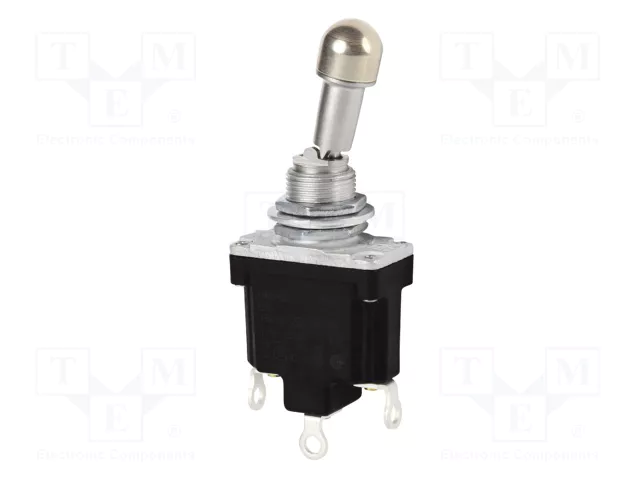
Honeywell 11NT1-3D Locking Toggle Switch Guide
The Honeywell 11NT1-3D locking toggle switch is part of Honeywell’s NT Series and is designed for applications where reliable manual control must also be protected against unintentional switching. In many control systems, the challenge is not only selecting a rugged toggle switch, but choosing one that helps prevent accidental operation. That is where a locking lever configuration becomes especially valuable. The Honeywell 11NT1-3D locking toggle switch addresses that need while also keeping the environmental sealing and panel-friendly design associated with the broader NT family.
What Makes the Honeywell 11NT1-3D Different
The Honeywell 11NT1-3D locking toggle switch is commonly listed as an SPDT panel-mount switch with an On-On switching function. The key distinction is its locking lever actuator, which adds an extra level of deliberate control compared with a standard round toggle. In practical applications, this can help reduce unintended switching in equipment exposed to vibration, operator contact, maintenance activity, or environments where switch position should not change casually.
Technical Characteristics of the Honeywell 11NT1-3D Locking Toggle Switch
Current part listings commonly identify the Honeywell 11NT1-3D locking toggle switch with a 15 A AC rating at 125 V, solder lug termination, panel mounting, and a locking lever actuator length of 26.67 mm. Distributor data also commonly shows IP67/IP68 ingress protection, which aligns with Honeywell NT Series design features such as sealing between the lever and bushing as well as the cover and case. Together, these details make the Honeywell 11NT1-3D locking toggle switch relevant in applications where ruggedness and deliberate operator action are equally important.
Where a Locking Toggle Switch Adds Value
The Honeywell 11NT1-3D locking toggle switch can be especially useful in industrial control panels, mobile equipment, auxiliary power systems, service vehicles, outdoor cabinets, and specialized operator stations. In these environments, a switch that can resist accidental movement may improve operational clarity and reduce the chance of unintended state changes. This is particularly helpful when a selected mode should remain stable unless intentionally changed by trained personnel.
Why This Product Stands Out
Many toggle switches can open or close a circuit. Fewer are optimized for both environmental protection and intentional actuation control. The Honeywell 11NT1-3D locking toggle switch combines those priorities in a format that remains familiar to operators and straightforward for engineers to integrate into panel designs. That combination makes it a strong choice for demanding manual control tasks.
For more information about Honeywell, comparing locking and non-locking NT Series variants can help define the best operator control strategy for the application.
FAQ
What type of switch is the Honeywell 11NT1-3D?
The Honeywell 11NT1-3D is a sealed panel-mount toggle switch in the NT Series. It is commonly listed as SPDT with an On-On switching function and a locking lever actuator.
Why choose the 11NT1-3D locking toggle switch instead of a standard toggle?
The locking lever helps prevent accidental or unintended switching. This is useful in equipment subject to vibration, operator traffic, maintenance activity, or applications where a selected mode should not be changed casually.
Is the 11NT1-3D suitable for harsh environments?
Yes. The NT Series is designed with sealing features and current product data commonly shows IP67/IP68 ingress protection, supporting use in outdoor, splash-prone, or demanding panel conditions.
Where is the Honeywell 11NT1-3D locking toggle switch commonly used?
It is commonly suitable for industrial panels, mobile machinery, utility vehicles, service equipment, marine-adjacent panels, and outdoor systems where both ruggedness and controlled manual switching are important.
What should engineers verify before specifying the Honeywell 11NT1-3D?
They should confirm the required circuit function, whether a locking action is necessary, the available panel space, actuator clearance, terminal style, and environmental sealing requirements of the final installation.