
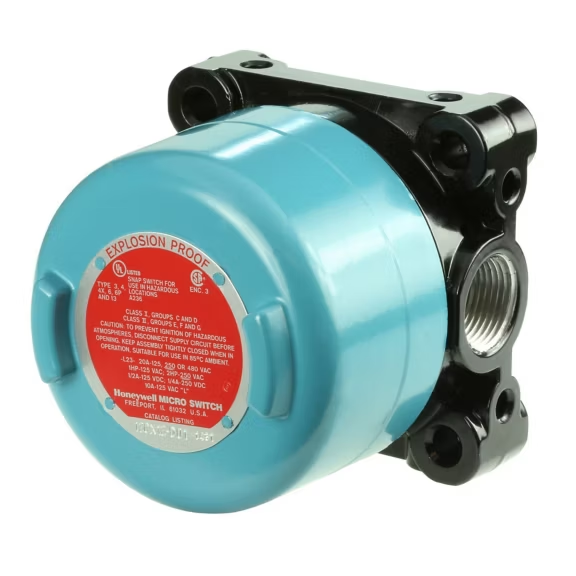
Honeywell 11CX1E Hazardous Location Limit Switch Guide
The Honeywell 11CX1E hazardous location limit switch is part of the MICRO SWITCH CX Series, a switch family designed for harsh industrial settings where environmental exposure and hazardous atmosphere requirements must be considered from the start. Public product data identifies the Honeywell 11CX1E as a hazardous location switch with SPDT switching, 15 A current capability, IP66 sealing, and a chassis-mount design. Those characteristics make it relevant for plant operators, MRO teams, and design engineers who need dependable position sensing in severe-duty environments.
What the Honeywell 11CX1E Is Used For
The Honeywell 11CX1E hazardous location switch is used to detect mechanical movement or position and convert that event into a clear electrical control signal. In industrial practice, this may include monitoring valve position, travel limits, access mechanisms, process equipment states, or machine interlock conditions. Because the switch belongs to a hazardous-location family, it is particularly suited to environments where explosive atmospheres, outdoor weather exposure, and contamination risks make enclosure integrity essential.
Technical Features of the 11CX1E
Available public specifications connect the Honeywell 11CX1E limit switch with an SPDT throw configuration, screw termination, IP66 protection, and an operating temperature range of approximately -25 °C to 85 °C. Other product references list a 15 A maximum current rating. Honeywell’s official CX Series documentation adds the broader context by describing the series as weather-sealed, explosion-proof, and suitable for hazardous atmospheres, with certification for applicable portions of NEMA 7 and 9. This combination of electrical and environmental data helps explain why the Honeywell 11CX1E hazardous location limit switch is used in demanding field conditions.
Industrial Value of Honeywell 11CX1E
Searches for Honeywell 11CX1E, hazardous location limit switch, SPDT industrial switch, and IP66 explosion-proof switch reflect the practical concerns of users working in process industries, outdoor equipment systems, and maintenance-heavy operations. In those settings, the right switch supports uptime, predictable control behavior, and safer inspection outcomes.
Selection Guidance
Before ordering the 11CX1E hazardous location limit switch, engineers should confirm the actuator arrangement, wiring format, environmental approval needs, load conditions, and mounting style. This helps ensure the replacement preserves both the control logic and the environmental suitability of the original installation.
FAQ
What type of switch is 11CX1E?
It is a Honeywell hazardous location limit switch in the MICRO SWITCH CX Series, intended for severe industrial environments.
Does 11CX1E use SPDT contacts?
Yes. Public technical references identify it as an SPDT switch.
What ingress protection is associated with Honeywell 11CX1E?
Available listings connect it with an IP66 rating, which indicates strong resistance to dust and water ingress.
What is the operating temperature range of Honeywell 11CX1E?
Published technical data places it at roughly -25 °C to 85 °C, making it suitable for a broad range of industrial service conditions.
Why is Honeywell 11CX1E useful in hazardous areas?
Because it combines rugged industrial switching with enclosure performance and hazardous-location suitability expected in severe-duty installations.
What should be checked before replacing Honeywell 11CX1E?
Check the original part code, actuator style, load requirements, terminal arrangement, and environmental approval expectations before installation.
For more information about Honeywell, related CX Series products, and supporting industrial switch references, this page can help.