
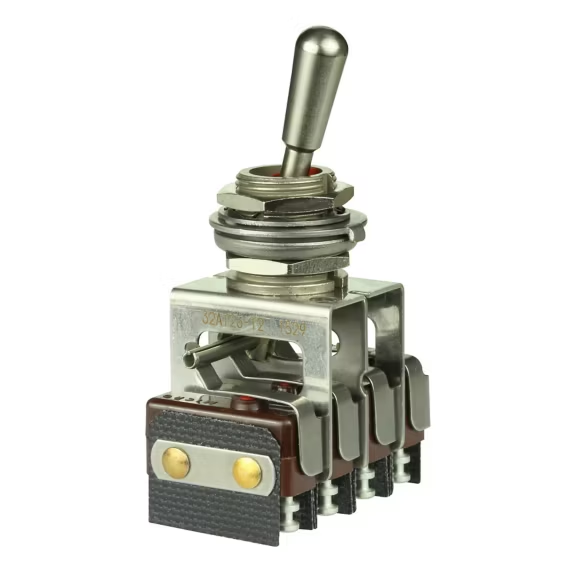
Honeywell 11AT56 DPDT Toggle Switch Technical Overview
The Honeywell 11AT56 toggle switch is a member of the MICRO SWITCH AT Series and is publicly described as a DPDT toggle switch with screw terminals and a standard lever. Depending on the listing, the 11AT56 is also associated with a 3-position configuration, making it particularly relevant in operator control applications where users need more than a simple two-state manual input. For engineers, that distinction is important because position count can directly affect machine logic, selector behavior, and operator workflow.
Technical Profile of the Honeywell 11AT56
The Honeywell 11AT56 operator control toggle switch is categorized within a rugged industrial family built around metal mechanical construction. Public product sources describe it as DPDT and identify screw-terminal connectivity, which supports serviceable field wiring. One catalog reference further identifies the switch as a 3-position arrangement and notes maintained and momentary action behavior in the series-specific description, which suggests that this is not simply a generic panel switch but a more application-specific control component.
Why Position Configuration Matters
For technicians and system designers, the value of a Honeywell 11AT56 DPDT toggle switch lies in controlled manual logic. A 3-position switch can support center-state functions, directional commands, mode selection, or staged operator input. In industrial and specialty equipment, that additional state can be essential for safe operation, clearer human-machine interaction, or function separation in compact panel layouts.
AT Series Construction and Reliability Context
Honeywell presents the AT Series as a compact multi-pole toggle switch line available in several pole counts and built with a metal toggle lever, metal bushing, and metal housing. That overall family design supports durability in demanding environments and helps explain why specific codes such as the Honeywell 11AT56 toggle switch remain relevant in replacement planning. When maintenance teams search for an exact part number, they are often trying to preserve both the electrical logic and the tactile mechanical behavior of the original assembly.
Best Practices Before Using Honeywell 11AT56
Before installing the Honeywell 11AT56 AT Series toggle switch, it is wise to verify position logic, whether the action is maintained or momentary in each direction, panel cutout compatibility, terminal layout, and original circuit documentation. This is particularly important with operator-control hardware, because an incorrect switch can cause confusing behavior even when it physically fits the mounting point.
FAQ
What is Honeywell 11AT56?
It is a Honeywell AT Series DPDT toggle switch used in operator control applications and listed with screw terminals and a standard lever format.
Is Honeywell 11AT56 a 2-position or 3-position switch?
Public references commonly identify it as DPDT, and at least one detailed listing describes it as a 3-position version. Because position behavior is application-critical, the original datasheet should always be checked before replacement.
Why is the Honeywell 11AT56 useful in control panels?
It can support more complex manual input than a basic two-state switch, which helps in direction control, mode selection, and equipment operation where center positions or staged logic are required.
What terminal style does Honeywell 11AT56 use?
Public product listings identify the switch as using screw terminals, a format widely preferred for maintainable industrial wiring.
What should be checked before replacing Honeywell 11AT56?
Check the exact switching function, number of positions, maintained versus momentary action, lever style, and mounting compatibility. These details can affect both machine logic and user safety.
Is Honeywell 11AT56 part of the Honeywell MICRO SWITCH AT Series?
Yes. It belongs to the AT Series, a long-running Honeywell switch family known for compact multi-pole construction and durable metal hardware.
If you need broader family references or related switch documentation, more information about Honeywell is available here.