
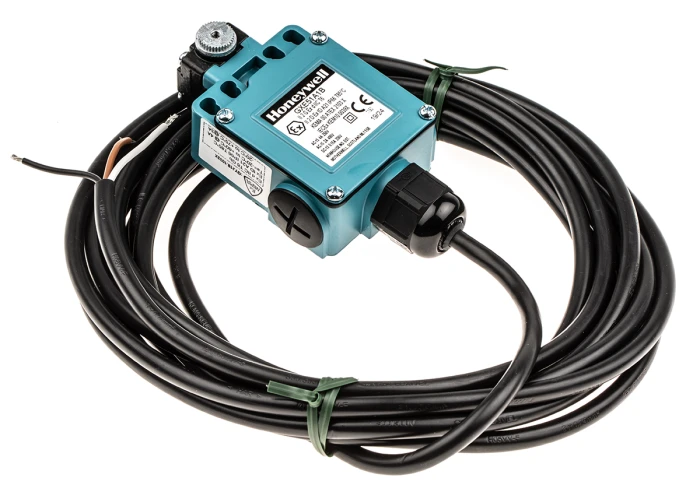
Honeywell GXE51A1B Limit Switch: Technical Overview, Features, and Use Cases
The Honeywell GXE51A1B limit switch is designed for industrial environments where reliable position detection matters as much as mechanical durability. As part of Honeywell’s hazardous area switch family, this model is commonly associated with demanding automation applications that require dependable switching performance, a compact side rotary design, and stable electrical output over time. Engineers, maintenance teams, and panel builders often look for products like the Honeywell GXE51A1B limit switch when they need a rugged component that can help confirm motion, end-of-travel position, or machine state in harsh operating conditions.
What Is the Honeywell GXE51A1B Limit Switch?
The Honeywell GXE51A1B limit switch is a side rotary industrial limit switch with SPDT contact arrangement, typically configured with one normally closed contact and one normally open contact. In practical machine design, this means the switch can provide flexible signaling for both control and safety-related sequences. The model is widely referenced for applications that need reliable mechanical actuation, repeatable switching, and a robust enclosure concept suited to demanding industrial duty.
Key Technical Characteristics of the Honeywell GXE51A1B Limit Switch
Available technical references identify the Honeywell GXE51A1B limit switch as a side rotary switch with SPDT output and a current rating commonly listed around 4 A to 5 A depending on the reference format and application context. Distributor records also identify it as a chassis-mount industrial switch used in machinery and automation environments. The hazardous-area installation documentation associated with the GXE/GXA family highlights environmental and maintenance considerations for this switch family, including safe installation routines and attention to explosion-proof performance where applicable.
From a design perspective, the Honeywell GXE51A1B limit switch is valued for mechanical reliability, clear actuation behavior, and compatibility with machine architectures that need end-position confirmation. This makes it relevant in conveyor systems, process equipment, heavy-duty automation assemblies, and industrial motion sequences where feedback integrity is important.
Why Engineers Choose the Honeywell GXE51A1B Limit Switch
One of the main reasons engineers specify a Honeywell GXE51A1B limit switch is operational confidence. In industrial automation, a limit switch is not just a simple electromechanical part. It often serves as a decisive input in machine logic, interlocking, and motion control. If the switch does not perform consistently, the wider system can suffer from nuisance stops, misreads, or process instability.
The Honeywell GXE51A1B limit switch supports applications where equipment is exposed to vibration, repeated cycles, and harsh surroundings. A side rotary actuator style is especially useful when the moving machine element approaches the switch from a lateral direction, giving designers more freedom in mounting and cam arrangement. In real-world terms, that flexibility can simplify enclosure design and improve maintenance accessibility.
Common Applications
The Honeywell GXE51A1B limit switch is suitable for industrial machinery, packaging lines, material handling systems, heavy equipment interfaces, and process automation installations. It is also relevant where environmental sealing, rugged construction, and dependable switching matter more than compact consumer-style switching. In these environments, accurate position indication helps reduce uncertainty across machine cycles and makes troubleshooting easier.
Because Honeywell industrial switches are widely recognized in automation projects, the Honeywell GXE51A1B limit switch can also fit well into retrofit work. Maintenance teams frequently prefer known industrial platforms because they simplify replacement planning and documentation control across multiple sites.
Installation and Maintenance Considerations
When installing the Honeywell GXE51A1B limit switch, it is important to verify actuator travel, mounting alignment, and application suitability. Overtravel, repeated impact loading, and poor mechanical alignment can shorten service life in any electromechanical switch. In hazardous or dusty environments, documented maintenance procedures become even more important. Good practice includes checking the operating interface, inspecting mounting integrity, and confirming that the wiring and enclosure approach match the application conditions.
For more information about Honeywell, it is helpful to review broader product family resources and cross-check actuator compatibility before final selection.
FAQ
Is the Honeywell GXE51A1B limit switch suitable for harsh industrial environments?
Yes. The Honeywell GXE51A1B limit switch is typically chosen for industrial environments where durability, repeatability, and robust switch construction are important. It is associated with a hazardous-area switch family, which signals its relevance for demanding applications when installed correctly.
What actuator style does the Honeywell GXE51A1B limit switch use?
This model is commonly identified as a side rotary type. That makes it useful in machine layouts where the actuating object approaches from the side rather than from the top or directly in line with a plunger mechanism.
What kind of electrical output does the Honeywell GXE51A1B limit switch provide?
The Honeywell GXE51A1B limit switch is generally listed with SPDT switching and 1NC/1NO contact configuration. This provides flexibility for control logic, machine state monitoring, and interlock signaling.
Can the Honeywell GXE51A1B limit switch be used in retrofit projects?
Yes. It is often relevant for retrofit and replacement projects where a rugged industrial Honeywell limit switch is preferred. Before replacing an existing switch, the installer should confirm mounting dimensions, actuator geometry, electrical rating, and environmental requirements.
Why is the Honeywell GXE51A1B limit switch a strong choice for automation systems?
Because it combines proven Honeywell industrial switch design, reliable side rotary actuation, and the kind of switching architecture commonly used in end-of-travel and machine-position detection. In automation systems, this helps support dependable feedback and more predictable machine behavior over time.