
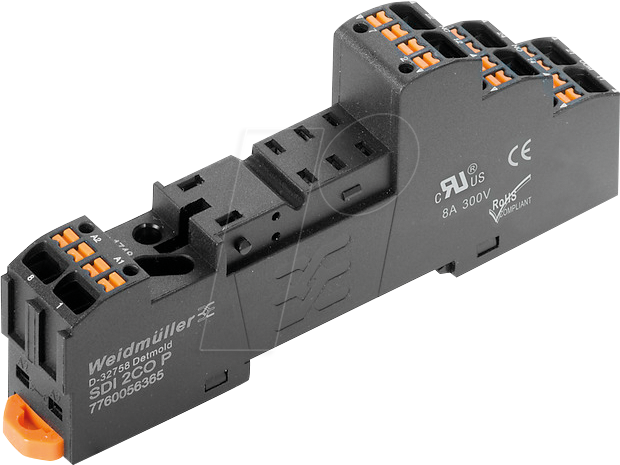
Weidmüller SRD ECO 3CO Relay Socket Explained
The Weidmüller SRD ECO 3CO relay socket is a core interface component in relay-based control architectures where structured wiring, dependable contact support, and straightforward maintenance are required. Also searched as Weidmüller 1132820000 relay socket, this product belongs to the D-SERIES DRR range and is intended for use with compatible plug-in relays. In industrial control systems, the socket is more than a mounting accessory. It defines installation logic, wiring convenience, and long-term service accessibility.
What the Weidmüller SRD ECO 3CO is
The Weidmüller SRD ECO 3CO is a relay socket with 3 CO contacts, a 12 A continuous current rating, and a screw connection design. It is part of the D-SERIES DRR platform and is intended to accept suitable industrial plug-in relays in panel-building and control applications. Engineers often refer to it as a Weidmüller SRD ECO 3CO relay socket or Weidmüller 1132820000 D-SERIES socket when comparing relay interface hardware.
Its value lies in creating a reliable physical and electrical foundation for relay integration. A good socket makes installation cleaner, replacement faster, and cabinet organization more consistent. That becomes especially important in production systems where relay maintenance must be fast and unambiguous.
Important technical features
The Weidmüller SRD ECO 3CO relay socket is specified with three changeover contacts and a 12 A continuous current capability. The screw connection design supports secure conductor termination and remains a familiar choice in many industrial environments where technicians value robust mechanical retention and straightforward wiring procedures.
The product dimensions are also relevant for cabinet planning. The socket is listed at approximately 27 mm depth, 76.7 mm height, and 38 mm width. These figures matter when arranging relay rows, cable routing paths, and maintenance access zones inside a control panel. The ambient temperature range extends from -40°C to +65°C, supporting use in demanding technical conditions.
Why a relay socket deserves careful selection
In many projects, relay selection gets the attention while the socket is treated as a secondary item. In practice, the socket often determines the quality of the installation experience. The Weidmüller SRD ECO 3CO relay socket provides the structured interface between the relay and the panel wiring, and that interface influences mechanical stability, electrical clarity, and replacement speed.
Search behavior reflects this reality. Professionals frequently look for exact combinations such as Weidmüller SRD ECO 3CO relay socket, Weidmüller 1132820000 socket, or Weidmüller 3 CO relay socket because compatibility and performance cannot be left to assumption.
Typical applications in control engineering
The Weidmüller 1132820000 relay socket is relevant in machine building, industrial automation, process control, utility infrastructure, and panel manufacturing. It suits applications where plug-in relays are preferred for their modularity and service convenience. Common use cases include output isolation, signal routing, alarm handling, status indication, and control interlocks.
Because it uses screw connections, it also aligns well with many traditional and mixed-technology control panels where screw termination remains part of the design standard. For service teams, a clearly arranged socket-and-relay structure simplifies diagnostics and component replacement.
Environmental and operational perspective
The listed temperature range and industrial construction make the Weidmüller SRD ECO 3CO suitable for harsh or variable operating conditions. Reliable socket performance helps protect the overall consistency of the control system, particularly where multiple relays are installed side by side and maintenance time must be minimized.
Dimensionally, the product supports predictable cabinet planning. Electrically, the 12 A continuous current rating gives it a strong position in relay interface applications that require more than low-level signal handling. That balance is one reason engineers continue to search for exact model references rather than generic relay socket descriptions.
How to evaluate fit before installation
Before choosing the Weidmüller SRD ECO 3CO relay socket, it is advisable to confirm relay compatibility, contact configuration, expected current, conductor sizes, and panel space. It is also good practice to consider maintenance workflows. A socket that is easy to wire but difficult to service may create avoidable operational friction later on.
For more information about compatible ranges and related industrial interface products, visit Weidmüller solutions.
FAQ about the Weidmüller SRD ECO 3CO relay socket
What is the Weidmüller SRD ECO 3CO?
The Weidmüller SRD ECO 3CO is a relay socket in the D-SERIES DRR range. It is designed to accept compatible industrial plug-in relays in control and automation panels.
How many contacts does the Weidmüller 1132820000 socket support?
This socket is designed for 3 CO contacts, meaning three changeover contact paths within the matching relay configuration.
What is the current rating of the Weidmüller SRD ECO 3CO relay socket?
The product is specified with a 12 A continuous current rating, making it suitable for a wide range of industrial relay applications.
Why do many engineers still prefer screw connection relay sockets?
Screw connections are valued for secure conductor retention, familiar installation procedures, and suitability in many industrial wiring standards. They also remain practical for maintenance teams working across legacy and modern systems.
Is the Weidmüller SRD ECO 3CO suitable for harsh environments?
It is specified for an ambient temperature range from -40°C to +65°C, which supports use in demanding industrial conditions when installed correctly within the overall system design.
What should be checked before using this relay socket?
Users should verify relay compatibility, contact arrangement, current requirements, wiring method, and available cabinet space. Reviewing service accessibility is also recommended for efficient long-term maintenance.