
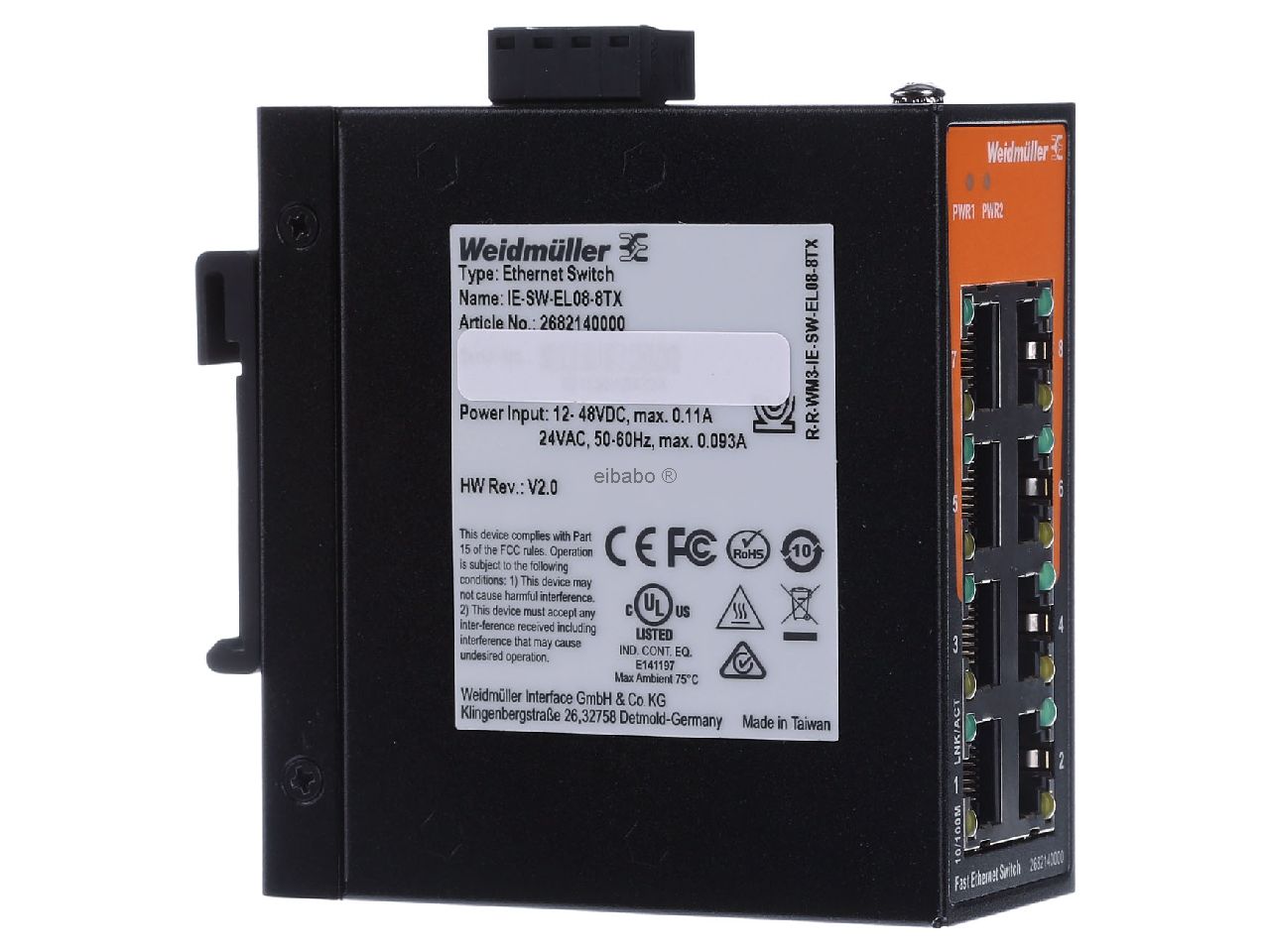
Weidmüller IE-SW-EL08-8TX Unmanaged Fast Ethernet Switch Technical Guide
The Weidmüller IE-SW-EL08-8TX unmanaged Fast Ethernet switch is designed for stable communication in industrial Ethernet networks where reliability, simplicity, and compact installation are more important than advanced configuration features. In many machine and plant environments, unmanaged switches remain the practical choice because they reduce complexity while delivering dependable network connectivity at the field and control levels.
What the switch is designed to do
The Weidmüller IE-SW-EL08-8TX industrial Ethernet switch is built for communication between participants in Ethernet networks. It belongs to the unmanaged switch segment, which means it focuses on straightforward deployment rather than managed functions such as VLANs or advanced traffic control. That makes it especially useful in machine automation, line extensions, and decentralized cabinet installations.
With 8 RJ45 ports, the switch supports 10/100Base-T(X) communication and includes auto-negotiation and auto MDI/MDI-X. These are important convenience features because they reduce installation errors and allow faster network setup in the field.
Technical highlights that matter in practice
The switch uses store-and-forward switching technology and supports IEEE 802.3x flow control. Its backplane bandwidth is specified at 1.6 Gbit/s, with a 1K MAC table and a 448 kbit packet buffer. Those values make it suitable for typical Fast Ethernet traffic in industrial control systems where stable data exchange between PLCs, HMIs, I/O devices, and industrial PCs is required.
Power flexibility is one of the more practical benefits. The model supports 12/24/48 V DC as well as 24 V AC, and it provides two redundant power inputs. The DC operating range is listed at 10.8 V to 52.8 V, while AC supply range is 18 V to 36 V. Reverse polarity protection and overload current protection are also included.
Mechanical and environmental suitability
The Weidmüller IE-SW-EL08-8TX unmanaged switch is housed in a metal enclosure with IP30 protection and is intended for DIN rail mounting. Its published operating temperature range of approximately -40 °C to +75 °C is a strong indicator that it is meant for real industrial conditions, not only office-grade network installations.
The device also has a listed MTBF of more than 1.39 million hours according to Telcordia SR-332, which supports its positioning as a robust industrial networking component.
Where this switch fits best
This model is a good fit for machine builders, panel builders, utilities, infrastructure projects, and factory automation teams that need a compact industrial unmanaged Ethernet switch without configuration overhead. It is especially suitable for cells and line segments where network architecture is fixed and predictability matters more than advanced switching policies.
For many industrial users, that simplicity is an advantage, not a limitation. Fewer settings mean faster commissioning and fewer chances for misconfiguration. For more information about Weidmüller, related industrial Ethernet products can be explored as part of a complete network design strategy.
FAQ
What is the Weidmüller IE-SW-EL08-8TX used for?
It is used to connect devices in industrial Ethernet networks, such as PLCs, HMIs, industrial PCs, remote I/O units, and other Ethernet-capable automation components.
How many ports does the Weidmüller IE-SW-EL08-8TX have?
This switch provides 8 RJ45 ports for 10/100Base-T(X) Fast Ethernet communication.
Is the Weidmüller IE-SW-EL08-8TX a managed switch?
No. It is an unmanaged industrial switch, intended for straightforward deployment without advanced configuration.
Can the switch be mounted in a control cabinet?
Yes. It is designed for DIN rail mounting and is suitable for industrial cabinets and machine enclosures.
Does the switch support redundant power input?
Yes. The technical data lists two redundant power inputs, which helps improve availability in industrial installations.
Why is the temperature range important?
The wide industrial temperature range helps ensure stable operation in harsh environments where office-grade networking hardware may not perform reliably.