
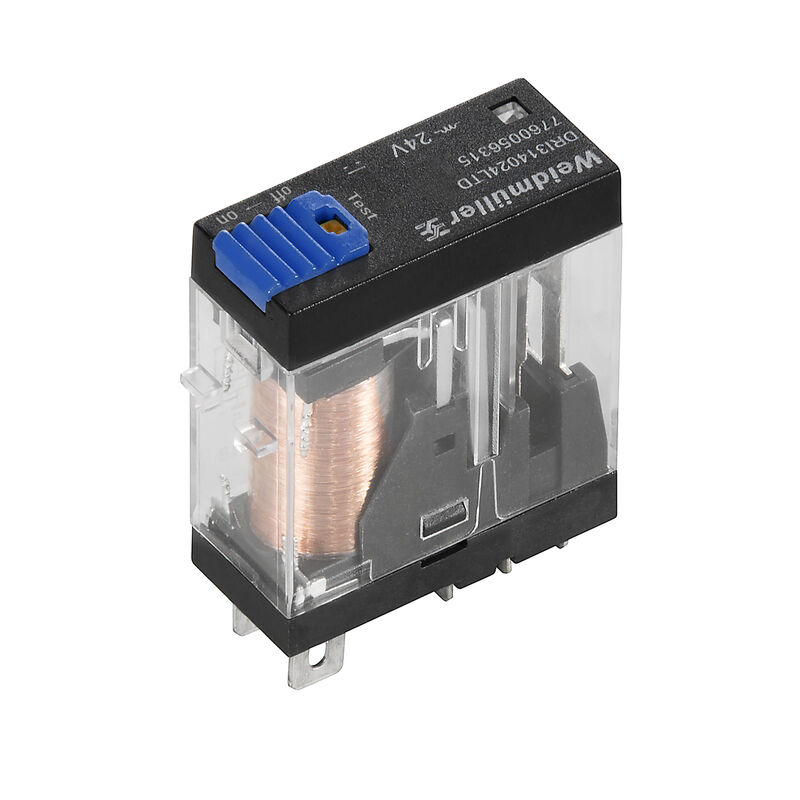
Weidmüller DRI314024LTD Relay Guide
The Weidmüller DRI314024LTD miniature industrial relay is a compact D-SERIES relay intended for digital signal switching in industrial environments where low electrical load performance, service visibility, and component protection all matter. Also known as Weidmüller 7760056315 relay, this model is a practical choice for control systems that use 24 V DC logic and need a 1 CO relay with integrated service-oriented features.
What the Weidmüller DRI314024LTD is
The Weidmüller DRI314024LTD is a miniature industrial relay with 1 CO contact and flat blade connections (4.7 mm x 0.5 mm). It is described as a relay for switching, amplifying, and multiplying digital signals with low electrical load in a small design. This version is specifically known for including an LED, a free-wheel diode, and a test button, which makes it especially suitable in DC control applications where protection and diagnostics both matter.
The integrated free-wheel diode is a notable technical advantage in DC systems because it helps address voltage peaks associated with coil switching behavior. That makes the relay particularly attractive for control designs where long-term stability and protective detail are taken seriously.
Why the 24 V DC version is important
The Weidmüller DRI314024LTD 24 V DC relay is highly relevant in PLC-controlled machines, modern control panels, and automation cabinets where DC logic is the standard. Many industrial systems rely on 24 V DC architecture because it is widely supported and easy to integrate into contemporary control strategies.
Exact searches such as Weidmüller DRI314024LTD relay, Weidmüller 7760056315 industrial relay, and Weidmüller 24 V DC relay with diode reflect the fact that users are often looking not just for a relay, but for a very specific protective and diagnostic feature set.
Why LED, free-wheel diode, and test button matter together
Each of these features adds practical value. The LED gives immediate status visibility. The test button supports manual functional verification. The free-wheel diode helps manage DC coil switching effects and is particularly useful in protecting surrounding control electronics from switching-related stress. Together, these features make the Weidmüller DRI314024LTD miniature relay a strong choice in well-engineered DC control systems.
From a lifecycle perspective, these details also support easier troubleshooting and more predictable long-term operation.
Typical applications
The Weidmüller 7760056315 relay is commonly used in machine control cabinets, PLC interface assemblies, industrial automation systems, and compact switching applications based on 24 V DC control voltage. It fits command transfer, signal conditioning, output interposing, and interface tasks where one changeover contact is sufficient and service visibility is valuable.
It is often paired with compatible DRI socket solutions, which helps create a modular, serviceable relay strategy inside the control cabinet.
Selection guidance
Before selecting the Weidmüller DRI314024LTD industrial relay, engineers should verify coil voltage, contact arrangement, current requirement, and compatible socket choice. It is also wise to confirm whether the application benefits from diode protection and manual test capability. In many DC systems, these features are not extras. They are part of a more robust control design.
For more information about related relay components, visit Weidmüller solutions.
FAQ about the Weidmüller DRI314024LTD relay
What is the Weidmüller DRI314024LTD?
The Weidmüller DRI314024LTD is a miniature industrial relay for compact digital signal switching applications.
What makes this relay different from simpler versions?
This version includes an LED, a free-wheel diode, and a test button, which add diagnostic and protective value in DC systems.
What control voltage does the Weidmüller 7760056315 relay use?
It is a 24 V DC relay variant.
How many contacts does it have?
The relay uses 1 CO contact, meaning one changeover switching path.
Why is the free-wheel diode important?
It helps manage switching-related voltage peaks in DC coil operation, which can support better long-term protection for surrounding electronics.
Where is this relay commonly used?
It is commonly used in PLC-based automation, machine control panels, industrial interface circuits, and DC control systems that need a compact relay with better service and protection features.